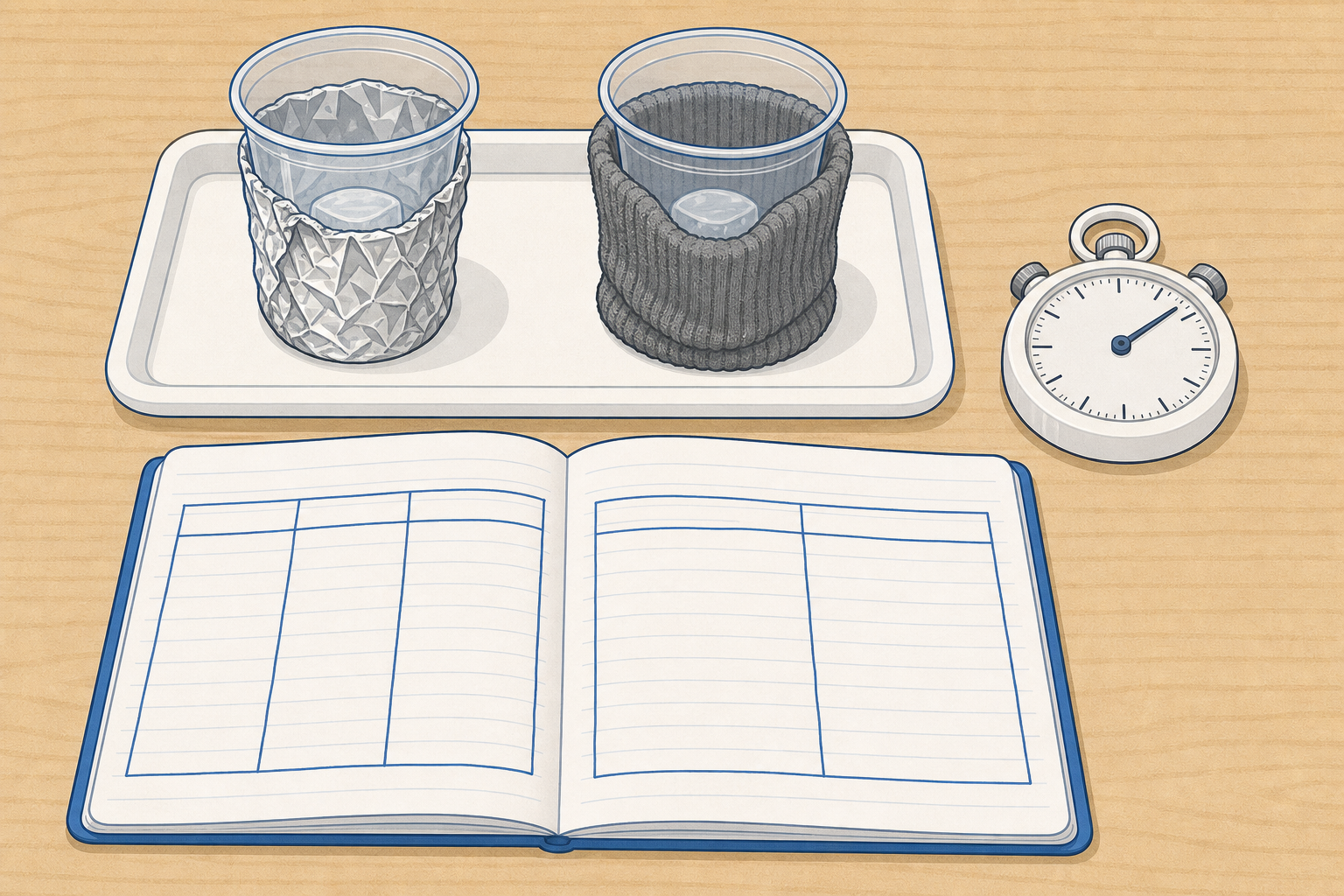
 Earlier in this project your group planned a heating or cooling fair test and ran the first trial. One reading can fool us. Why do scientists run a test more than once before they trust the answer?
And here is a harder question: could another group get your result, with nothing but your plan to go on?
One reading can be a fluke: a one-off lucky or unlucky result that never shows up again. That is why we repeat.
Repeat means we run the same fair test again with everything kept the same. Evidence is what the readings show, not what we hoped would happen.
Real scientists go one step further. They write their method down so clearly that somebody else can run it and check the result. Today, another group will run your test from your plan, and you will run theirs. Can they get what you got?
If two trials disagree, what should a careful scientist do next?
In the lesson Plan and run our heating and cooling inquiry, your group chose one of two tests, wrote a plan and ran it once:
- The ice test: which wrapping (wool, foil, paper or bubble wrap) keeps an ice cube frozen longest?
- The warm water test: which cup (plastic, metal or paper) keeps water warm longest?
You watched for about eight minutes and wrote your readings in the Trial 1 column of your plan page. Find that page now and read your question at the top. Today we run the same test twice more.

Today another group runs your test, and you run theirs. Can they get what you got?
- Swap your plan page from last time with your partner group, and move to their table.
- Read their plan. Set up their test exactly as it says, and do not ask them anything. If the plan does not tell you something, make your best guess and put a ? beside that part.
- Start when your teacher says. When the timer ends, write each reading in the Trial 2 column on their page.
- Go back to your own table with your own page. Read what they got, and look for any ? they left you.
- Run your own test again with fresh ice or fresh water. When the timer ends, write your readings in the Trial 3 column on today's page.
Use the same words for your readings as last time: still solid, edges soft, half melted or mostly water for ice; warm, cooler or cold for water.

Now fill in today's Results and Conclusion page:
- Copy your Trial 1 and Trial 2 readings from your plan page.
- For each material, put the three readings in order and write the middle one.
- Which material did best? That is your winner.
- Did your prediction hold? What do the readings show?
- Did the other group get the same winner? If not, what could have made the difference?
- Write one way to make your plan clearer. Any ? they left you is a good place to start.
Evaluate means deciding from the evidence whether the prediction held, and saying what you would improve. That is what the last three lines are for.
Unlock the full learning experience
You're previewing this lesson. Get full access to this lesson and hundreds more — each one ready to teach, with interactive activities, printable resources and pupil progress tracking built in.
This lesson is copyright of 123Learn.ie 2017 - 2026. Unauthorised use, copying or distribution is not allowed.