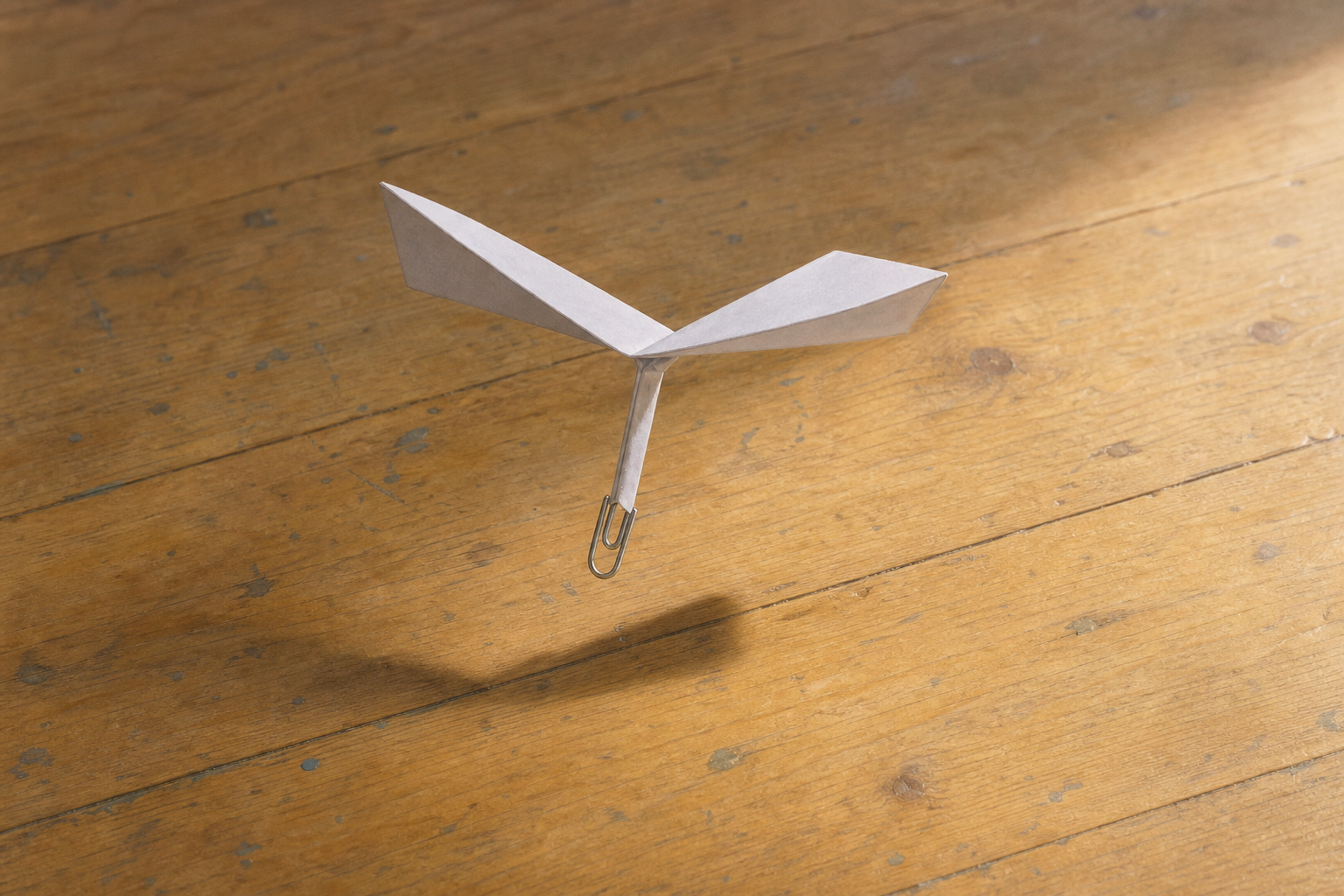
 Watch as I drop this paper spinner, then a crumpled ball of the same paper. Notice how slowly the spinner falls compared with the ball.
Hands up: do you think bigger wings would make a spinner fall slower, faster, or the same?
Today's words: air resistance (air pushing against a moving object and slowing it), gravity (the pull that brings things down), fair test (change one thing, measure one thing, keep the rest the same).
The question you are about to test is this one: Does wing length change how long a paper spinner takes to fall?
You will see five cards — wing length, fall time, drop height, the paper and the paperclip — and for each one you call out the bin it belongs in: Change, Measure, or Keep the same. The class agrees all five together before anyone writes anything down.
Next you get your Investigation Journal page, and your group compares short vs long wings unless you are told otherwise. On the page write:
- The question, and a prediction with a reason.
- What you change, what you measure, what you keep the same.
- Your two wing sizes.
- One trust check your group chooses. A trust check is the one thing you promise to do so your times can be trusted — you might re-measure the height mark before every drop, or agree to throw out any trial where the spinner hits a chair or the timer stops late.
Does wing length change fall time?
First, make two paper spinners that match your plan, which for most groups means one short-winged and one long-winged spinner. The wing length is the only thing that changes between them, so use the same paper, the same paperclip and the same folds for both. Build each one like this:
- Cut out the rectangle on the outline your teacher has given you.
- Cut down the centre line between the two wings and stop at the join with the stem, so the stem stays in one piece.
- Trim the wings to your chosen length: short leaves 4 cm of wing, medium leaves 6 cm, and long is the full 8 cm wing. Your group uses two of these only.
- Fold one wing forward and the other wing back, so they stick out in opposite directions.
- Fold the stem sides in along the marked lines until the stem is a narrow strip, then fix one paperclip at the bottom of the stem, in the same place on both spinners.
Agree four roles in your group:
- Dropper — releases the spinner cleanly from the height mark.
- Floor-spotter — watches the floor and calls "stop" on first touch.
- Timer — starts on release, stops on the spotter’s call.
- Recorder — writes each called-out time straight onto the journal trials grid.
In a group of three, the timer also records. Anyone beyond four watches this trial and takes a role on the next pair of drops.
Every drop starts at your station's height mark, because a spinner released higher has longer to fall and the time would no longer be telling you about the wings. Do each wing size at least twice, so you can see whether a time repeats or whether something went wrong on one drop. As each time is called out, the recorder writes it straight onto the journal trials grid, since a time you try to remember until later is no longer a measurement. Several groups are dropping at once, so if your station is busy, watch another group work and be ready to say what you noticed about their release, their timing or their wings.
Check your group's trial times are already on the Investigation Journal page. Do not drop again unless a time is missing and a station is free.
Work out a simple average for each wing size: add trial 1 and trial 2, then halve. Example on the board: 2.2 s + 2.6 s = 4.8 s; half of 4.8 is 2.4 s. If you only have one clean time for a wing size, write that time and note "one trial".
Bring your group's two averages to the board, so the class can see what every group's spinners actually did.
Work through the questions on the board using your own times as the evidence, not what you expected before you started. Then say which force pulled the spinner down, which force slowed it, and what would have made your test unfair.
Unlock the full learning experience
You're previewing this lesson. Get full access to this lesson and hundreds more — each one ready to teach, with interactive activities, printable resources and pupil progress tracking built in.
This lesson is copyright of 123Learn.ie 2017 - 2025. Unauthorised use, copying or distribution is not allowed.