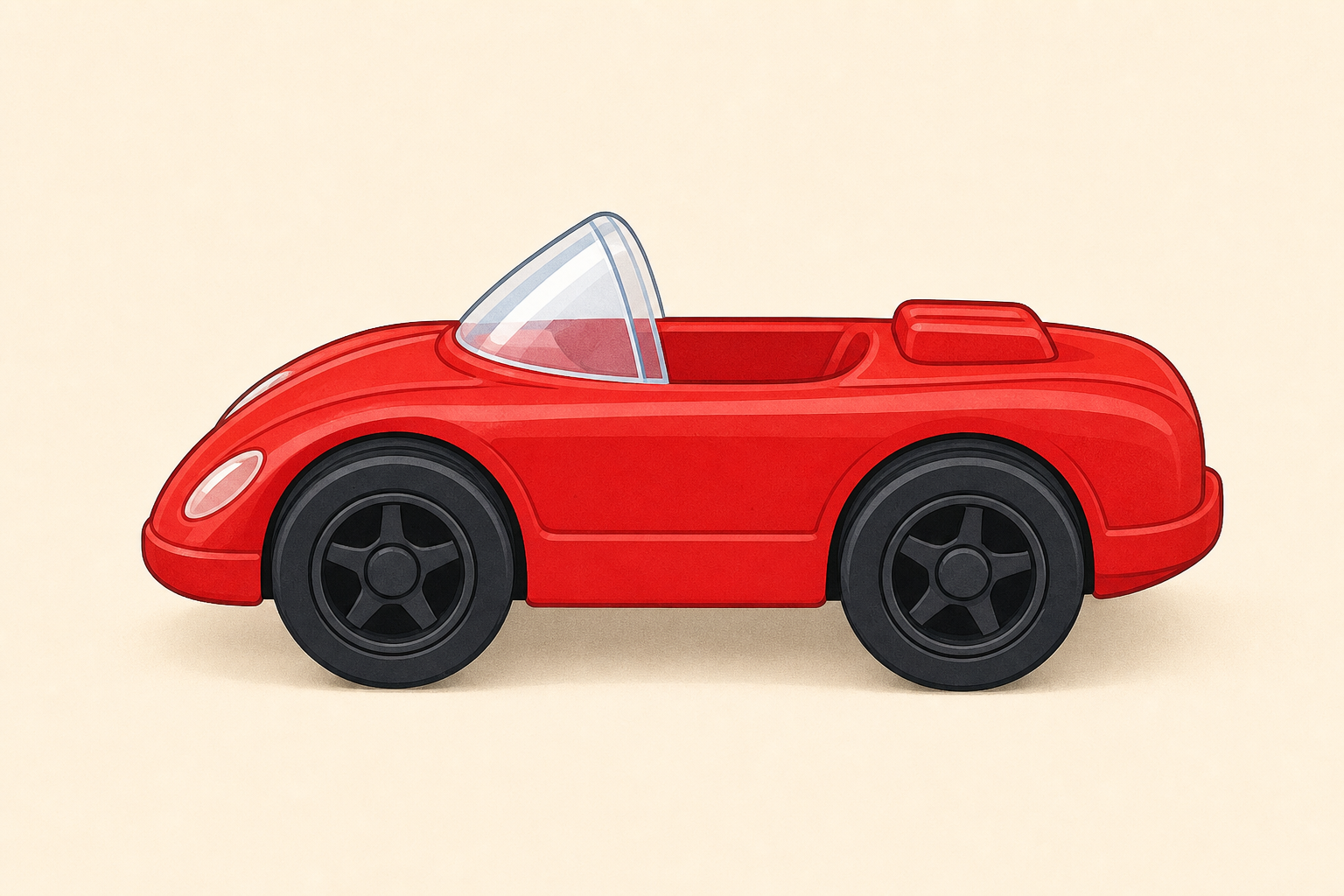
 Watch this pull-back car. When I let it go, what do you think will change about how it moves, and what might make those changes happen?
Hands up your guess: will it stay at the same speed in a straight line the whole way, or will something make it slow, stop or turn?
Scientists and engineers care about every one of those changes (start, slow, stop, turn) because that is how bikes, trains and cars are made safe to use.
Three words for the car we just watched. Call out as we go:
Force: a push or a pull. What push started the car?
Motion: how something is moving: starting, going, slowing, stopping or turning.
Change of motion: a start, stop, speed-up, slow-down or turn caused by a force. What force slowed our car?

A spring pushed the car. Can air push something too? Your group is going to find out, with a balloon rocket on a string. Follow the four pictures.
Try it with a small puff, then with a big puff. Watch it at the start, in the middle and at the end.
- What started the rocket?
- Which way did the air go, and which way did the rocket go?
- What slowed it down?
Now take away the string. Can a balloon push a car along the floor? Look at the car your teacher made. Your group is going to build one.
Engineers try ideas before they build the real thing, so plan first. Choose one thing your car will show the class:
- Go further: try a small puff, then a big puff.
- Stop sooner: try a smooth floor, then a mat or a folded coat.
- Turn: stand a book at an angle in its path, or nudge it with a ruler as it passes.
Agree a prediction with your group: what will happen to the car, and why? You will write that prediction on your Investigation Journal page after you have run the car.
Unlock the full learning experience
You're previewing this lesson. Get full access to this lesson and hundreds more — each one ready to teach, with interactive activities, printable resources and pupil progress tracking built in.
This lesson is copyright of 123Learn.ie 2017 - 2026. Unauthorised use, copying or distribution is not allowed.