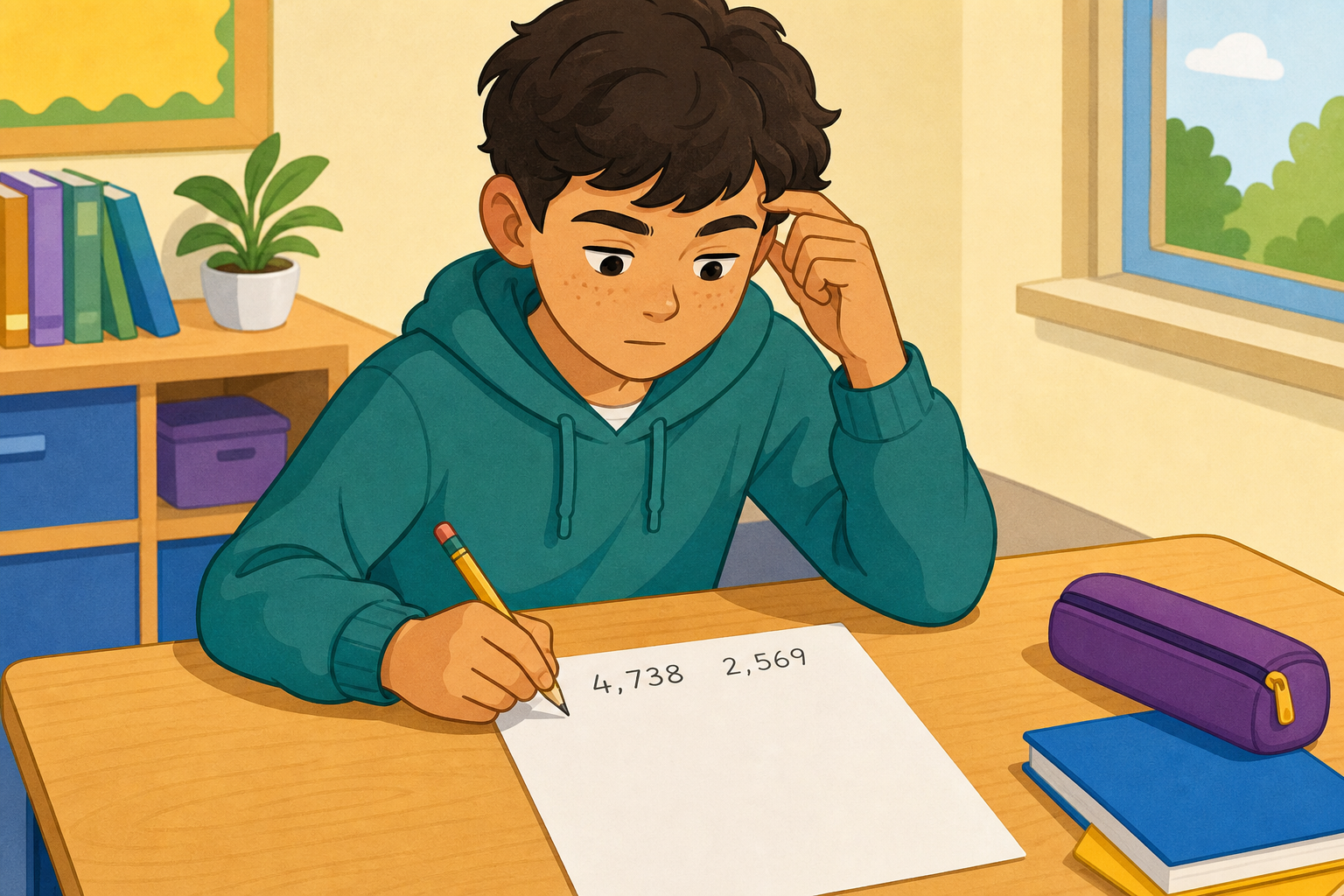
Here are two big numbers I want to add together: 4,738 + 2,569. We could try it in our heads, but these numbers are awkward. Where would you start if you had to add them on paper? Hands up: would you start with the big thousands or the little units?
Take three hands-up answers, not open call-outs. Don't resolve the start question yet — let the disagreement sit. The 'start from the units' rule is the pay-off of the next step, so resist confirming it here.

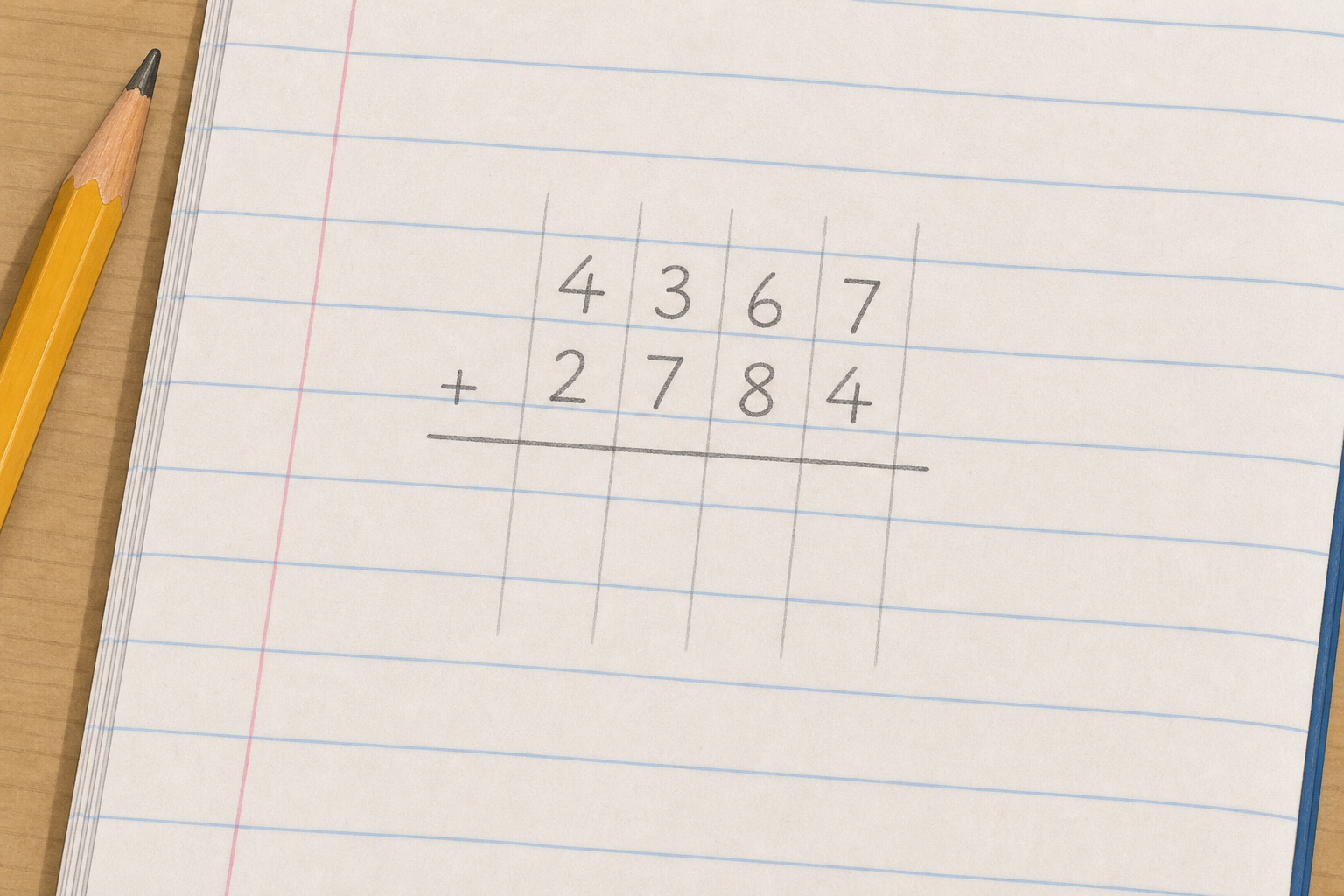
Watch as we set these out one under the other and add from the units end. Look hard at the units column: 8 and 9 make 17, which is too big to fit in one column — a column can only hold a single digit. So we keep the 7 here and the spare ten moves one column to the left, because ten units are worth one ten. That is why a carry always travels left, never right: each ten is worth one in the next column up.
This time the carry keeps going. A carry lands in a column that is already full, so it tips over too and pushes another carry left. Watch how a brand-new digit appears at the very end. How many times do you count a carry happening?
Now nearly every column is empty on top. Lots of people guess this one lands on ten thousand. Add it up carefully — do we reach ten thousand, or stop just short? Predict your answer before we check it.
Walk each example aloud, one at a time, working right to left.
Between the first and second examples, do a quick turn-and-name: ask one pupil to say where the carry went and why, then revoice it for the room before moving on. This keeps the back rows with you across all three demos.
The single idea to drive home: a carry always moves one column LEFT, because ten in a column is worth one in the column above it.
Today we work through this one together on the board: 6,847 + 3,956. We will set it out, then add one column at a time from the right. Before each carry lands, call out where it has to go.
This round is for talking it through together — pupils take turns at the board and the class agrees or corrects out loud.
Step the algorithm column by column. As you reach each column, ask the class to predict the digit and the carry before it lands. Have individual pupils come up to set each column. Watch for the common slip of writing the full two-digit sum in a column instead of carrying — say the carry out loud every time: '13 — write the 3, carry the 1'. The answer is 10,803, so this one grows a fifth digit; flag that as it happens.
In your maths copy, set up the lesson's first sum, 4,738 + 2,569, one number under the other with the units lined up. Work each column with the class, and mark every regroup with a small carry-1 above the next column to the left.
Walk the room glancing at column alignment and the small carry-1 marks — this is whole-class copybook practice, not marking. The most common slip is poor lining-up, so catch a crooked layout early.
Today we work through these sums together, each one a little bigger than the last. We will set each one out, add from the units, and check the answer as a class before we move on:
This round is the practice bank — pupils take turns at the board, check each answer, and the class confirms before moving on. Keep the board work brisk rather than over-explaining.
The first sum is a quick win so every pupil enters. The next three need real working time: 9,876 + 1,234 is the cascade into a new digit, and 5,000 + 4,999 is the near-miss — let pupils predict whether it reaches ten thousand before checking. Use the on-screen Check (✓) as part of the narration: 'yes — that's it'. Fast finishers watch the board and mouth the next carry rather than working ahead.
Why does a carry in addition always move LEFT, never right? And here is a quick check: if you add two numbers and your answer is smaller than one of them, what must have gone wrong?
Listen for pupils explaining the carry in their own words — that each column can only hold one digit, so the spare ten belongs in the next column up. Revoice a strong answer: so the ten can't stay where it is — it's worth a whole new column to the left. The second question heads off the common slip of dropping a carry: a sum smaller than an addend is impossible, so a missed regroup must be the cause.
Next we take the same line-up-the-columns idea and use it on decimals, where the decimal point becomes the anchor we line everything up against.
Keep this brief. The cascade idea (one carry triggering another) is the piece worth restating, as it is the part pupils most often forget on paper.
You're previewing this lesson. Get full access to this lesson and hundreds more — each one ready to teach, with interactive activities, printable resources and pupil progress tracking built in.