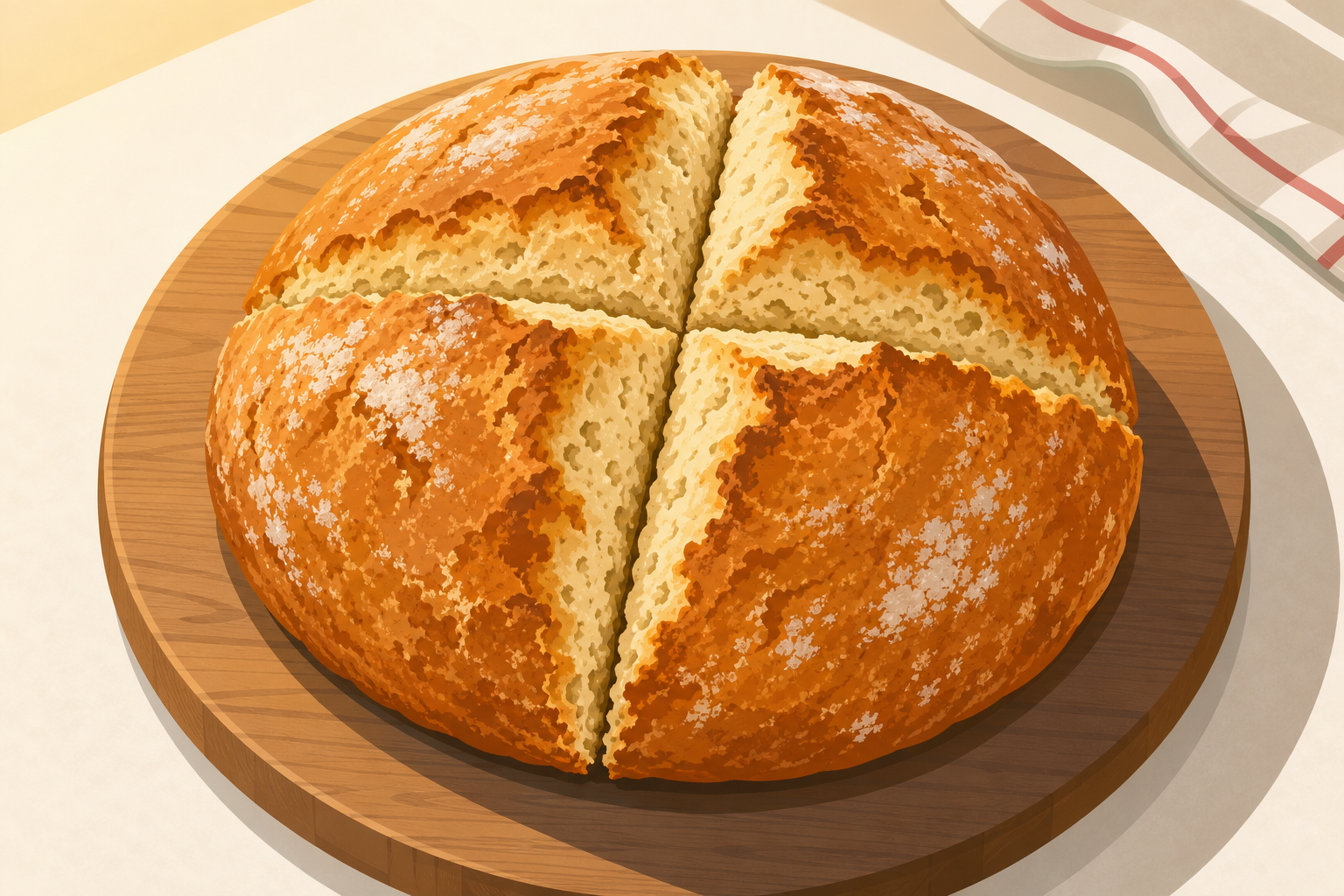
Imagine a round soda bread fresh from the oven, and four of you are going to share it fairly. What do we call one of those pieces? And here is the tricky part: why must all four pieces be exactly the same size?
Display or sketch a round soda bread and take three hands-up answers, not open call-outs. Listen for the word quarter and for any pupil who says the pieces must be "fair" or "the same" — revoice that as equal parts, the key idea of the whole lesson.
Watch as one whole pizza is cut into 2 equal parts. Each piece is one half, written ½. The bottom number, 2, tells us how many equal parts the whole is cut into. We call that bottom number the denominator.
Now the same whole is cut into 4 equal parts. Each piece is one quarter, written ¼. The denominator here is 4. Notice how each piece got smaller when we cut more.
This time the whole is cut into 3 equal parts. Each piece is one third, written ⅓. The denominator is 3.
Last, the whole is cut into 5 equal parts. Each piece is one fifth, written ⅕ — the smallest pieces of all four. The denominator is 5.
Walk each example aloud, one snapshot at a time. Each time say the same sentence frame: "one whole, cut into [N] equal parts — each part is one [name]." The first time you reach the bottom number, say the word denominator and point to it on screen so pupils see the word and its meaning together.
Break the beat between snapshots: after each reveal, ask the class a quick question — "how many equal parts this time, and what is one piece called?" — and take a couple of hands-up answers before moving on, so the watch beat does not run unbroken. Keep returning to the words equal parts and denominator on every slide.
So far we shaded just one piece each time. But the top number of a fraction tells us how many pieces to shade. Watch: here the whole is cut into 3 equal parts, and this time we shade two of them. That is two thirds, written ⅔. The bottom number, 3, is how many equal parts; the top number, 2, is how many we shade.
This short beat builds the numerator on screen before pupils have to use it in the challenge. Say it plainly: "the bottom number is how many equal pieces; the top number is how many we colour in." Ask one quick question — "if I wanted three quarters, how many pieces would I shade out of four?" — and take a named pupil's answer to check the idea has landed.
When I call out a fraction, let's slice the pizza into that many equal parts and shade one piece. We'll make a half, a quarter, a third and a fifth — and say each fraction out loud before we check it.
If you are not at the board, watch closely and agree or correct out loud.
This round is for talking it through together — pupils take turns at the board and the class agrees or corrects out loud. For pupils at their seats, watching the board and agreeing aloud is their participation.
Call a fraction (one half, then one quarter, then one third, then one fifth). A pupil sets the slice count and shades one piece. Before they shade, ask the class: "how many equal parts do we need?" Rotate four pupils so each names and builds one fraction; if time allows, loop a second pupil through to confirm each one. Watch for the slip of shading the right count but with uneven-looking slices — remind them the tool keeps them equal, but the denominator is the number of parts.
In your maths copy, draw three bars all the same length. Shade one half of the first bar, one third of the second bar, and one quarter of the third bar. Write the fraction underneath each one.
Walk the room glancing for bars of roughly equal length and for fair splits — this is whole-class copybook practice, not marking. Prompt any pupil whose "thirds" are uneven to fold or eyeball the bar into three before shading.
Today we work through these fractions together: show one half, then one quarter, then one third, then two thirds. Each time, slice the pizza into equal parts and shade the right number of pieces, then check.
Remember the top number tells you how many pieces to shade.
This round is the practice bank — pupils take turns at the board, check each answer, and the class confirms before moving on. Keep the board work brisk rather than over-explaining.
The last target, two thirds, is the step up: pupils must shade two of the three parts, not one. Ask a named pupil: "how many of the three parts do we shade for two thirds?" For each target ask "are the parts truly equal?" before pressing Check.
Here is a puzzle to talk about: one third is bigger than one quarter, even though four is more than three. How can that be true?
Give this the time it deserves — it is the conceptual heart of the lesson. Take several answers, not one. Listen for pupils who reason from the pizza: cutting the whole into more parts (quarters) makes each part smaller. Revoice a strong answer slowly so the room hears it: "so the bigger the bottom number, the more pieces — and the smaller each piece becomes." Press a second pupil to say it back in their own words. Head off the misconception that a bigger denominator means a bigger fraction.
Next time we take the same fraction idea and use it on a length and on a set of objects — splitting a strip and sharing a group fairly.
Close by repeating the lesson's one big idea: equal parts. A quick thumbs-up check — "who can tell me what the bottom number of a fraction means?" — surfaces any lingering confusion before the next lesson.
You're previewing this lesson. Get full access to this lesson and hundreds more — each one ready to teach, with interactive activities, printable resources and pupil progress tracking built in.