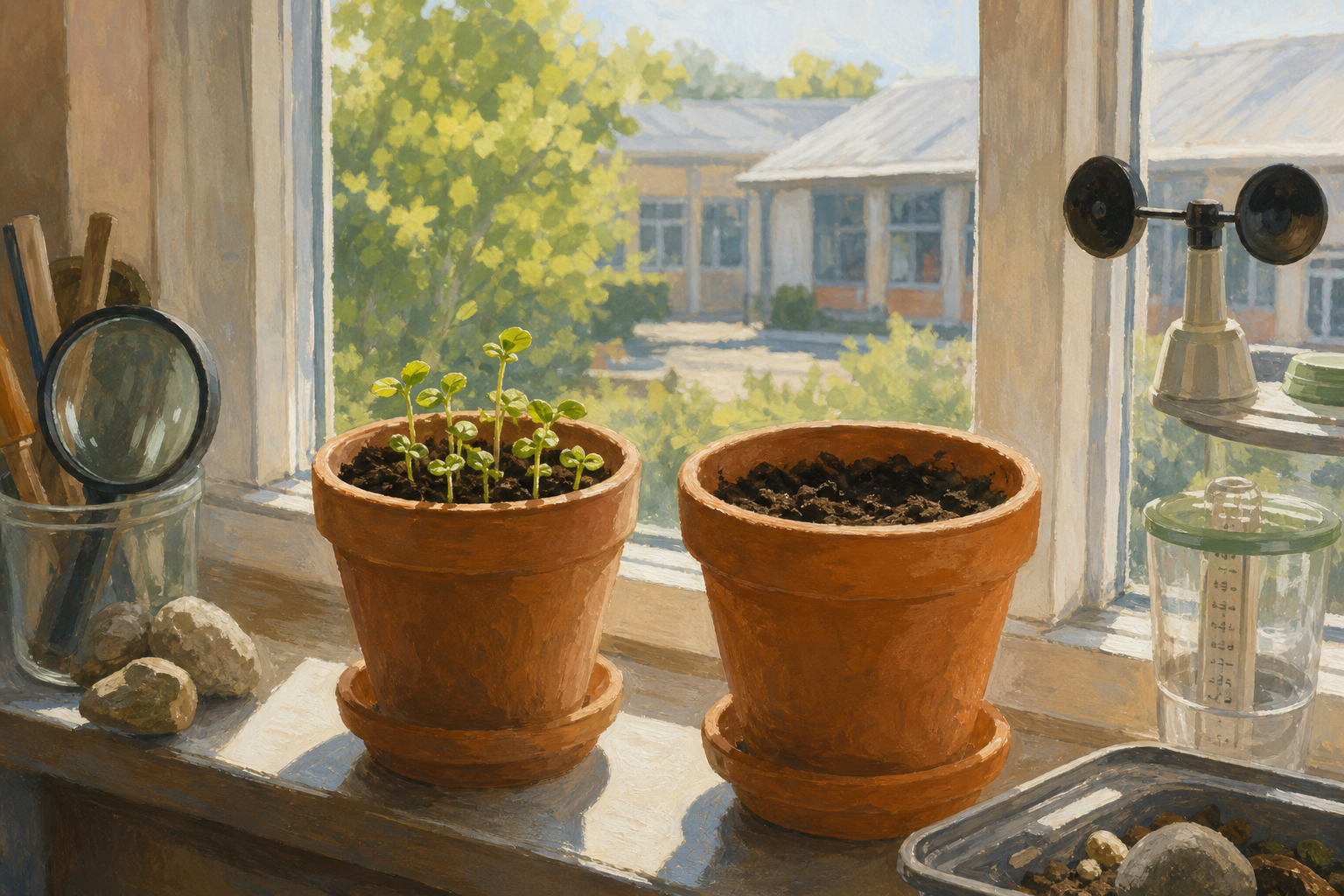
Imagine you put two flowerpots on the windowsill. You give them the same seeds and the same soil, but you only water one of them. A week later, one pot is full of green shoots and the other is bare.
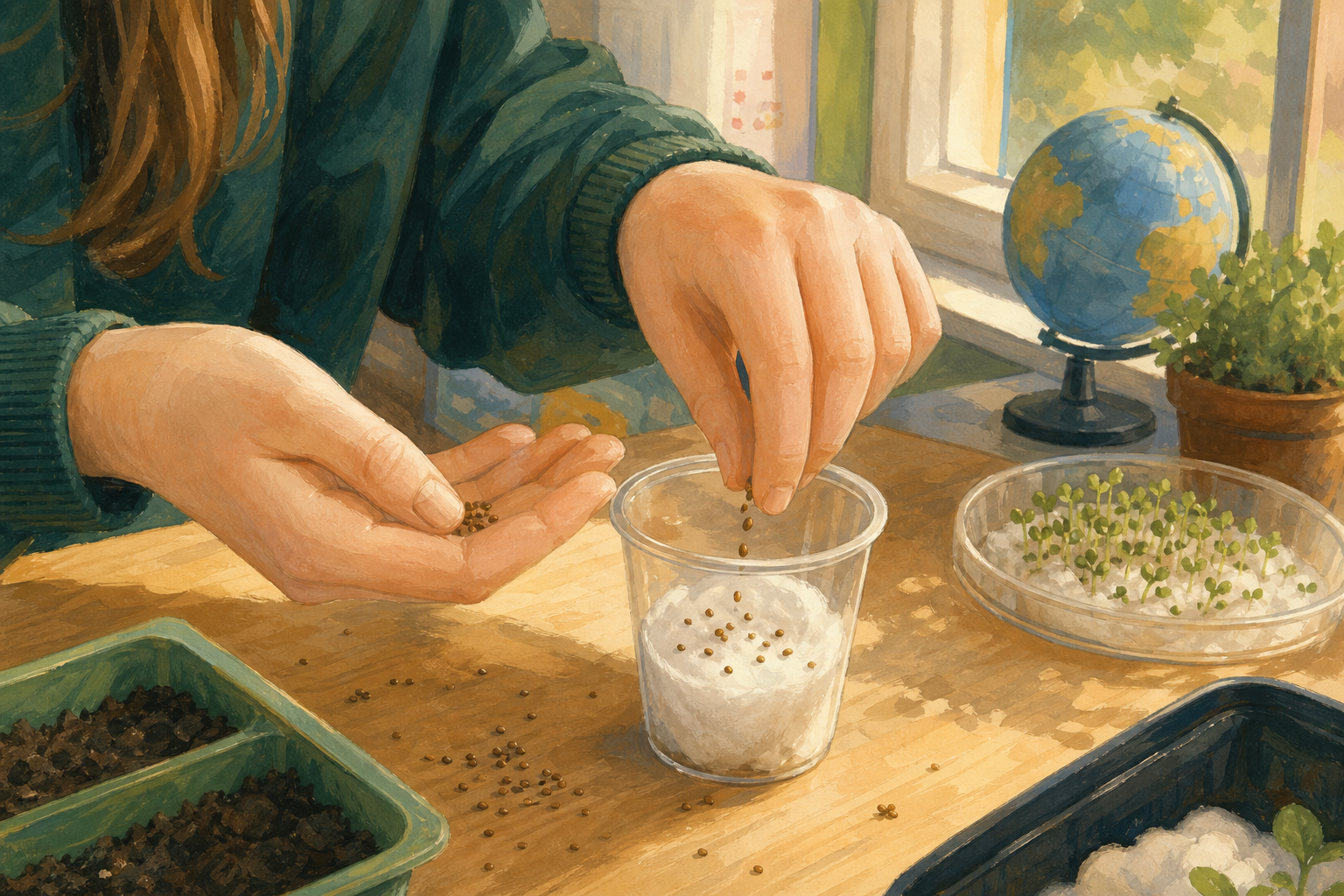
What made the difference? What do plants actually need to grow? Hands up your best guess.
Keep this light: it is just the curiosity beat. Take three or four guesses (water, sunlight, soil, warmth) and write the words on the board without judging them. Do not set up the cups yet, that comes next.
Ask: "What do you think a plant would miss most if we took it away?"
To find out what plants need, we will plant fast-growing cress seeds and test just one thing. Right now, just watch the screen and call out answers with the class. You will plan and write your own test on paper a bit later.
For our test to be fair, we change only one thing and keep everything else the same. Together, let's work through one example on the screen: a test of light. Call out where each card should go: Change, Measure, or Keep the same.
Drive the interactive on the IWB as a single whole-class worked example testing light. This is a watch-and-call-out step only: pupils have no paper planner yet, so make clear nobody is writing during this step. Five cards appear: light, water, kind of seed, amount of cotton wool, and how tall the cress grows each day. Ask the class to call out where each belongs: drag light to Change, how tall the cress grows each day to Measure, and the other three to Keep the same.
Note on the growing medium: we grow our cress on damp cotton wool (not soil) so the roots and shoots are easy to see, which is why the card says 'amount of cotton wool'. The windowsill scenario in the hook used soil just to picture the idea.
Make the transition explicit: once the class has sorted the light example together, say clearly: "That was our shared example testing light. In a few minutes, each group will get its own planner sheet and decide for itself: will you test light or water? You'll write your own plan then." The IWB models one test; each group's own FairTestPlanner page (handed out later) then captures their own chosen variable.
Misconception to head off: some pupils will want to change both light and water at once. Stress that then we could not tell which one caused the difference.
Watch as we set up one example together, thinking out loud at each step, before you do your own.
This shows us the whole way a scientist works: wonder, predict, set up, then watch over the days.
Model the full inquiry cycle out loud with a single demonstration pot, so every group has seen each beat before starting:
Use the teacher demonstration set (kept separate from the group trays, see prep) for this modelled pot so you do not use up a group's portion.
Watch out for this: cress kept in the dark can actually stretch taller and leggy while staying pale and weak, because it uses the seed's stored energy to reach for light it cannot find. So height alone can mislead pupils. When you model the prediction, lead with colour and sturdiness (green and strong vs pale and floppy) as the main sign of healthy growth, not just height. Be ready for a dark cup that is surprisingly tall but pale.
Stress that the result will not appear today, it grows over the coming days.
Now it's your turn. Your group has just been given its own planner sheet, the FairTestPlanner. Have it on the desk in front of you.
First, decide now as a group: are you testing light or water? Make that choice out loud before you touch anything.
Then find the prediction box at the top of your planner and write your prediction: what do you think will happen, and why? Then set up two cups that are the same in every way except the one thing you are testing.
Hand out the FairTestPlanner sheet now, one per group, before anything else in this step. Hold one up and point to the prediction box at the top and the growth table below it, so every group can see what their own page looks like and where each part is. This is the first time pupils touch the planner, so orient it before asking them to write on it.
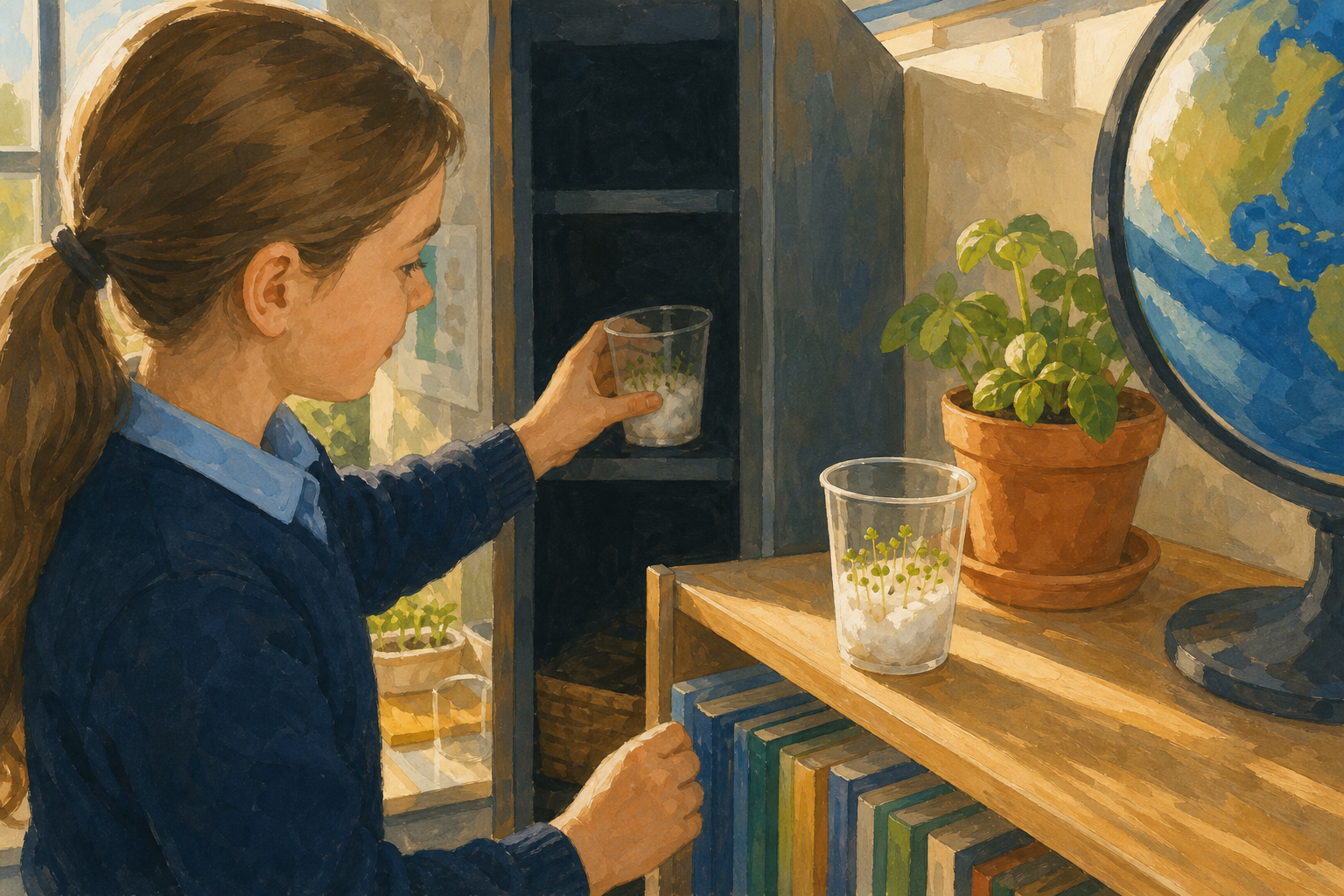
Groups plant seeds on damp cotton wool in two identical cups. A light-testing group puts one cup in the light and one in a dark press, watering both the same. A water-testing group keeps both in the light but waters one and leaves the other dry.
Make the choice explicit: before any group plants, have each group say aloud whether they are testing light or water. Do not let setup begin until you have heard each group's choice; this is the decision moment.
Protecting the time: have the seeds, cotton wool and water pre-portioned into a tray per group before the lesson so groups can start straight away (see prep notes). Tell groups to begin writing their prediction while you finish handing trays out, so the writing and the settling-in happen together rather than one after the other.
Insist every group writes a prediction before setting up. Circulate and check each pair of cups differs in only one way.
Label cups with group name and which cup is which. Set them where they can be checked daily over the coming days.
Because our cress grows over days, we need a record to follow it. On your FairTestPlanner page, look below the prediction box for the growth table: the grid with columns headed Day, Height (mm) and Colour. Fill in the first row as Day 1.
Each day you will write the date, how tall the shoots are in millimetres, and their colour. Today both your cups look the same (bare cotton wool with seeds) so draw them now as your before picture. This matters because at the end of the week you can hold your Day 1 drawing right next to your cups and see exactly how much they changed.
Show the FairTestPlanner growth table on the IWB (or hold a printed page up) and point to it directly when you introduce it, so pupils can find the right part of their own page. Say where it sits: "It's the grid below your prediction box, with columns headed Day, Height and Colour." The page includes a pre-ruled growth table with columns for Day, Height (mm) and Colour and a row for each of the coming days. Pupils simply fill in Day 1 today: the date and a quick drawing of the starting state (bare cotton wool or just-planted seeds). Framing it as a 'before' picture gives the otherwise-blank Day 1 a clear purpose, the baseline they will compare against.
Agree as a class how everyone will measure height fairly: ruler held straight, measure the tallest shoot. Remind them to judge colour and sturdiness too, not only height, since these are the truer signs of healthy growth.
Homework: ask pupils to notice over the week where plants grow well near their home, a sunny windowsill, a shady corner, and be ready to say which seems best.
Let's share our predictions before we wait. Talk with your class:
Display-only science-talk. Revoice pupil predictions and link them to the fair-test idea: "You kept the seeds and cotton wool the same, so if one grows better we can fairly say it was the light." If a group leaps to 'the dark one will be shortest', gently flag that the dark cress might actually be taller but pale, so we judge by colour and strength, not just height. Remind the class the real answer comes over the next days, not today, which is exactly how scientists run observation-over-time investigations.
Today you set up a real plant investigation that you will watch over the coming days, and you will draw your conclusion right here once the cress has grown.
Check your cups every day and fill in your record. At the end of the week, look back over your record and write your conclusion on the FairTestPlanner page: which cup grew better, and what does that tell you about what plants need?
Quick recap. Confirm every group has labelled cups in place and a started growth record. Set a daily routine for checking and measuring over the coming week.
Closing the investigation: the FairTestPlanner page carries a conclusion box. At the end of the growing week (after the daily entries are complete), give the class ten minutes during a science or seasaí session to revisit their records and write their conclusion: which cup grew better and what it tells them about what plants need. Prompt them to judge by colour and sturdiness as well as height, since the dark cress may have stretched taller but stayed pale and weak. This is the payoff of the fair test they set up today, so be sure to make time for it.
You're previewing this lesson. Get full access to this lesson and hundreds more — each one ready to teach, with interactive activities, printable resources and pupil progress tracking built in.