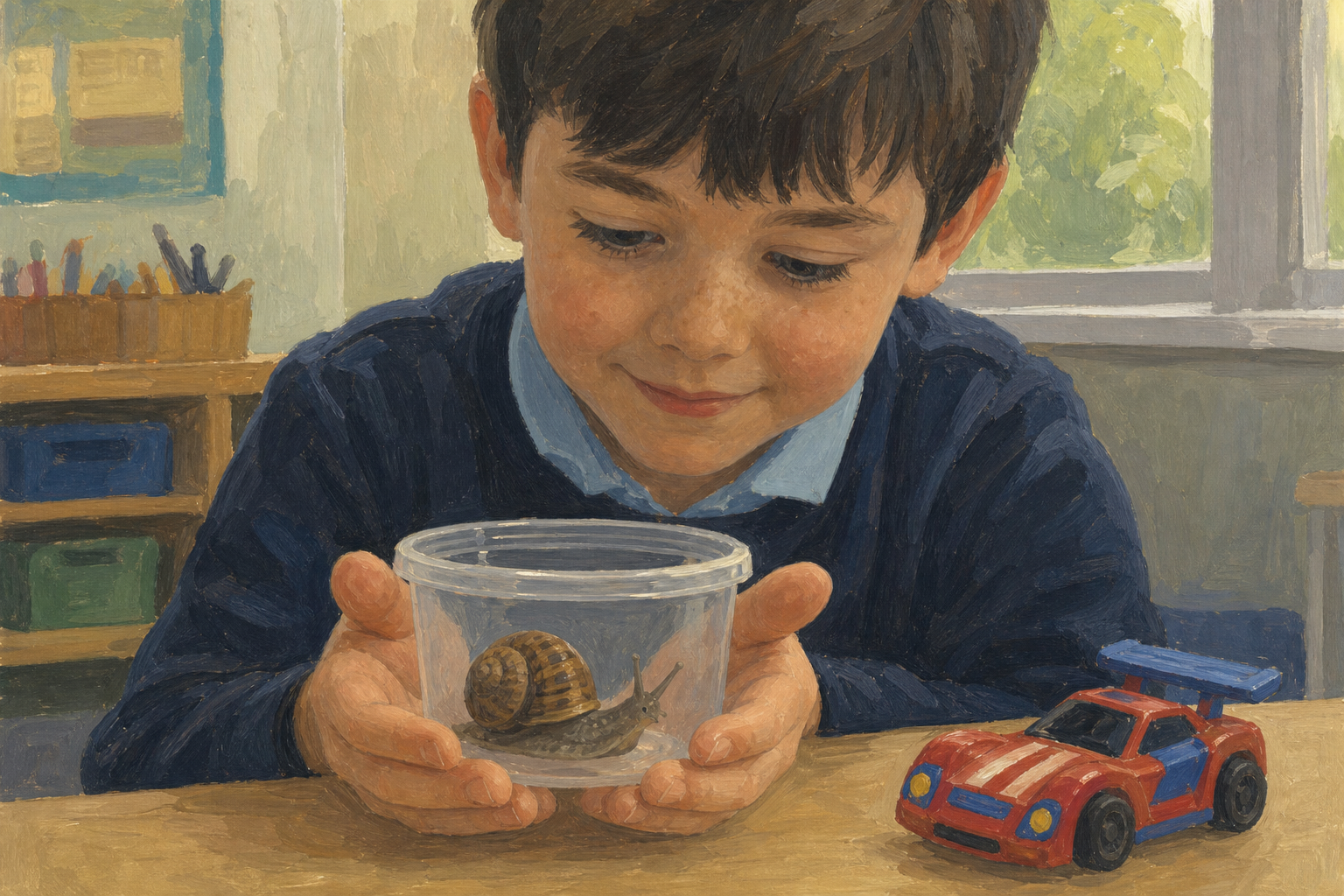
Look! Here is a little snail in a tub, and here is a toy car. One of them is alive and one is not. Which one do you think is alive? Put up your hand if you think it is the snail.
How can we tell? The snail does some special things that the car can never do. Today we are going to be detectives and find out what living things do.
Hold up the snail tub in one hand and the toy car in the other. Keep this light: it is just the curiosity hook, not the full investigation.
Take a few guesses. Ask How do you know the snail is alive? and let two or three children answer. Don't correct or list the rules yet, that comes next.
Living things do three special jobs that objects can never do. Let's learn them together.
| Concept | Why it matters | Example |
|---|---|---|
| Living thing — something that is alive, that grows, needs food and water, and moves or changes | It helps us tell the difference between a creature or plant and an object | A snail moves along the tub, eats a leaf and needs water to stay alive |
| Non-living thing — something that is not alive and never grows, eats, drinks or moves by itself | Objects only move when we make them, so they are not alive | A toy car only rolls when you push it, and it never grows or gets hungry |
| Grows — gets bigger over time, the way young living things do | Growing is one big sign that something is alive | A little bean seed pushes out a shoot and gets taller day by day |
This table is the children's on-screen content for 1st Class. Read each row aloud and point at the snail and the toy car as you go.
Then model the noticing out loud before the children do it themselves: I am looking at the snail. I wonder what it does that the car cannot. I predict it will move. I am watching... yes, it slid along and left a little trail. The car stayed still until I pushed it. So I think the snail is living because it moves all by itself.
Head off the common mix-up: some children think anything that moves is alive (a car, the wind). Stress that a living thing moves by itself and also grows and needs food and water.
Now it is your turn to be a noticing detective. At each station you will look at one living thing and one object next to it.
First, before you look closely, tell your group what you think the living thing will do. Then watch very carefully. What does the snail or the bean do that the object never does? Does it move? Is it growing? Does it need food or water?
Talk about it with your group, then we will write it down.
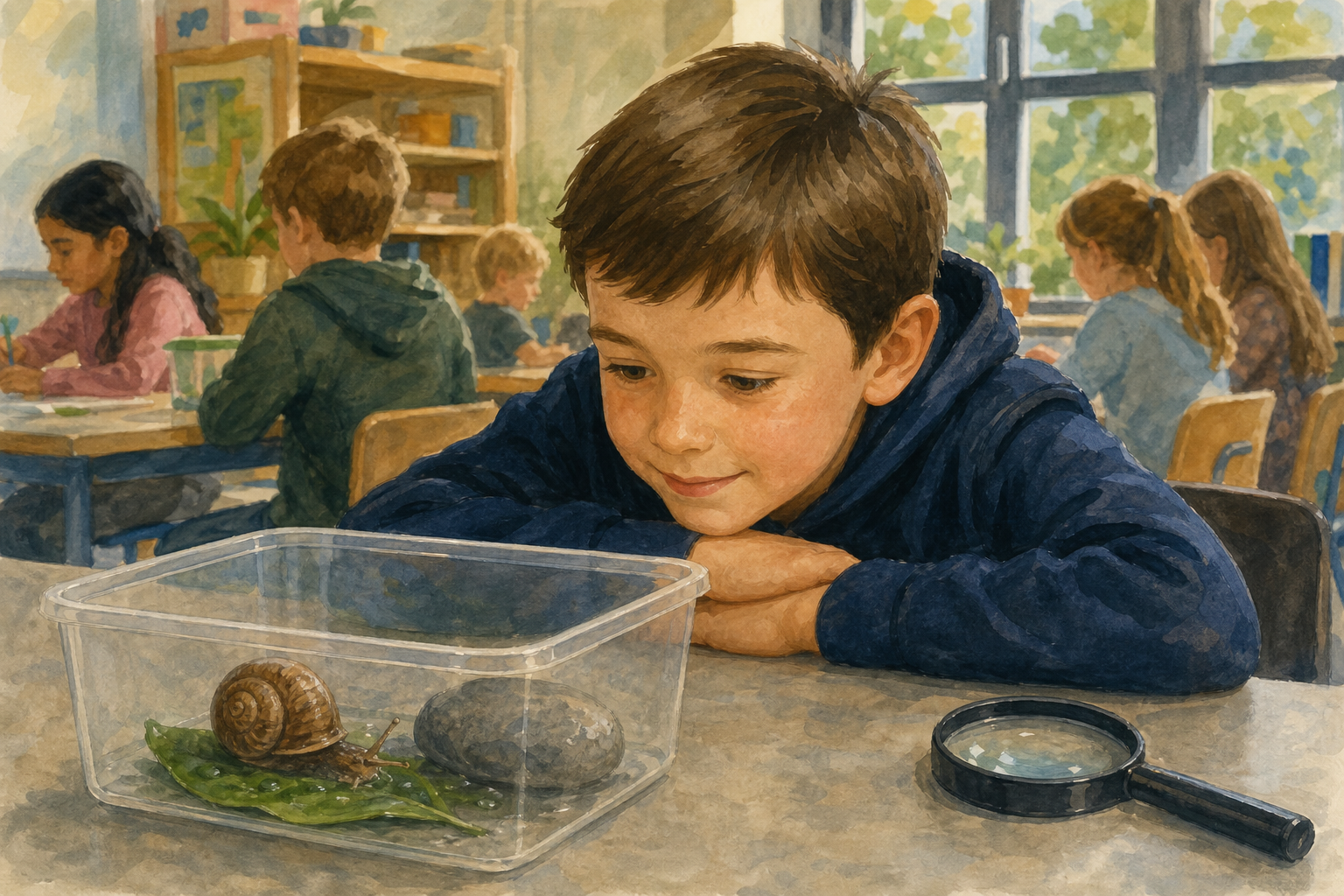
Set up 3 stations before the lesson. Push back desks into station tables. Station 1: a snail (or woodlouse) in a clear tub next to a small stone. Station 2: a sprouting bean in a jar next to a toy car. Station 3: a potted plant or daisy next to a teddy or pencil case.
Move groups round in turn, about 5 minutes each. At each station ask: What is it doing? Could the object ever do that?
Look-fors:
Differentiation: for children who need support, give a simple choice — does it move, yes or no? For fast finishers, ask them to whisper-predict what the snail will do next.
Let's sort what we noticed. On your journal page you have a living thing on one side and an object on the other.
In the middle, draw or write what the living thing does that the object never does. Did the snail move? Did the bean grow? Did the plant need water? Show your group your page when you finish.
Pupils complete their ComparisonTable journal page: living thing · object · what's different. This is the paper record for the lesson.
Drive the make-sense as a sorting talk: read out things one at a time — moves by itself, gets bigger, needs a drink, stays exactly the same, only moves when pushed — and ask the class which side each belongs on. Build a simple class list of what living things do (grows, needs food and water, moves or changes).
Keep this oral and on paper, not typed.
Let's talk together. What did the snail and the bean do that the stone and the toy car never did?
Think about this: how do we know if something is alive? What three jobs do all living things do? Can you point to a living thing here in our classroom or out in the school garden?
This is a display-only science-talk beat — children think and talk, nothing is typed.
Draw out the three big signs together: living things grow, need food and water, and move or change. Revoice children's answers so the whole class hears them.
Finish with a noticing prompt for the school garden — can you spot a living thing on the way out today?
Homework (noticing task, recorded on paper): ask children to find one living thing at home and draw one thing it does that an object cannot.
Today you were living-thing detectives. Here is what we found out:
Quick recap to close. Point at the snail and the toy car one last time and ask the class to call out which is living and why.
Make sure the snail and any minibeasts are returned outdoors gently, and everyone washes their hands.
You're previewing this lesson. Get full access to this lesson and hundreds more — each one ready to teach, with interactive activities, printable resources and pupil progress tracking built in.