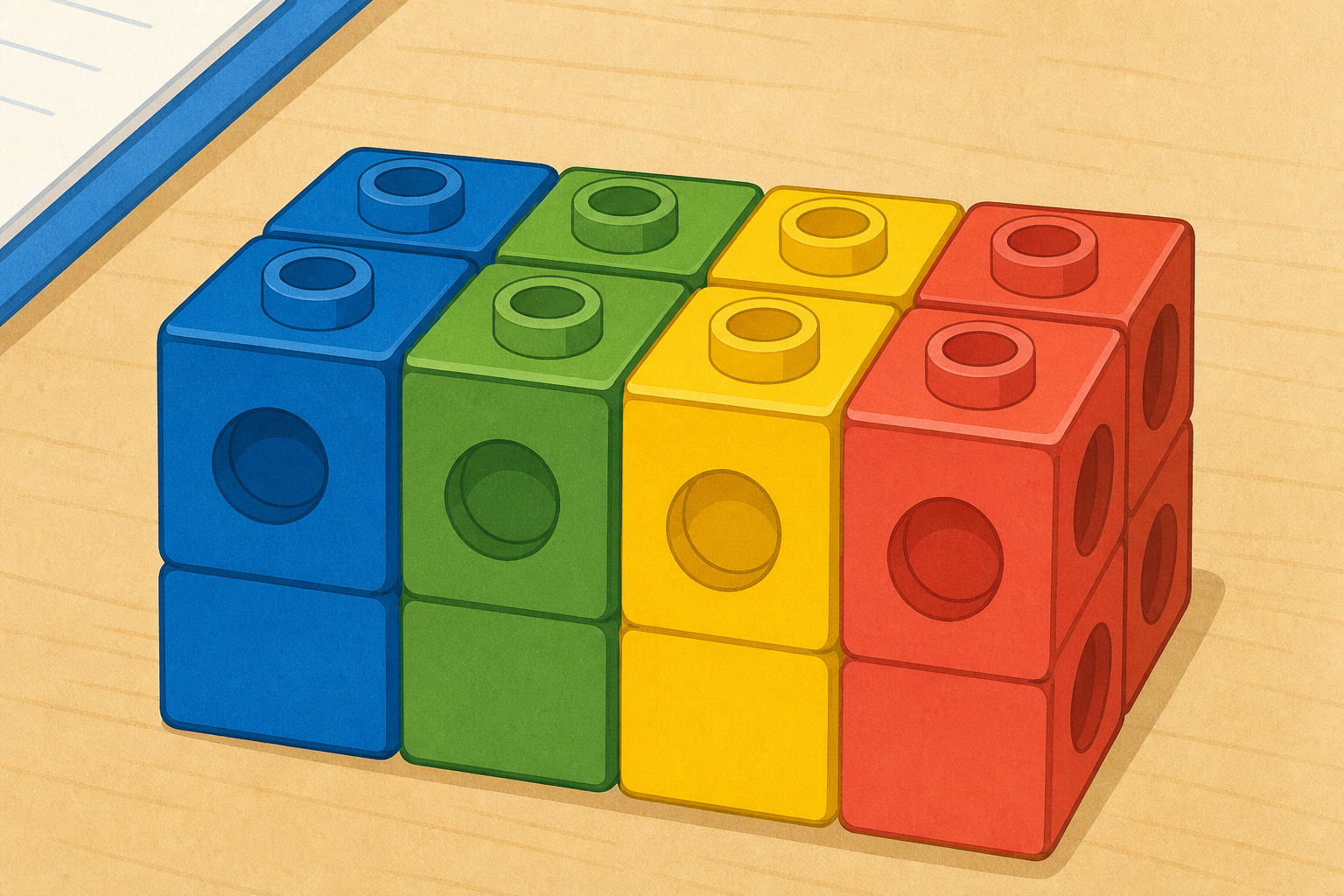
Here is a small box built from little cubes. Roughly how many cubes do you think are hidden inside it? Have a guess before we count.
Look at three cuboids on screen, each already filled with unit cubes. For each one, look at the bottom layer first: how many cubes cover the floor of the box? Then count how many layers are stacked on top. The volume is the cubes in one layer times the number of layers.
This next box has every side the same length. Be ready to say how the base and the layers work when the box is a perfect cube.
Together we build and read three cuboids on the shape-measurer, starting small with 3 × 2 × 2, then a cube of 4 × 4 × 4, and finishing with 10 × 10 × 10. One pupil at a time sets each cuboid on the board while everyone watches. As a class we call out the bottom layer, then how many layers, then check the volume against the screen. The last box is worth a good look.
In your maths copy, sketch each cuboid as a 3D box outline with its dimensions labelled (l × w × h). Work out the volume in cm³ under each box and underline the answer.
You're previewing this lesson. Get full access to this lesson and hundreds more — each one ready to teach, with interactive activities, printable resources and pupil progress tracking built in.