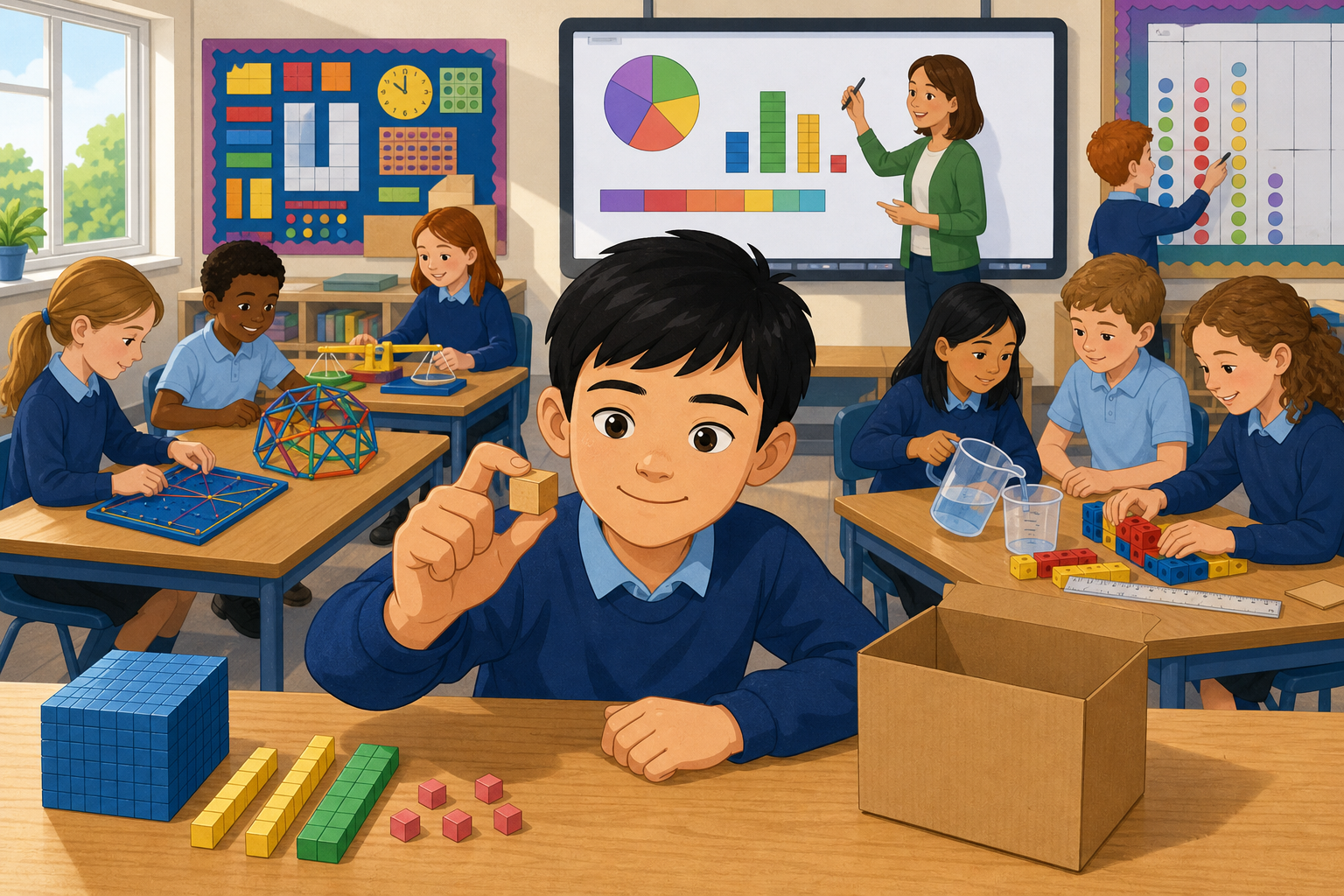
Here is one little cube, and here is a small cardboard box. Hands up: how many of these little cubes do you think it would take to fill the box right up to the top, with no gaps and none sticking out?
Have a guess before we work it out. Is it more than ten? More than twenty?
Watch each box fill with cubes, layer by layer. Count the bottom layer with me, then see what happens when another layer lands on top. Each cube is one cubic unit.
Now we build some cuboids together, one at a time, and count the cubes each one holds. Each time, we find the bottom layer first, then say how many layers stack on top. One of you comes up to set the width, the depth and the height at the board, then reads the cube count out for us to check together — the rest of us agree aloud or put it right.
First, build 4 across, 3 deep and just 1 layer high. How many cubes in that one flat layer? Say it together.
Now keep the same layer and stack a second one on top: 4 across, 3 deep, 2 layers high. Predict the total before it appears, then read it out together.
Last, a cube that grows in every direction: 3 across, 3 deep, 3 layers high. Count the layers together as they stack.
In your maths copy, sketch a cuboid built from cubes that is 2 cubes wide, 2 cubes deep and 3 cubes high. Then write how many unit cubes it holds in total.
You're previewing this lesson. Get full access to this lesson and hundreds more — each one ready to teach, with interactive activities, printable resources and pupil progress tracking built in.