1 - Introduction ~5 mins
Welcome
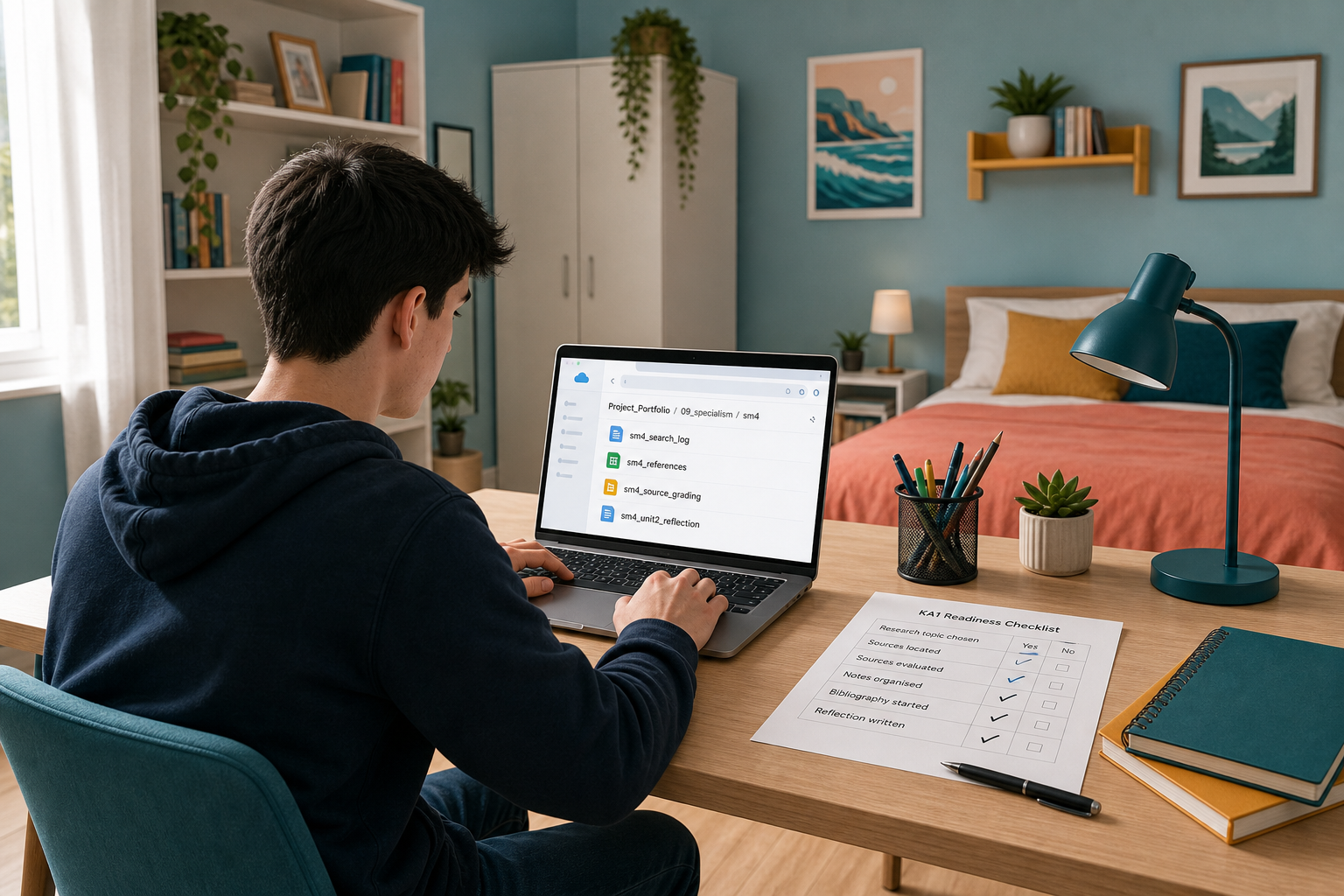 Unit 2 built your investigation toolkit piece by piece: targeted search, proper references, authorship checks, RAVA source grading, and a hard look at your digital footprint. Today you stop leaving loose or vaguely named files and assemble one tidy investigation set inside {{code:sm4}} that is ready for the investigation you will present.
By the end of this lesson, you will be able to:
- Tie your search log, references, source grading, and footprint notes into one tidy investigation set inside {{code:sm4}}
- Check, line by line, which parts of your investigation are finished and which are still missing
- Rename and verify every Unit 2 file with a clear {{code:sm4_}} name so your teacher can find it
Warm-up
Without opening your cloud drive, name three files you already made for this investigation (for example a search log, a reference list, or a source-grading page). If you can only name one, that is useful information: today is about closing those gaps before you present your findings.
2 - Key Concepts ~6 mins
Before you tidy files, lock three ideas: what an investigation set is, what a finished investigation looks like, and how deep a Unit 2 reflection should go.
| Concept | Why it matters | Example |
|---|---|---|
| Investigation set — every research file for your SM4 question lives in {{code:sm4}} with a clear {{code:sm4_}} name, not scattered on the desktop, in Downloads, or as {{code:Document1}} | You will be asked to present findings from a real investigation; if evidence is missing or misnamed, your teacher cannot check your work cleanly | {{code:sm4_search_log}} sits in {{code:sm4}} beside {{code:sm4_references}} — not on the desktop or in a random Coursework folder |
| Readiness check — a short checklist confirming topic, question, sources, references, grades, footprint notes, and where the files live | The presentation workshop is not the time to discover you never graded a source or never wrote a reference list | The seven lines are printed below; you mark Yes or No beside each one from what is actually in {{code:sm4}} |
| Unit 2 Reflection — a short written sheet that names what you can now do with search, sources, and footprint choices | You need to show that your thinking changed, not only that you made files; the sheet is where that shows | See Aoife's sample below — real sentences, not one-word answers |
Worked example: Aoife's files in sm4
Aoife is building a small enterprise pitch for custom GAA training gear. Her investigation question is: What do competing Irish makers charge, and what claims do they make about quality? After Unit 2 her {{code:sm4}} folder holds these names (Online apps may hide extensions — use the {{code:sm4_}} stem):
- First, {{code:sm4_investigation_proposal}} — topic, question, audience
- Second, {{code:sm4_search_log}} — five or more queries with best URL and reason
- Third, {{code:sm4_references}} — five properly formatted references
- Fourth, {{code:sm4_source_grading}} — at least three sources graded on Reliability, Accuracy, Validity, Authority
- Fifth, {{code:sm4_authorship_notes}} — two short authorship checks
- Sixth, {{code:sm4_digital_footprint}} — audit plus one positive footprint plan
- Seventh, {{code:sm4_unit2_reflection}} — today's sheet (headings now; full sentences in Portfolio Build)
If a file is missing, Aoife marks No on the checklist and either finds it or plans a short rebuild later. Do not invent research in this lesson.
The seven readiness lines
These are the lines you will copy into your reflection document in the next step. Mark Yes or No beside each one, based on what is really in your {{code:sm4}} folder right now:
- My investigation topic and question are written down in {{code:sm4_investigation_proposal}}.
- My search log shows at least five queries with the best URL and a reason, in {{code:sm4_search_log}}.
- I have five properly formatted references in {{code:sm4_references}}.
- I have graded at least three sources on Reliability, Accuracy, Validity and Authority in {{code:sm4_source_grading}}.
- I have two short authorship checks in {{code:sm4_authorship_notes}}.
- I have my footprint audit and one positive footprint plan in {{code:sm4_digital_footprint}}.
- Every one of those files sits inside {{code:sm4}} with a clear {{code:sm4_}} name.
Worked reflection sample (Aoife's voice)
Use this depth when you write your own sentences in Portfolio Build — short, specific, honest:
- What I can do now: I can run a focused search, save the best URL in a log, and write a full reference with author, title, date, and URL.
- Source skill that improved most: RAVA stopped me treating every blog like Citizens Information. A gear review with no named author scored low on Authority, so I dropped it from my pitch evidence.
- Footprint choice I will keep: I will keep my side-hustle drafts in the school portfolio only until the pitch is ready, not on a public social account.
- Gaps before the presentation: My reference list has three solid entries, not five. Next step: add two gov.ie or shop-about pages tonight, not during the workshop.
3 - Step-by-step Task ~15 mins
Follow the steps for your cloud platform to open your existing {{code:sm4}} folder, rename or place Unit 2 investigation files with clear {{code:sm4_}} names, then create a short Unit 2 Reflection document with headings and a Yes/No checklist only. Structure first — full reflection sentences come in Portfolio Build.
Missing files are normal at this stage. Create the reflection and checklist first, mark gaps honestly, and do not invent research. If something is missing, add an empty placeholder with the correct name and mark that checklist line No.
4 - Common Issues ~4 mins
Common Issues
| Issue | Solution |
|---|---|
| I cannot find {{code:Project_Portfolio}} or {{code:09_specialism}} | Use the search box at the top of OneDrive or Google Drive and type {{code:Project_Portfolio}}. If it still does not appear, ask your teacher; you may need the fresh Specialism setup from Module 1 rather than an Intro carry-forward. |
| My search log or references are still named something vague like {{code:Document1}} | Rename them now to the course stems ({{code:sm4_search_log}}, {{code:sm4_references}}) inside {{code:sm4}}. Vague names make KA verification slow and easy to fail. |
| I am missing two or more Unit 2 files | Do not invent fake research. Create empty placeholders with the correct {{code:sm4_}} names, mark those checklist lines No, and finish the reflection headings first. At most one short stub rebuild is allowed later in Portfolio Build if time remains (for example three solid references). Schedule catch-up for any other Nos before the KA1 workshop. |
| I created the reflection outside {{code:sm4}} | Move the file into {{code:sm4}} now. Online apps save where the file was created; moving after the fact is fine, but starting inside the folder is the habit to keep. |
5 - Independent Practice ~20 mins
Independent Practice
- {{code:sm4}} holds your investigation files with clear {{code:sm4_}} names (placeholders allowed where content is still missing)
- {{code:sm4_unit2_reflection}} is saved inside {{code:sm4}} with all four reflection headings filled in real sentences
- The checklist shows honest Yes/No marks, and any No lines name a next step
- Your teacher can open {{code:sm4}} and find search, references, and grading evidence (or clearly named placeholders) without asking you where things went
Unlock the full learning experience
You're previewing this lesson. Get full access to this lesson and hundreds more — each one ready to teach, with interactive activities, printable resources and pupil progress tracking built in.
This lesson is copyright of 123Learn.ie 2017 - 2025. Unauthorised use, copying or distribution is not allowed.