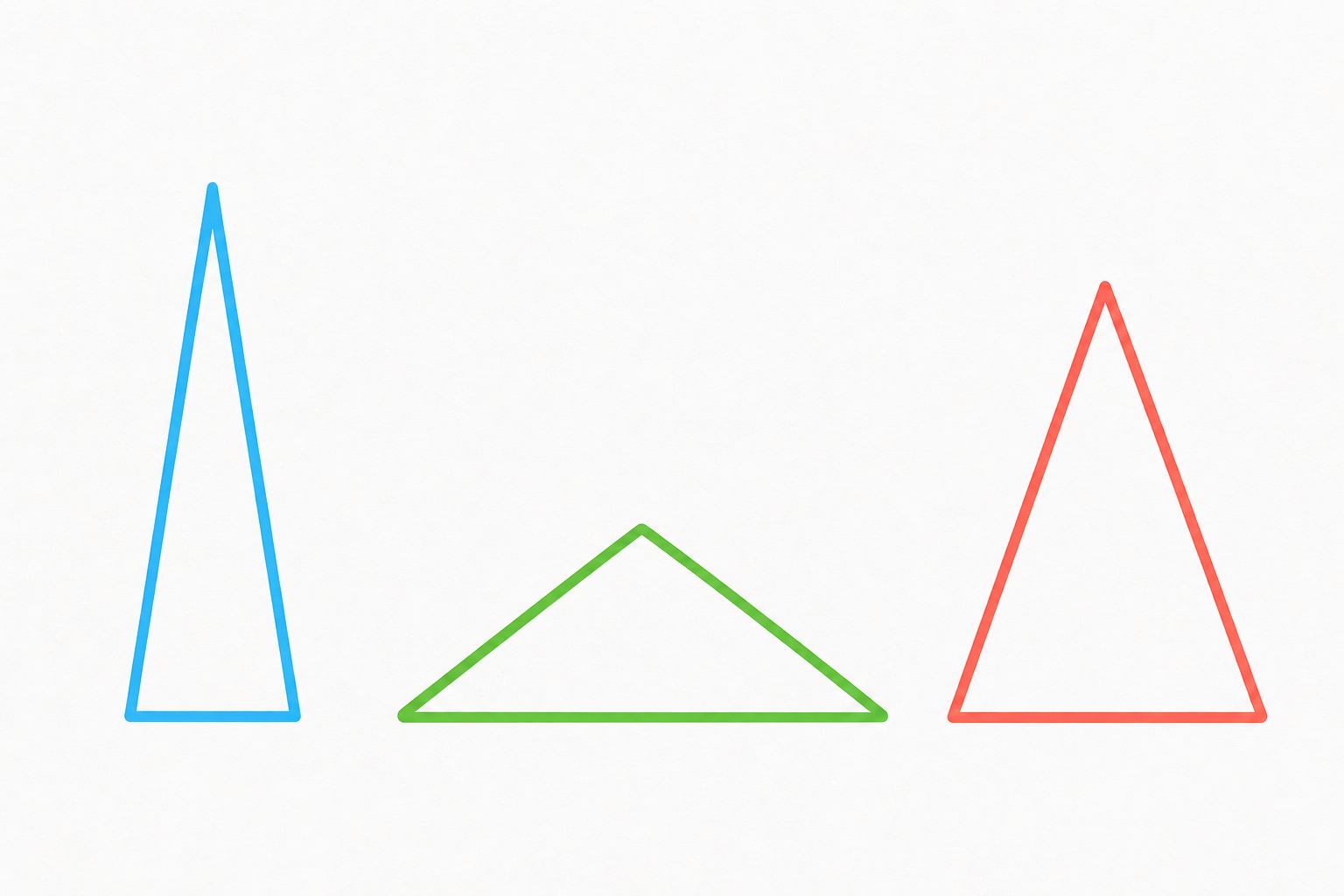
Look at these three triangles on the board. One is tall and thin, one is wide and flat, and one is very pointy. They look really different from each other.
Hands up: what is the same about all three of these shapes?
Take three hands-up answers, not open call-outs. You are fishing for they all have three sides — but accept and revoice anything close ("three corners", "three lines"). Do not name the rule yet; the model step does that.
Watch the shape inspector reveal the sides of a triangle. Count them with me as each one lights up. Three straight sides, three corners. That is what makes a triangle a triangle.
Now watch a square. Count its sides with me as they light up. Four straight sides, four corners. A shape with four sides has a special name: a quadrilateral.
A rectangle looks longer than a square, but watch the sides light up. Four sides again. So a rectangle is also a quadrilateral, even though it is not a square.
Walk each example aloud, one at a time, and have the class count the sides as they light up.
Now we work through four shapes together. For each one, count its straight sides out loud with the whole class, then decide as a class: is it a triangle, a quadrilateral, or neither?
Count the sides with me. One, two, three straight sides. So this is a triangle, even though it is tall and thin.
This one looks very different, but count the sides again. One, two, three. Three straight sides, so it is still a triangle.
Count carefully. One, two, three, four straight sides. Four sides means this is a quadrilateral, even though it is long and stretched.
Count slowly together. One, two, three, four, five straight sides. Five sides is too many for a triangle and too many for a quadrilateral, so this shape is neither.
This round is for talking it through together — the class counts the sides aloud on each shape before naming it.
Work the four shapes one at a time. Let a pupil reveal the sides on each, then have the whole class count aloud as the sides light up. Revoice each correct answer: "three straight sides, so it is a triangle". The two triangles look very different on purpose, so pupils learn to count rather than guess by looks; the stretched quadrilateral and the five-sided "neither" case make the same point. Keep each shape brisk — a count and a quick class verdict, then move on.
In your maths copy, draw two different triangles and two different quadrilaterals. Make them look really different from each other, the way the ones on the board did.
Under each pair, write the group name: triangles under your two three-sided shapes, and quadrilaterals under your two four-sided shapes.
Walk the room glancing for: two genuinely different shapes in each pair (not two near-identical squares), and the correct group name written underneath. No marking — this is whole-class copybook practice, not assessment. Give pupils enough time to draw four shapes carefully with a ruler.
Now we build shapes with straws at the visualiser. A few pupils take turns to come up and build each shape, while everyone else checks the build by counting the sides aloud. Show a thumbs up if you agree the shape is right.
This is a single visualiser demonstration, not desk work: a few pupils take turns building at the visualiser while the watching class checks each build by counting the sides aloud and gives a thumbs up to agree. Straws are optional — if you have none, draw each shape on paper under the visualiser instead. Keep the board work brisk rather than over-explaining.
Watch for the make-or-break moment at the last task, and give it plenty of time: four straws cannot close into a triangle because a triangle needs exactly three sides. Let a pupil try and fail, then revoice: "a triangle has three straight sides — four straws makes a four-sided shape, a quadrilateral, not a triangle". For the "different quadrilateral" task, accept any closed four-sided shape (a long thin one, a kite-ish one) — the point is four sides, not a neat square.
One pupil says a square is a quadrilateral. Another says a quadrilateral is not always a square. Who is right? How could you prove it?
Listen for pupils separating has four sides (always true of a square and a quadrilateral) from has four equal sides and square corners (only the square). Revoice: "every square is a quadrilateral because it has four sides — but a quadrilateral only needs four sides, so it does not have to be a square." If pupils struggle, point back to the long thin quadrilateral built in the challenge: four sides, clearly not a square.
Next we look at shapes with even more sides — pentagons, hexagons and octagons — and learn how their names tell you how many sides they have.
Keep this brief. A quick "three sides means…?" / "four sides means…?" call-and-response is a tidy close.
You're previewing this lesson. Get full access to this lesson and hundreds more — each one ready to teach, with interactive activities, printable resources and pupil progress tracking built in.