Mathematics
Intermediate
50 mins
Teacher/Student led
+90 XP
What you need:
IWB/Projector/Large Screen

Timetables, Schedules and Time Zones

Learn to read bus timetables to find departure and arrival times, work out journey durations, and understand how local time shifts when travelling across time zones.
Teacher Class Feed

Load previous activity

    1 - Getting Started ~4 mins

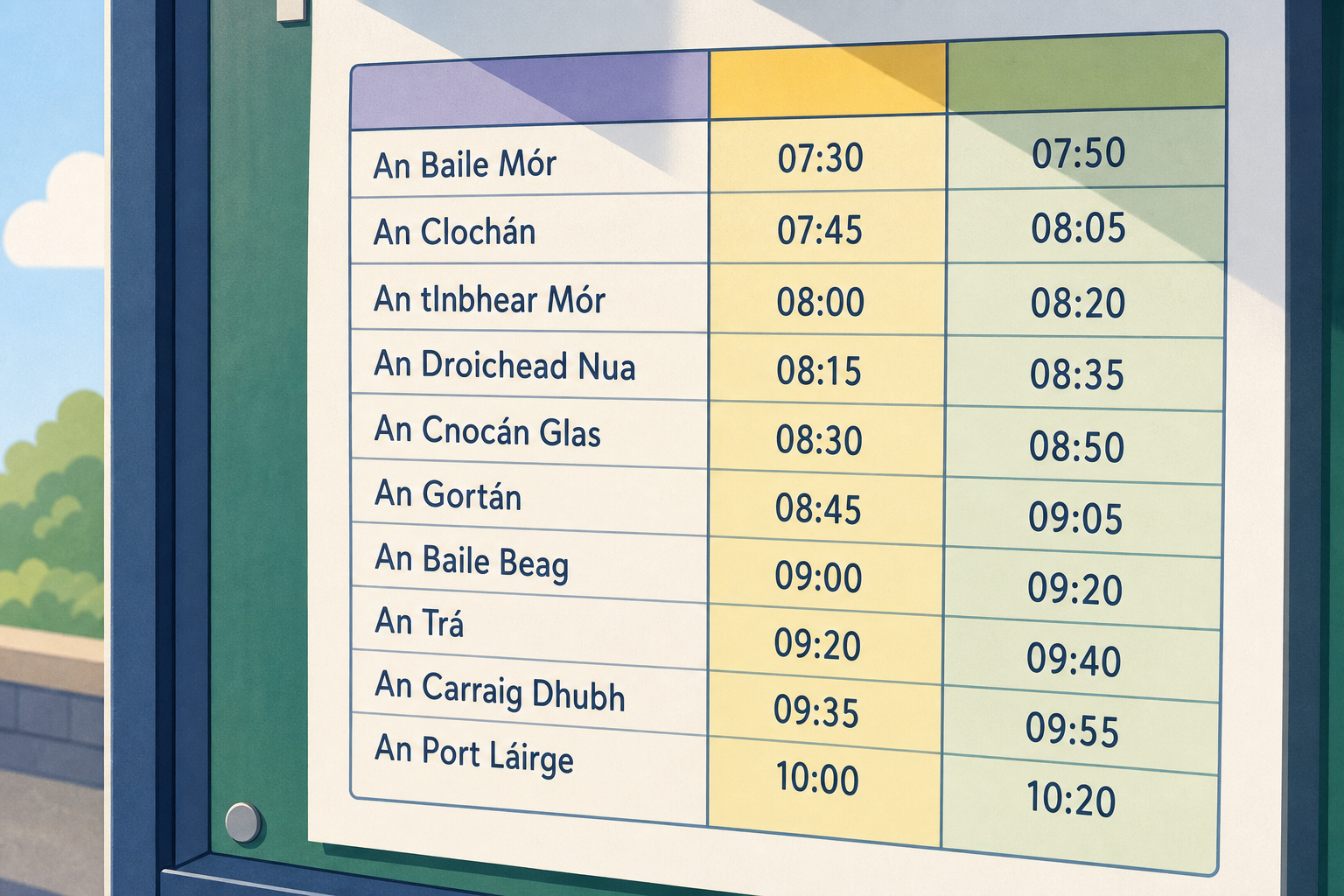
    Illustration for Getting StartedHere is a Dublin to Cork bus timetable. The times are written the 24-hour way, so 13:55 means just before 2 o'clock in the afternoon. Look down the list of buses leaving Dublin this morning. Which bus would get you to Cork before 2 o'clock in the afternoon? Have a good look before any hands go up.

    2 - Watch and Notice ~8 mins

    Illustration for Watch and Notice

    Find a departure and arrival

    Watch as we read along one row to find when a bus leaves Dublin, then down to the same bus's arrival at Cork. The row tells us the place; the column tells us which bus.

    How long does the journey take?

    Watch as we count on from the departure time to the arrival time to find how long one journey lasts. We count up to the next whole hour first, then on by hours, then to the finish.

    Which service is fastest?

    Watch as we compare three buses. The one with the shortest journey duration is the fastest, even if it isn't the first to leave.

    3 - Why Is the Time Different? ~4 mins

    Illustration for Why is the time different?

    The Earth keeps turning

    The Earth is always turning. That means different parts of the world face the sun at different moments, so their clocks do not all read the same. When it is afternoon here, the other side of the world has already had its night.

    East is ahead, west is behind

    Key point

    If you travel east, you move towards where the sun has already risen, so the clock there is ahead of ours. If you travel west, the clock there is behind ours.

    Worked example

    Let's work it out for 15:00 in Dublin. New York is 5 hours behind, so we count back 5 hours from 15:00: that gives 10:00 in New York. Sydney is 11 hours ahead, so we count on 11 hours from 15:00. Counting on past midnight, 15:00 + 11 hours lands on 02:00 the next day in Sydney.

    4 - Try It Together ~9 mins

    Today we work through the timetable together: which bus, how long does it take, and would I make my connection? We'll read the row, read the column, then count on to find each journey duration before we agree the answer.

    Read the Dublin to Cork timetable

    5 - Write the Durations in Your Copy ~3 mins

    COPYBOOK MOMENT

    In your maths copy, copy three rows of the timetable and beside each one write its journey duration. Then write the local time in New York and Sydney when it is 15:00 in Dublin.

    Remember: New York is 5 hours behind Dublin, and Sydney is 11 hours ahead. Counting on for Sydney crosses into the next day.

    6 - Class Challenge ~8 mins

    Today we plan some real journeys: find the fastest service and work out the total travel time when there is a connection to catch. Then, on the board together, a time-zone stretch — there is a video call at 17:00 Dublin time, so what time is it for a cousin in Sydney? Count on 11 hours from 17:00, and watch as it crosses past midnight into the early morning of the next day.

    Plan the journey

    7 - What Did We Notice? ~3 mins

    MATHS TALK

    Why is it a different time of day in Sydney when it is the afternoon here? One pupil says the sun is in the same place everywhere at once. Another says different parts of the world have different times. Who is right, and how would you settle it?

    8 - What's Next ~2 mins

    Key Takeaways

    • Read across the row and down the column to find departure and arrival times.
    • Count on from departure to arrival to find a journey duration; the fastest service has the shortest duration.
    • Travelling east puts the clock ahead, travelling west puts it behind, so the local time shifts across time zones.

    Coming Up

    Next we look at converting between units of time, working out how many minutes are in a number of hours and how many hours in a number of days.

    Pupil practice
    Module 6 · Time and Money Shape & Space
    Lesson 62 · Timetables, Schedules and Time Zones
    Download Activity Book page (PDF)
    End of lesson
    123learn · Online learning platform

    Unlock the full learning experience

    You're previewing this lesson. Get full access to this lesson and hundreds more — each one ready to teach, with interactive activities, printable resources and pupil progress tracking built in.

    Hundreds of curriculum-aligned lessons
    Interactive activities in every lesson
    Printable resources & progress tracking
    Copyright Notice
    This lesson is copyright of 123Learn.ie 2017 - 2025. Unauthorised use, copying or distribution is not allowed.
    🍪 Our website uses cookies to make your browsing experience better. By using our website you agree to our use of cookies. Learn more