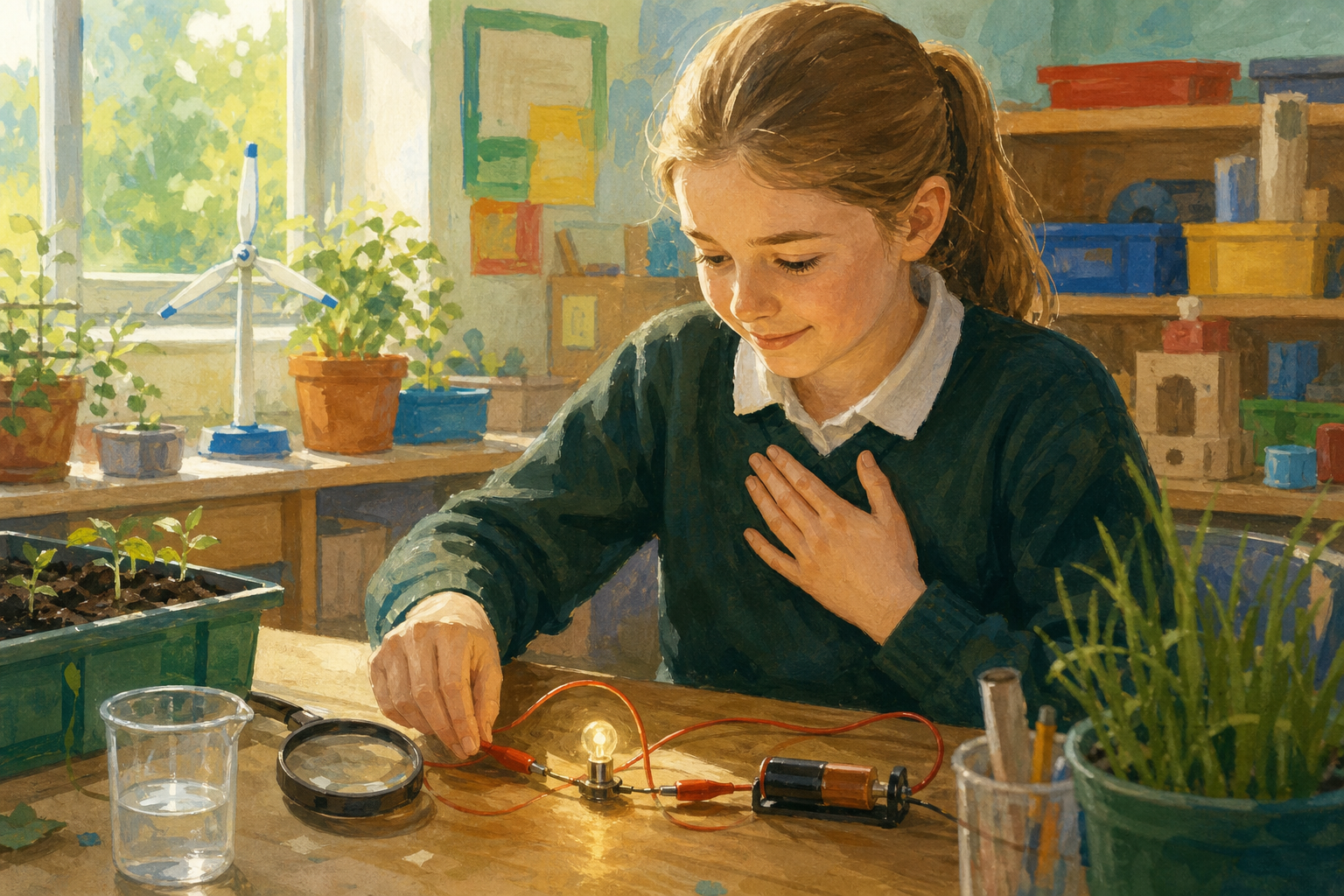
Put your hand flat on the middle of your chest and stay very still. Can you feel anything? Now run on the spot for a few seconds and feel again. Something inside you is working hard, even when you do nothing at all. Your body is full of parts that never stop, all day and all night. Today we are going to find out how all those parts team up to keep you alive.
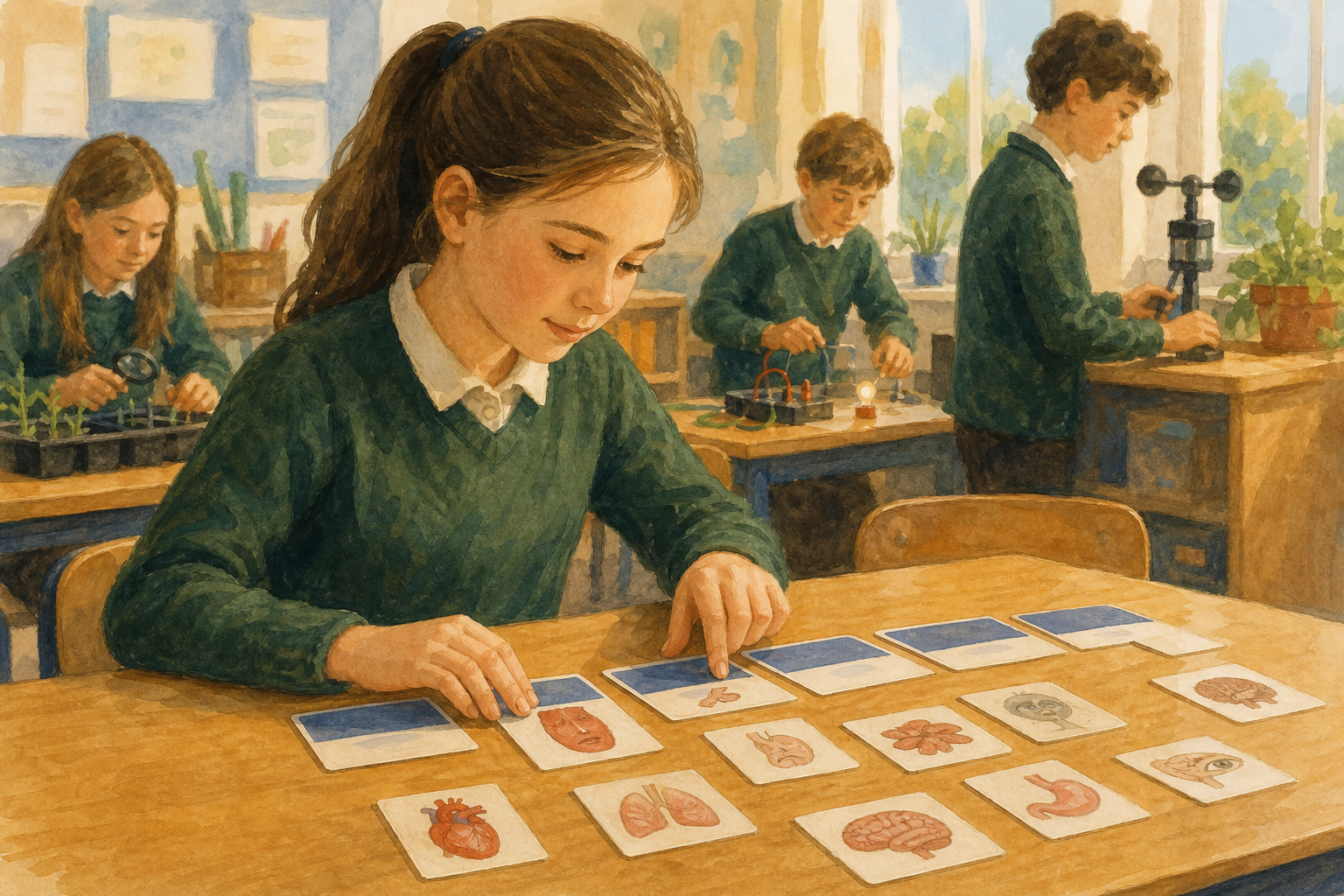
Keep this light: it is just the curiosity beat. Ask What could you feel? and let a few pupils answer (a heartbeat, breathing, warmth). Do not name systems yet, that comes next.
Doctors and biologists spend their whole lives finding out how the body works so they can keep us healthy. They have learned that your body is not one machine. It is a set of teams, and each team has a job. We call each team a system.
Here are the five teams we will sort today, and the job each one does. Read each row together as your teacher points to it.
| The team (system) | The job it does | Organs on the team |
|---|---|---|
| Breathing | Takes oxygen from the air into the body and pushes out air we don't need | lungs, windpipe (the tube you breathe through) |
| Circulation | Carries oxygen and food in the blood to every part of the body | heart, blood vessels (the little pipes the blood travels in) |
| Digestion | Breaks down the food we eat so the body can use it | stomach, small intestine (a long tube where food is broken down), liver |
| Movement | Holds us up and lets us move | bones (skeleton), muscles |
| Control | Sends messages and decides what the body should do | brain, nerves |
This is the teaching beat. Display the table on the IWB and walk the class through it one row at a time, reading each row aloud rather than asking pupils to read the whole table at once. Point to roughly where each team works on your own body as you go.
The plain-language hints in brackets (windpipe, blood vessels, small intestine) are now on the pupils' screen, but still say them aloud as you reach each row so the meaning lands for everyone.
Then hold up the printed organ cut-out cards and the five team-mat header cards so pupils see what they will sort next. The same eleven organs appear on the cards, on this table and on the board check later, so a pupil can always find a home for every card they sort.
Finish the beat by saying the key rule aloud (it is not on the pupils' screen, so say it clearly): We sort each organ by the JOB its team does, not by where it sits in the body.
Head off the common mistake: pupils often want to group organs by where they are (everything in the chest together). Say We are grouping by the job, not the place. The heart and the lungs are neighbours, but they are on different teams because they do different jobs.
Now it is your group's turn. You have a pile of organ cut-out cards and five team-mats: Breathing, Circulation, Digestion, Movement and Control.
Before you place a card, ask your group: What job does this organ do? Which team's job is that? Then put it on the right mat. Talk it over together. If two of you disagree, say why you think what you think before you decide.
When every card is placed, set to one side the one card your group found hardest or argued about most, so you can watch out for it on the board. Then check your mats against the table on the screen.
Groups of three or four. Hand each group a full set of organ cards (the same eleven organs as the table and the board check) and the five team-mat header cards. Circulate and listen for reasoning, not just right answers. Treat your circulation as the formative check for learning outcome 1: note which groups place every card correctly and which organs cause disagreement.
Gathering the hard cards for the board check: ask each group to set aside the single card they found hardest. In the last minute, do a quick round-the-room ask: Hold up the one organ your group found trickiest. Jot the two or three organs that come up most often, those are the ones you will lead with at the board. This way you do not depend on every group reliably setting a card aside.
Watch for: pupils placing the heart on the breathing mat because it is near the lungs. Prompt with What is the heart's job, pumping or breathing?
Differentiation: give a struggling group the organs three at a time; challenge a fast group to add an organ of their own (skin? kidneys?) and argue which team it joins.
Let's check our sorting together. On the screen we have the same eleven organs and the same five teams. We will send each organ down to its team one at a time. One group says where they put their card and why. Everyone else has a job too: decide in your head whether you agree before the card lands, and put your thumb up if your group placed it the same way. We will start with the organs that groups found hardest.
Drive the sorting-tree on the IWB in explore mode. The eleven items on screen are exactly the eleven organs from the table and the cards: lungs, windpipe, heart, blood vessels, stomach, small intestine, liver, brain, nerves, bones, muscles. The five groups are Breathing, Circulation, Digestion, Movement and Control, so every card a group sorted in step 3 has a home here.
Begin with the two or three organs you gathered in the round-the-room ask at the end of step 3 (the ones groups found trickiest). As each item comes up, ask a different group to place it and say the job, then fold in the rest of the class with Are they right? Where would you put it? Thumbs up if your group agreed. The whole class is judging along, not just the group at the board.
The teams don't work alone. They depend on each other. Let's see how. We will line our five mats up in a row and pass one job along the line.
It starts when you take a breath. Follow it: the Breathing team takes oxygen from the air into the body, then the Circulation team carries that oxygen in the blood to your legs, and then the Movement team uses the oxygen to run. And the Control team is in charge of the whole thing, telling the others to speed up when you run.
Here's a question to talk out together, and there's no wrong guess: what would happen to the running if one team stopped doing its job? Turn and tell a neighbour what you think.
Lay the five team-mats in a row on the floor or a long table. Walk the oxygen from Breathing → Circulation → Movement, touching each mat as you say its part. This is a whole-class group-discussion beat, not a written task.
Give pupils a few seconds to turn and tell a neighbour before you take answers, so everyone has a thought ready and no one is put on the spot cold. Draw out the key idea: No team can do its job alone. If the breathing team stopped, the circulation team would have no oxygen to carry, and the movement team could not run. This is exactly the second learning objective, so spend a moment here.
Now record what you found out on your Investigation Journal page. The page has five boxes already printed on it, one for each team: Breathing, Circulation, Digestion, Movement and Control. This is just like your team-mats, so you are grouping organs by the job their team does.
Work through these one at a time:
The science is in which box each organ lands in and in your arrow, so don't worry about neat handwriting.
Hand out the Investigation Journal page, which has five labelled team boxes printed on it (Breathing, Circulation, Digestion, Movement, Control) and space between them for a dependency arrow. Pupils write the organs into the correct box, then draw and label one arrow between two boxes.
This recording deliberately matches the step 3 team-mats: organs are grouped by the JOB their team does, not by where they sit in the body. That keeps the recorded artefact aligned with the objective and avoids the location misconception. Check against learning outcome 4: all five team boxes filled with the right organs, plus at least one labelled dependency arrow.
If time is short, the organs-in-boxes and the arrow are the priority. Differentiation: a struggling group may write organs three at a time and copy from their team-mats; a fast group may add a second dependency arrow.
Let's look back at what we found out today:
Read the recap with the class. Finish with a quick check: Name one team and one organ on it. Why can't that team work alone?
Homework idea (hands-on, recorded in the journal): ask pupils to feel their pulse at the wrist tonight and ask an adult what job they think the heart does. Bring the answer to the next lesson.
You're previewing this lesson. Get full access to this lesson and hundreds more — each one ready to teach, with interactive activities, printable resources and pupil progress tracking built in.