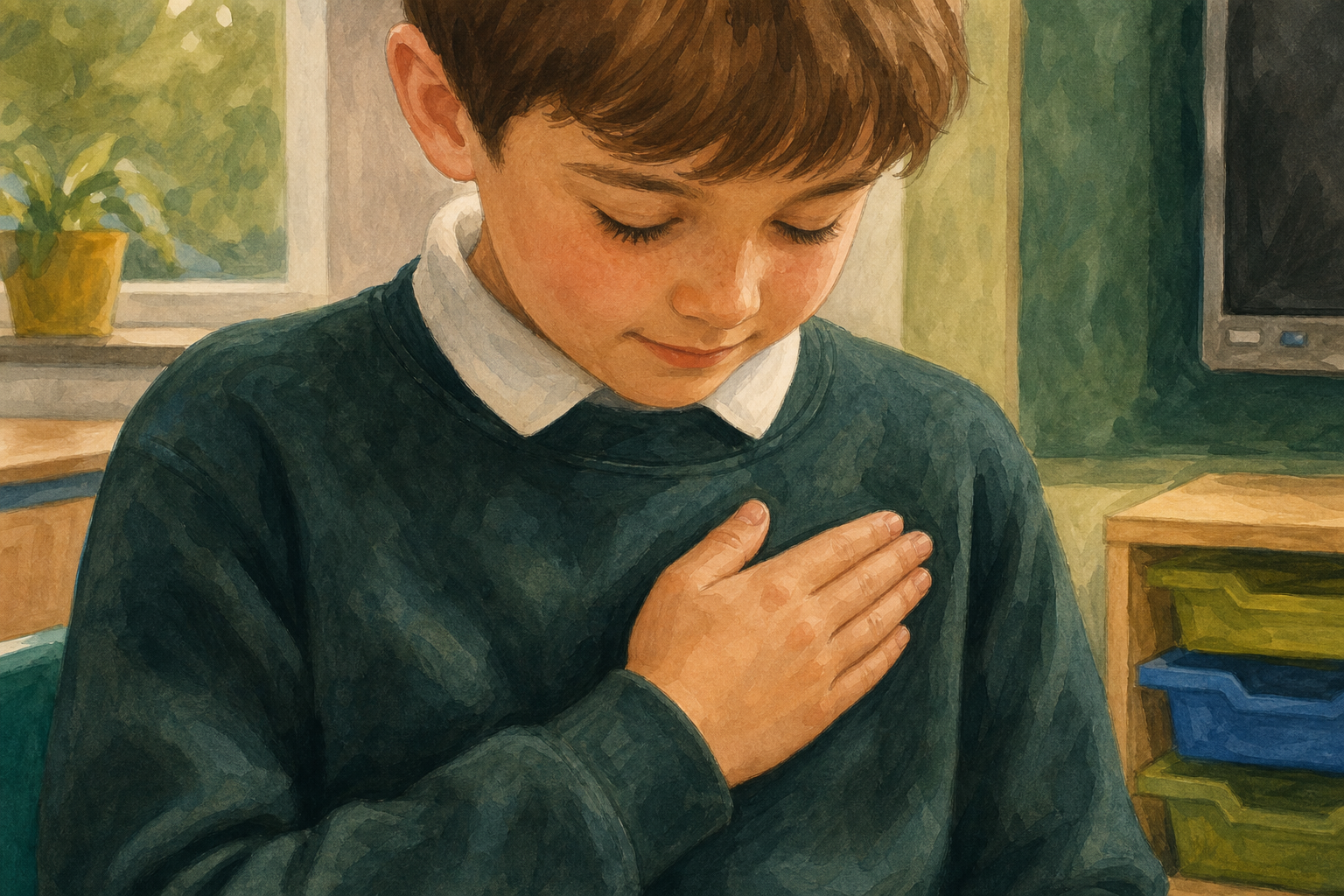
Put your hand flat on the middle of your chest and stay very still. Can you feel a gentle thump? That is your heart, working away even while you sit quietly.
Here is something to wonder about: if you ran around the yard for a minute, do you think your heart would beat the same, slower, or faster? Hands up your guess. Today we are going to find a way to feel our heart beating and count it, so we can find out for real.
Keep this light and quick. Just get a guess from the class, no need to explain the method yet. Ask "will your heart beat faster, slower, or the same after running?" and take a show of hands for each. Most will guess faster; do not confirm yet, that is what we are testing.
Your heart is a special muscle about the size of your own fist. It is a pump. With every beat it squeezes blood out to travel all around your body, then it fills up again, ready for the next beat. It never takes a break.
| Concept | Why it matters | Example |
|---|---|---|
| Heart — a muscle in your chest that pumps blood all around your body, day and night | Your whole body needs the blood your heart pumps to bring it air and food, so the heart keeps you alive | Put a hand on your chest and stay still to feel the gentle thump of it pumping |
| Pulse — the little beat you can feel at your wrist or neck each time the heart pumps | You cannot see inside your chest, but the pulse lets you feel and count your heartbeat from the outside | Press two fingers gently on your wrist below your thumb and feel each beat |
| Healthy heart — a heart that gets exercise and rest stays strong, like any muscle that is used | Knowing how to look after your heart helps you stay well your whole life | Running, walking the dog, dancing and playing all give your heart good exercise |
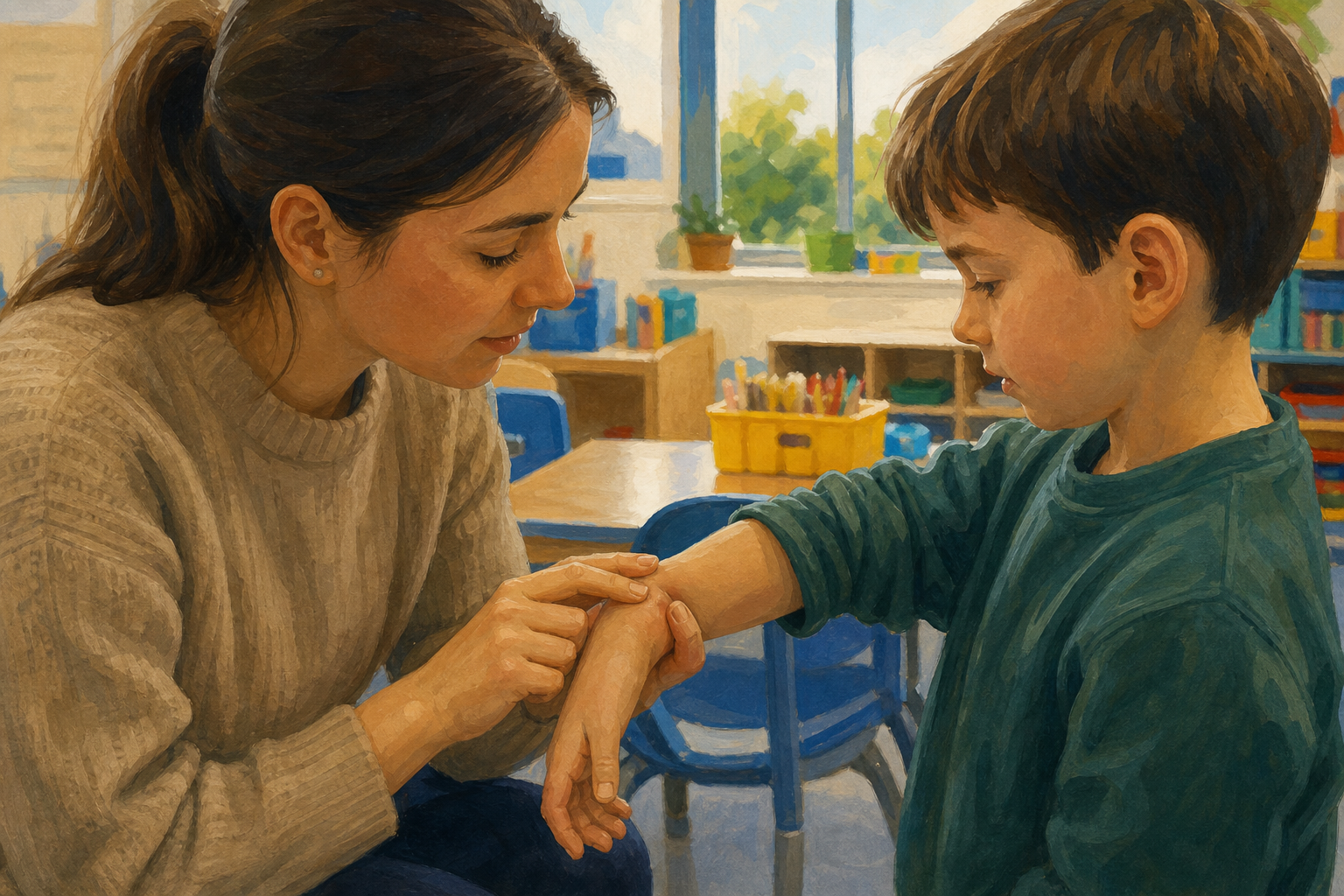
This table is the children's on-screen content for 3rd class. Read each row with the class and point at the thing as you go. Have everyone find their own pulse now: two fingers (not the thumb) on the wrist just below the base of the thumb, pressing gently. Walk round and help anyone who cannot find it.
Pacing risk — this is the make-or-break beat. Getting all 25 to 30 children to securely locate a pulse by hand is the single slowest task in the lesson, and the timed investigation cannot work until every child has found one. Be prepared to spend longer here than the budgeted minutes and do not rush on while hands are still empty. Offer the neck pulse (beside the windpipe) early as an easier backup for any child who cannot feel the wrist, rather than leaving it as a last resort. It is far better to take an extra few minutes here and borrow them from the discussion in step 6 than to start the timed count with children who have not yet found their pulse.
Common slip: children press too hard or use their thumb, which has its own pulse and confuses them. Tell them to press as gently as feeling a feather.
This is a watching-and-thinking step. You do not count your own pulse yet, that comes next. For now, just watch your teacher show how a pulse count works: they will count for 15 seconds while the timer runs on the board, then say their number aloud.
While you watch, get ready to make your prediction. After a minute of star-jumps, will your pulse count go up, down, or stay the same? Tell your partner what you think and why. Your own turn to count comes in the very next step.
Make it clear this step is a teacher demonstration plus a paired prediction only; children's own timed counting happens in step 4. Model the full cycle out loud so children copy it later. Say it like this: "I wonder if moving changes my heartbeat. I predict my count will go up because my body is working harder. I will count my own pulse for 15 seconds while the timer runs… I counted 18 beats. After star-jumps I will count again and compare."
Drive the fair-test-timer on the IWB in display mode: it counts down 15 seconds so the whole class sees how long a counting window lasts. Then take a few predictions and write the words up, down, same on the board with a tally of hands. Remind them a prediction is never wrong, it is the start of the science.
Now it is your turn to investigate. Your Investigation Journal page is on your desk with two boxes: Resting and After star-jumps. First, sit still and rest. When the 15-second timer runs, count the beats of your pulse and remember your number, then write it in the Resting box.
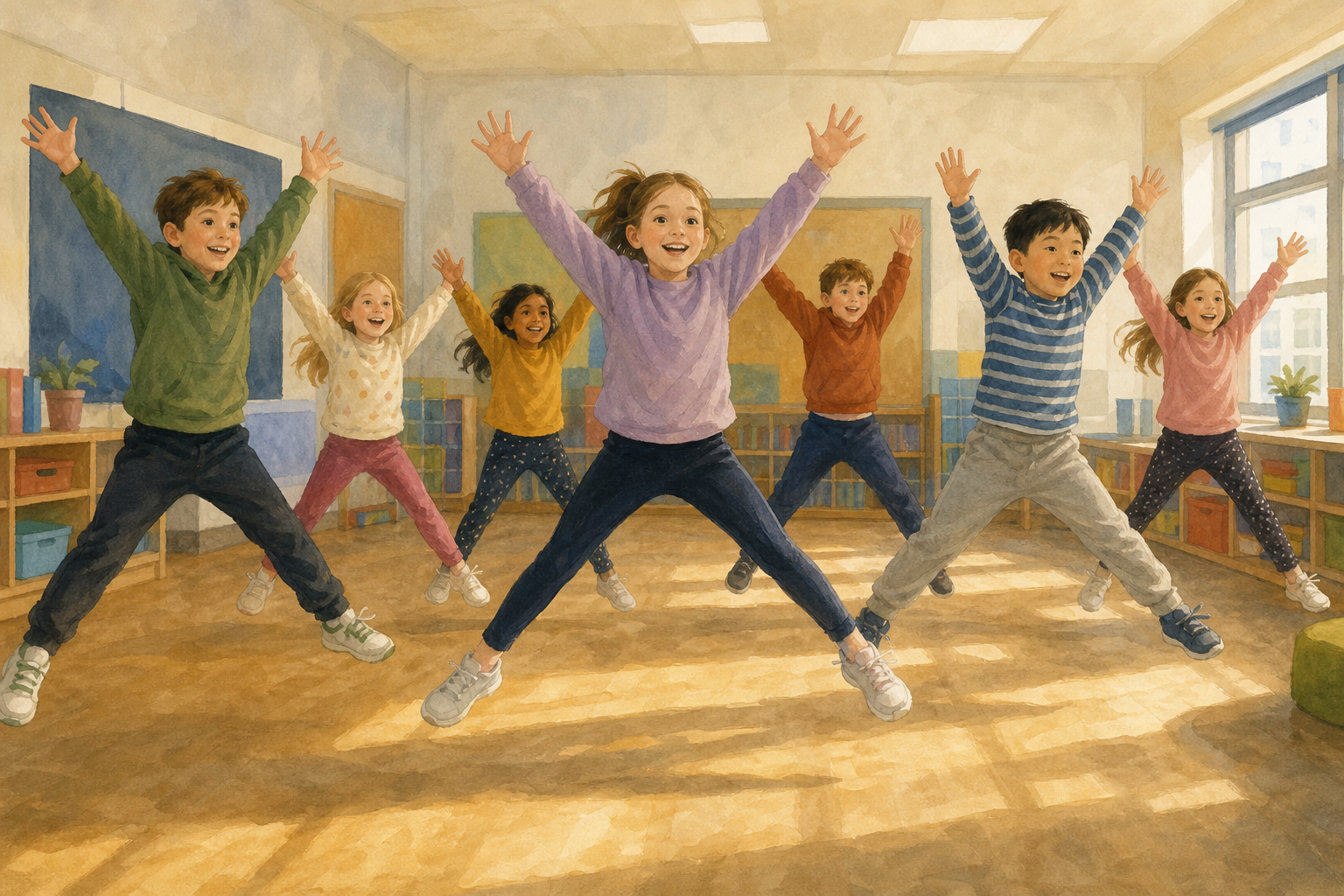
Next, stand and do star-jumps for one whole minute while the timer counts. As soon as you stop, sit and count your pulse for 15 seconds again, and write that number in the After star-jumps box. Compare the two numbers. What happened?
The pulse-finding should already be secure from the previous step, so these minutes are for the timed cycle alone. Run it in three clear beats with the timer on the IWB. (1) Resting count: everyone still, find pulse, count for the 15-second countdown, write the number. (2) One minute of star-jumps to the timer. (3) Straight back to sitting, find pulse, count for 15 seconds, write the number. Take the resting count first and write it before any movement, so it is a true resting value. Repeat the whole cycle a second time for a more reliable result: a second resting count and a second after-count in the spare boxes on the page, so children can see whether their numbers are similar both times.
Catching the after-count before it falls: the pulse drops quickly in the few seconds it takes children to resettle, so the after-count can already be falling by the time they count. Tell children to keep their fingers on or near their pulse during the last few star-jumps, then sit and count as fast as they can the instant they stop, with no fumbling to relocate it. The quicker the count begins after stopping, the truer the after-number.
Safety: any child who should not do star-jumps is the group timekeeper or marches gently on the spot instead. Watch for anyone light-headed; they sit out and just count a partner's pulse. Clear a space so nobody bumps a desk.
Children who finish counting first can sketch a second prediction for what would happen after dancing, or watch a partner count. Do not set a device task.

Let's gather some of our numbers and turn them into a chart. A few pupils will read out their resting count and their after-star-jumps count, and we will type them into the table on the board. While we do, look at your own two numbers and get ready to check: is the pattern on the chart the same as the one on your page?
Drive the data-recorder on the IWB in explore mode. It now holds eight rows and two columns: Resting and After star-jumps. This is a sample of the class, not every pupil, so frame it as "let's chart some of our pairs and see if the pattern matches everyone's page." Call up six to eight pupils to give their pair of numbers, type them in, then show the bar chart with one click. The After star-jumps bars should stand taller than the Resting bars.
Keep every watcher folded in: after each pair goes in, ask the whole class "hands up if your after-number was bigger than your resting number too", so children whose pair is not picked are still checking their own data against the chart. Then ask: "Are nearly all the second numbers bigger? Whose prediction was right?" Revoice what the chart shows: when the body works harder, the heart beats faster to send more blood and air to the muscles.

Our investigation showed something clear: after moving, our hearts beat faster. That is because moving muscles need more blood, so the heart pumps quicker to deliver it. After a rest, it slows down again.
Discuss with your class: What surprised you about your two numbers? Were your two pairs of counts close to each other, and why is it good to test twice? What things in your day give your heart good exercise, like the heart got from the star-jumps?
Long ago, people did not know the heart was a pump moving blood around the body. A doctor named William Harvey worked it out by careful observation, the same kind of looking and counting you did today.
Keep this display-only and verbal, no writing. Draw out two ideas: the heart speeds up when we move because muscles need more blood, and it is a muscle that stays strong with exercise (playing, walking, cycling, dancing) and rest. Link back to the chart they just saw, and to the value of repeating a measurement to check it. If step 2 ran long because pulse-finding was slow, this discussion can be trimmed to recover the time.
Homework idea to mention aloud: ask the children to notice one time at home when their heart beats faster (running upstairs, playing) and be ready to say what they were doing.
Brilliant scientific work today. Here is what you found out:
Read the recap with the class and check the headline idea has landed: "What happens to your heart when you move, and why?" Listen for it beats faster because the body is working harder. Praise the prediction-test-compare cycle they followed.
You're previewing this lesson. Get full access to this lesson and hundreds more — each one ready to teach, with interactive activities, printable resources and pupil progress tracking built in.