STE
Intermediate
75 mins
Teacher/Student led
+105 XP

What you need:
IWB/Projector/Large Screen

The Heart and Lungs: How the Body Responds to Exercise

Investigate how exercise affects your heart rate and breathing through a simple paired experiment. Measure your pulse and breathing before and after one minute of exercise, then pool class results to discover how the heart and lungs work together as an oxygen-delivery team.
Teacher Class Feed

Load previous activity

    1 - Getting Started ~4 mins

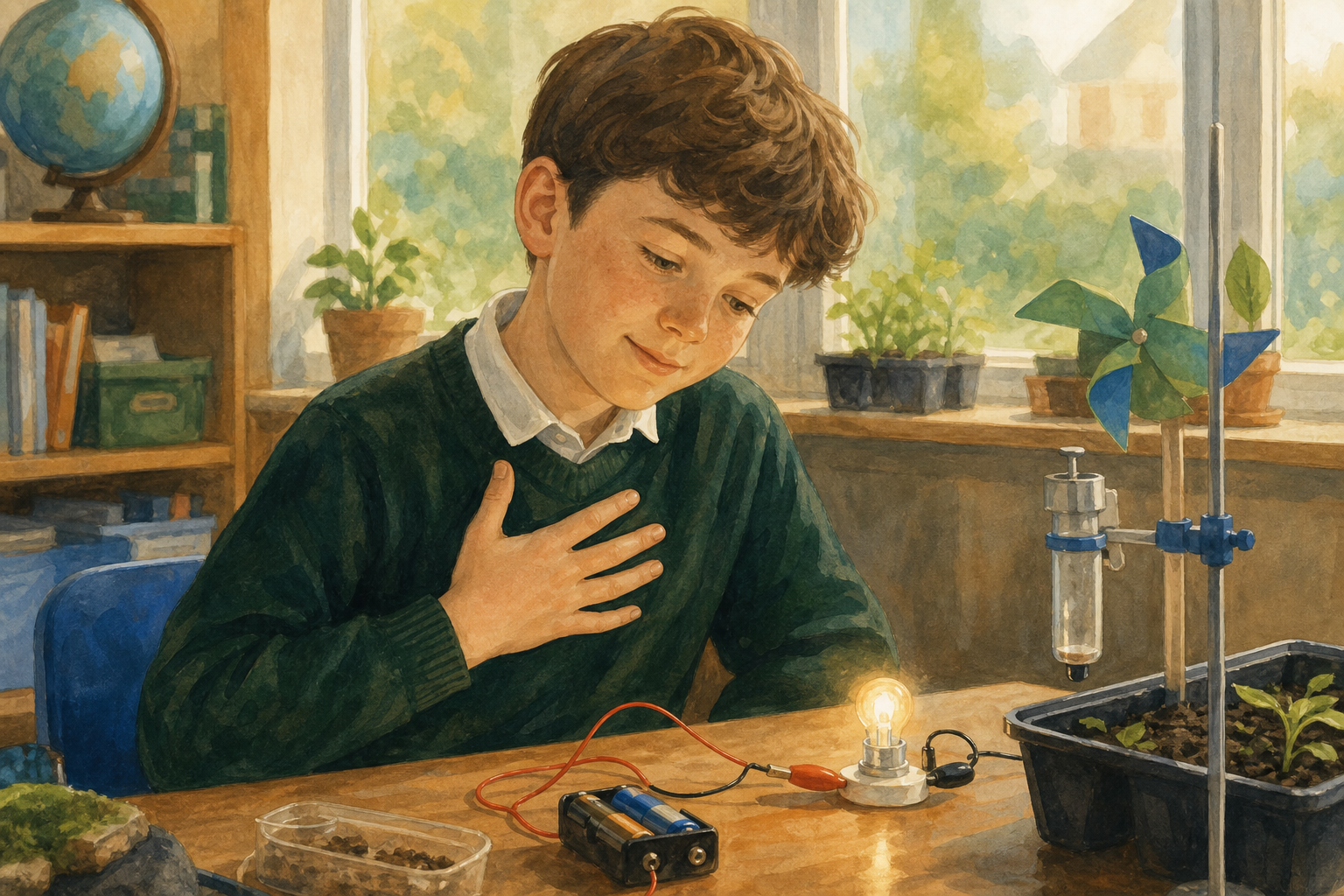
    Illustration for Getting StartedPut your hand on your chest and stay very still. Can you feel a tiny thump? That is your heart, beating away all day and all night, even while you sleep.
    Our big question

    Now here is our wondering for today: when you run around the yard, you can feel your heart pounding and you puff and pant. Does exercise really change how fast our heart beats and how fast we breathe? Hands up your guess. Today we are going to find a way to actually test it.

    2 - Our Question and Our Prediction ~6 mins

    Let's turn our wondering into a question we can test: Does one minute of exercise change our pulse and our breathing rate?

    Note

    Before we test anything, every scientist makes a prediction. A prediction is your best guess about what will happen, and saying why. Predictions are never "wrong", they are the start of the science.

    Talk to your partner: what do you think will happen to your pulse after the exercise? What about your breathing? Why do you think that?

    3 - How the Heart and Lungs Work as a Team ~8 mins

    Illustration for How the Heart and Lungs Work as a TeamYour heart and lungs are a team. Their job is to deliver oxygen to every part of your body. Here is how we will measure them and why it matters.
    ConceptWhy it mattersExample
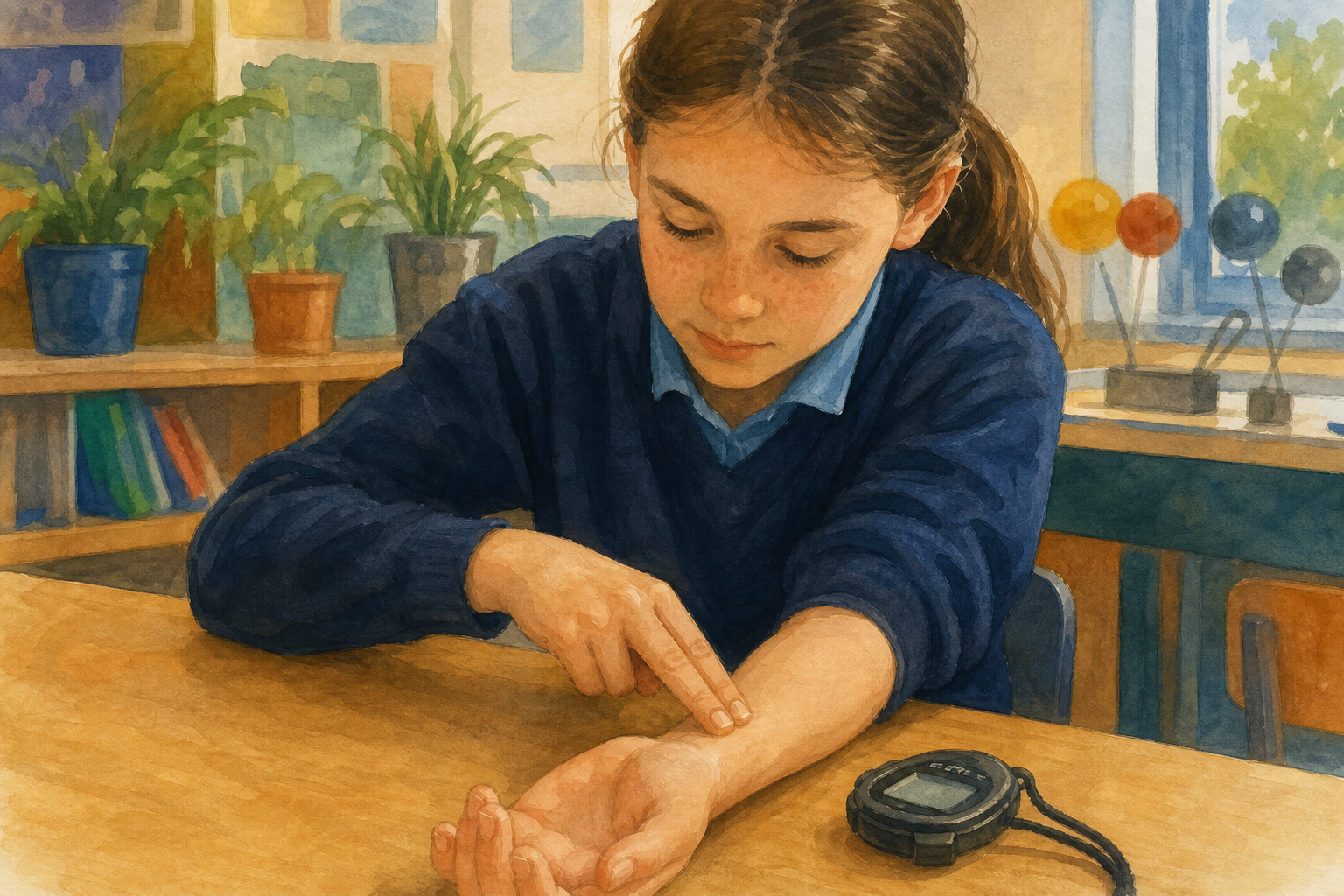
    Pulse — the beat you feel in your wrist or neck each time your heart pushes blood around your bodyCounting your pulse tells you how hard your heart is working right nowPress two fingers on the inside of your wrist and feel a steady tap-tap
    Breathing rate — how many breaths you take in one minute as your lungs pull in fresh airYour lungs put oxygen into your blood, so when your body needs more oxygen you breathe fasterSitting still you breathe slowly; after running you puff and pant
    Beats per minute — count the beats for 15 seconds, then multiply by 4 to get the whole-minute numberCounting a full minute is hard while you are puffing, so we count 15 seconds and multiply by 4 to keep it fair20 beats in 15 seconds means 20 × 4 = 80 beats per minute
    Oxygen-delivery team — the lungs take in oxygen and the heart pumps it around the bodyWhen you move, your muscles need more oxygen, so both the heart and lungs speed up togetherSprinting, your heart pounds AND you breathe hard at the same time

    4 - Watch How to Measure: a Worked Example ~7 mins

    Illustration for Watch How to Measure: A Worked ExampleWatch carefully as we measure one person before we all do it. We will do every step of the test once, out loud.

    First, the resting count. We sit still and find our pulse. When the 15-second timer runs out, we stop counting and multiply by 4. Then we count breaths the same way.

    Worked example

    Here is one full worked count:

    • Resting pulse: counted 18 beats in 15 seconds → 18 × 4 = 72 beats per minute.
    • Resting breaths: counted 5 breaths in 15 seconds → 5 × 4 = 20 breaths per minute.

    We write 72 and 20 on our record page. After the exercise we will do exactly the same: count for 15 seconds, multiply by 4, and write the new numbers down straight away.

    5 - Measure, Move, Measure Again ~18 mins

    Now it's your turn in pairs. One of you is the counter and timer-watcher, the other is being measured, then swap.

    Step 1 (resting): Sit still. When the 15-second timer runs, count your pulse once, then multiply by 4. Do the same for your breaths. Write both in the resting boxes on your record page.

    Step 2 (exercise): Do one minute of your chosen exercise (step-ups or jumping jacks) while the one-minute timer runs.

    Key point

    Step 3 (after): Straight away, count your pulse and breaths once each the same way, multiply by 4, and write them in the after boxes.

    6 - Pool the Class Results ~7 mins

    Let's gather everyone's numbers together so we can see the whole class's pattern. Each pair calls out their numbers and we type them into our class table on the board.

    We will look at how the resting numbers compare to the after-exercise numbers across the whole class.

    Our class pulse and breathing results

    7 - What Did We Find Out? ~5 mins

    Let's make sense of our results together. Look back at your prediction and at the class table.

    Talk about it

    Talk about it: did your pulse go up, go down, or stay the same after the exercise? What about your breathing? Why do you think the heart and the lungs both speed up at the same time when we move?

    8 - What You Covered ~2 mins

    • We turned a wondering into a testable question: does exercise change our pulse and breathing?
    • We made a prediction before we tested.
    • We measured pulse and breathing in beats and breaths per minute, by counting once for 15 seconds and multiplying by 4.
    • We found that exercise made our pulse and our breathing speed up.
    • The heart and lungs work together as an oxygen-delivery team that speeds up when our muscles need more oxygen.
    Pupil practice · Investigation Journal
    Module 1 · Living Things: the Human Body, Nutrition and Classifying
    Lesson 2 · The Heart and Lungs: How the Body Responds to Exercise
    Download Investigation Journal sheet (PDF)
    End of lesson
    123learn · Online learning platform

    Unlock the full learning experience

    You're previewing this lesson. Get full access to this lesson and hundreds more — each one ready to teach, with interactive activities, printable resources and pupil progress tracking built in.

    Hundreds of curriculum-aligned lessons
    Interactive activities in every lesson
    Printable resources & progress tracking
    Copyright Notice
    This lesson is copyright of 123Learn.ie 2017 - 2025. Unauthorised use, copying or distribution is not allowed.
    🍪 Our website uses cookies to make your browsing experience better. By using our website you agree to our use of cookies. Learn more