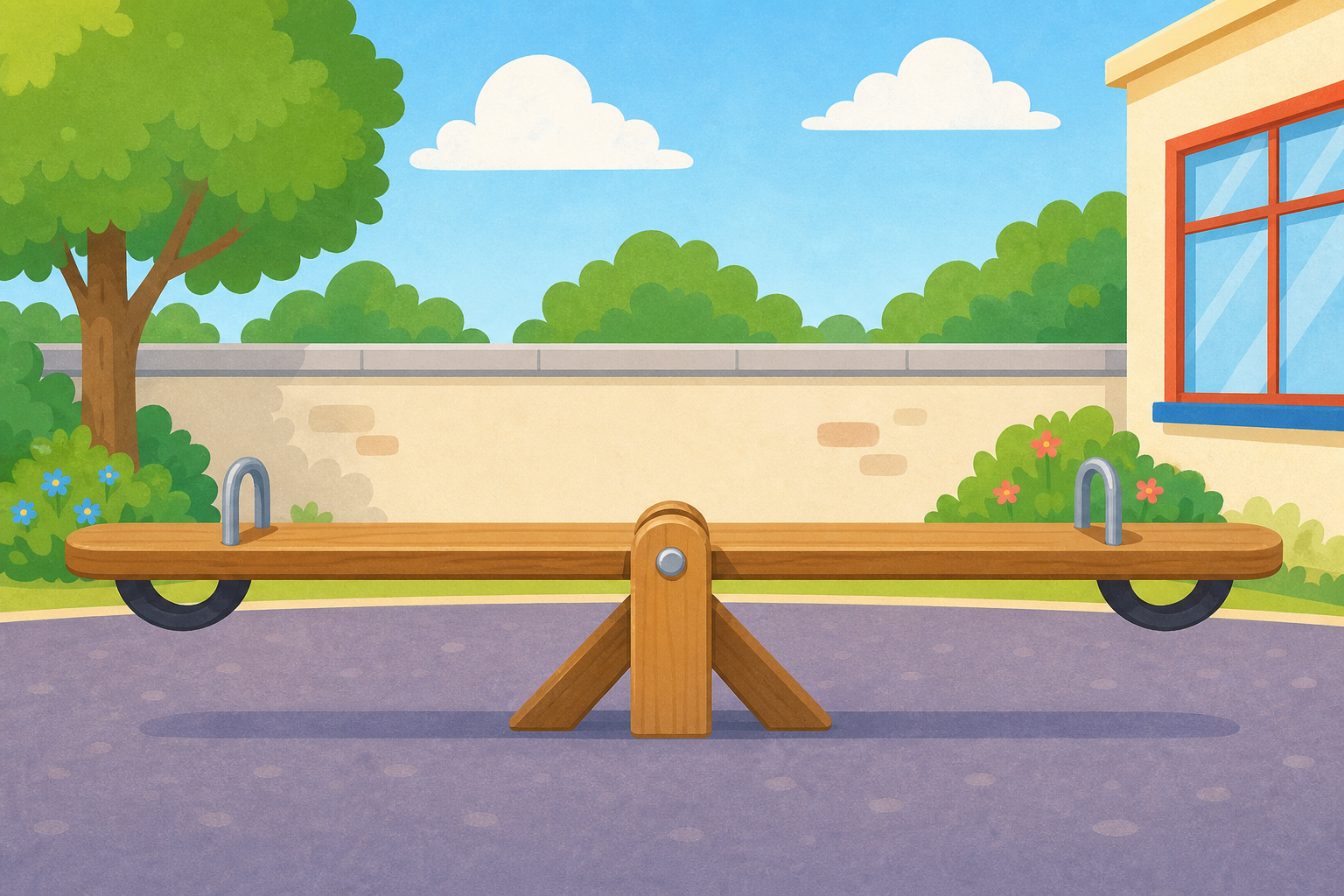
 Look at the seesaw in the playground. When does it sit perfectly level? What has to be true about the two sides?
Look at the two seesaws. Count the counters on each end. When both ends hold the same amount, the seesaw sits level.

We read = as is the same as. When the seesaw sits level, both sides hold the same amount, so we may write =. When it tips, the sides are not the same, so we do not write =.
Now look at this last one carefully. Can we write equals?

Now make it at your table. Fold a page in half. Put counters for one side on each half. Give every counter a partner. Is it level, or does it tip?

We will make 3 + 2 and 5, then 5 + 1 and 6, then 4 + 4 and 7, then 2 + 2 and 5.
Is it level?
In your maths copy, write only the ones that are level, with =. Do not write the one that tips.
- 3 + 2 and 5
- 4 + 4 and 7
- 5 + 1 and 6
Then make up one of your own that is level, with 6 on one side.
Unlock the full learning experience
You're previewing this lesson. Get full access to this lesson and hundreds more — each one ready to teach, with interactive activities, printable resources and pupil progress tracking built in.
This lesson is copyright of 123Learn.ie 2017 - 2026. Unauthorised use, copying or distribution is not allowed.