STE
Beginner
75 mins
Teacher/Student led
+105 XP

What you need:
IWB/Projector/Large Screen

The Brain, Senses and Reflexes

Investigate how your brain and senses work together to help you react quickly to things happening around you. Test your reaction time by catching a falling ruler, then compare results across the class.
Teacher Class Feed

Load previous activity

    1 - Getting Started ~5 mins

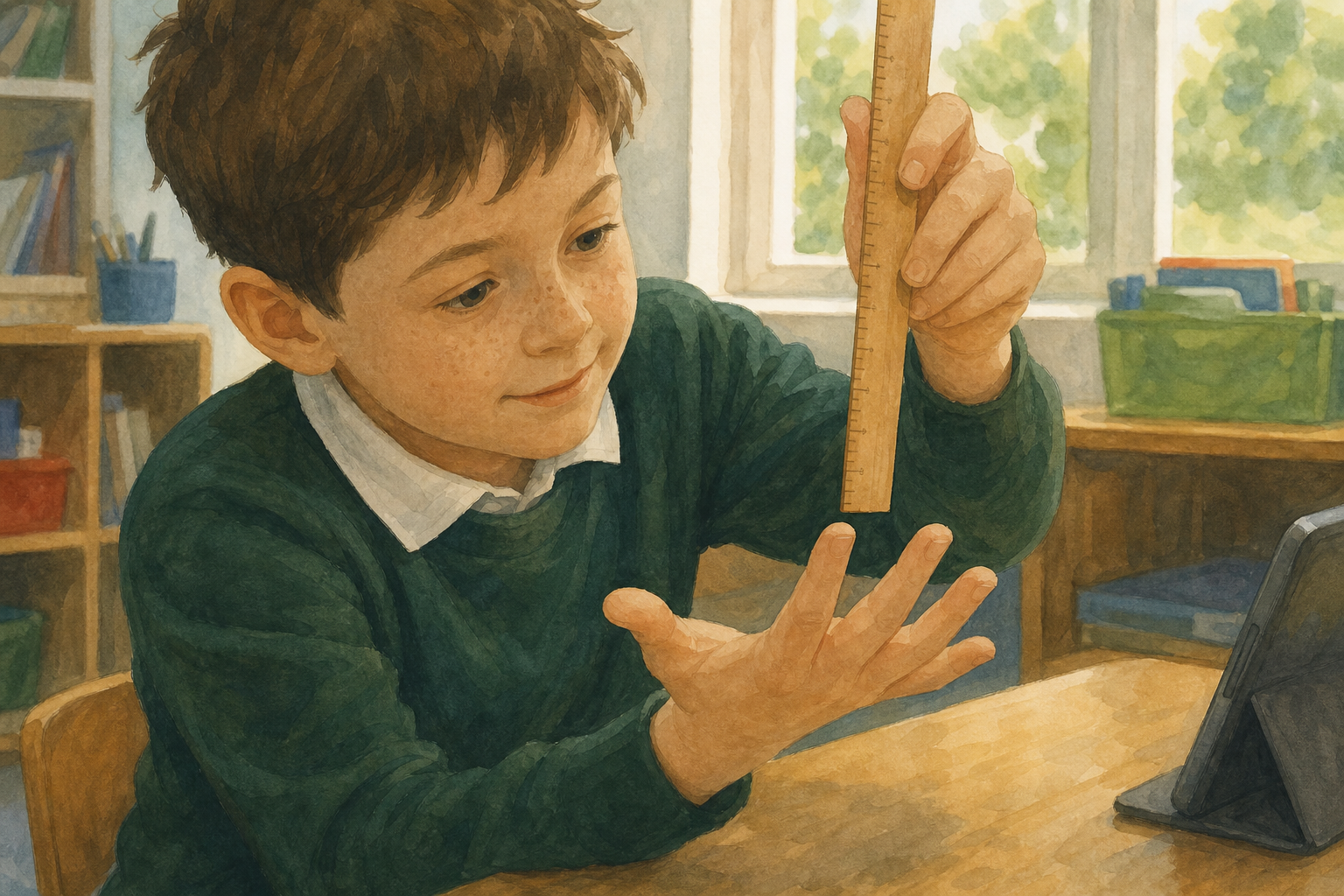
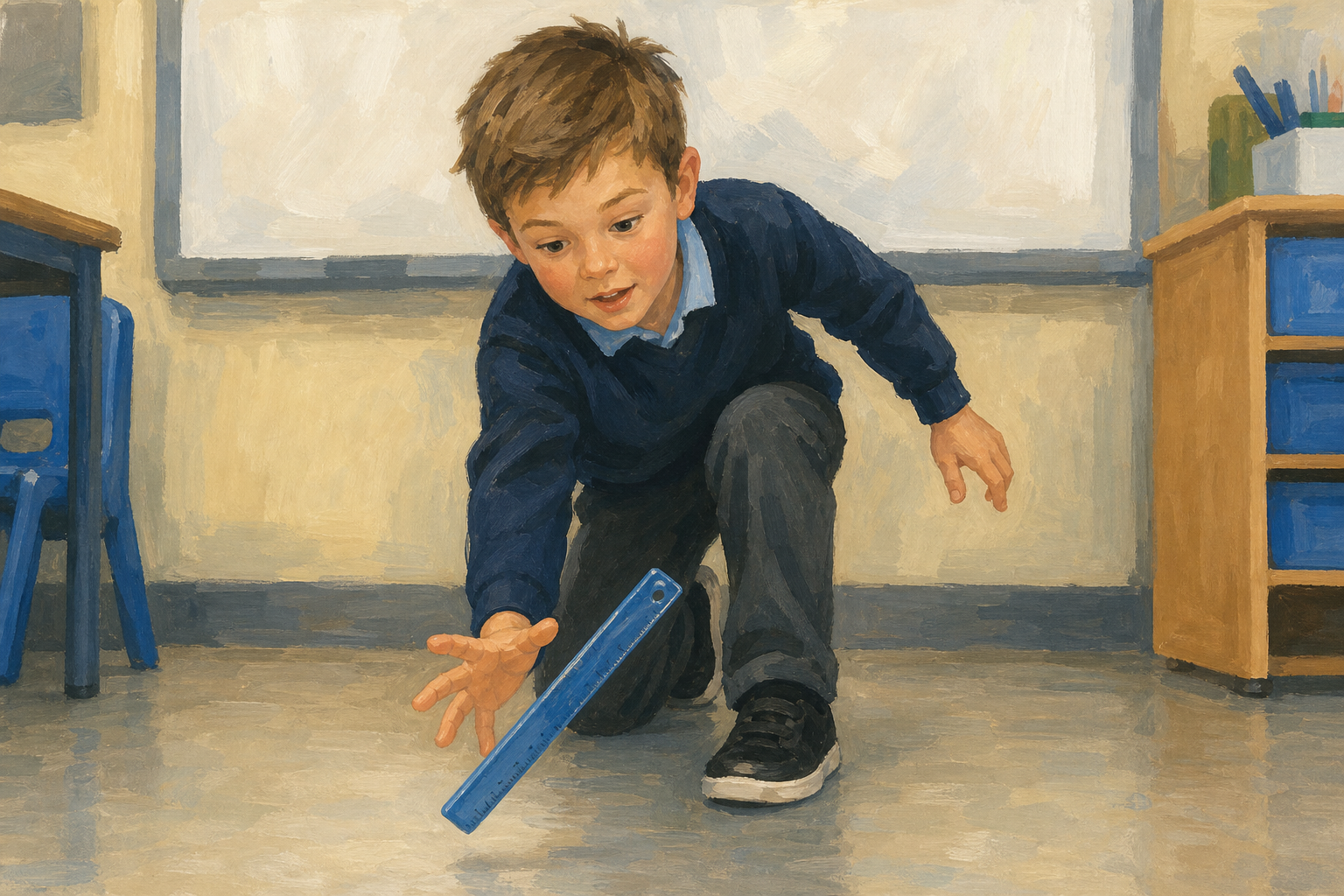
    Illustration for Getting StartedHold out your hand, ready to catch. I am going to drop a ruler between your fingers with no warning. Do you think you can catch it before it hits the ground?
    How quickly can your body react to something it sees? Hands up your guess: do you think you will catch the ruler near the top, near the middle, or not at all?

    2 - How the Brain Reacts ~8 mins

    Illustration for How the Brain ReactsWhen the ruler falls, your eyes see it move. They send a message racing along your nerves to your brain. Your brain decides "close your fingers!" and sends a message back to your hand. All of that happens in less than a second. That tiny gap is your reaction time.

    Key point

    Some reactions are so fast your body acts before your brain has even thought about it, like pulling your hand back from a hot pan. These are called reflexes, and they happen automatically to protect you.

    ConceptWhy it mattersExample
    Stimulus — something your senses pick upYour brain reacts only once your senses notice itThe falling ruler your eyes spot
    Reaction time — the gap between spotting it and reactingA faster reaction lets you catch or stop soonerCatch the ruler lower down for a quicker time
    Reflex — a reaction so fast you do not think about itReflexes protect you before you can decideBlinking when something flies near your eye

    3 - Model One Full Catch ~7 mins

    Let's watch one full test together before your group runs your own. I will think out loud at every step so you can do the same.

    Worked example

    I wonder how far the ruler will fall before I can catch it. I predict it will fall about the middle before my fingers snap shut. Now I rest my hand at the bottom of the ruler, a partner lets go with no warning, and I catch it. I observed that I caught it near the 15 cm mark. So I think my reaction was quick, but a lower catch would have been even quicker.

    4 - Run the Fair Test ~18 mins

    The whole class will test the same one thing: catching with your eyes ready against catching while a partner is distracting you by talking. Predict which one will give a faster catch and say why.

    Key point

    In your group, each person has three turns catching with eyes ready, then three turns while being distracted. Read the centimetre mark where the top finger grips and write each one on your Investigation Journal page. Keep everything else the same: the same ruler, the same dropper, the same starting position. For each condition, find the middle value of your three catches the way we modelled, ready to share one figure per condition.

    5 - Pool the Class Results ~8 mins

    Let's gather everyone's results so we can compare across the whole class. Because every group tested the same two conditions, we can add them together. We will type the class middle value for eyes ready and the class middle value for distracted into the table on the board, then turn it into a bar chart.

    Tip

    The shorter the bar, the faster the reaction. Look at the two bars together: which condition gave the lower catch distances across the class?

    How far did the ruler fall before we caught it?

    6 - Touch Only: What Is It? ~7 mins

    Illustration for Touch Only: What Is It?Your brain also reacts to touch. Without looking, reach into the feely-bag and feel the object with your fingers only. What do you think it is? Say what it feels like first: hard or soft, smooth or rough, round or pointy. Then say your guess before you pull it out to check.

    How does your brain work out what something is using only touch?

    7 - Make Sense Together ~4 mins

    Let's talk about what the class results showed. Look back at the chart. Which condition gave the faster catches? Did being distracted slow people down?

    Why does a quick reaction time matter for safety? Think about catching a glass before it falls, or stopping at a red light while cycling.

    8 - What You Covered ~3 mins

    Today you found out how your brain reacts to what your senses pick up:

    • Your senses pick up a stimulus, your brain decides, and your body reacts, all in less than a second.
    • Catching the ruler lower down means a faster reaction time.
    • Being distracted usually slows your reaction down.
    • A reflex is a reaction so fast your body acts before you even think about it.
    • Your brain can work out what an object is using touch alone.
    Pupil practice · Investigation Journal
    Module 1 · Living Things: One Organ, Classifying and Ecosystems
    Lesson 3 · The Brain, Senses and Reflexes
    Download Investigation Journal sheet (PDF)
    End of lesson
    123learn · Online learning platform

    Unlock the full learning experience

    You're previewing this lesson. Get full access to this lesson and hundreds more — each one ready to teach, with interactive activities, printable resources and pupil progress tracking built in.

    Hundreds of curriculum-aligned lessons
    Interactive activities in every lesson
    Printable resources & progress tracking
    Copyright Notice
    This lesson is copyright of 123Learn.ie 2017 - 2025. Unauthorised use, copying or distribution is not allowed.
    🍪 Our website uses cookies to make your browsing experience better. By using our website you agree to our use of cookies. Learn more