Mathematics
Intermediate
50 mins
Teacher/Student led
+80 XP

What you need:
IWB/Projector/Large Screen

The 24-hour Clock, an Introduction

Learn how the 24-hour clock works by converting between everyday times and the 24-hour format used on phones, buses and timetables. Discover the add-12 rule for afternoon and evening hours, and how to take 12 off to go back.
Teacher Class Feed

Load previous activity

    1 - Getting Started ~4 mins

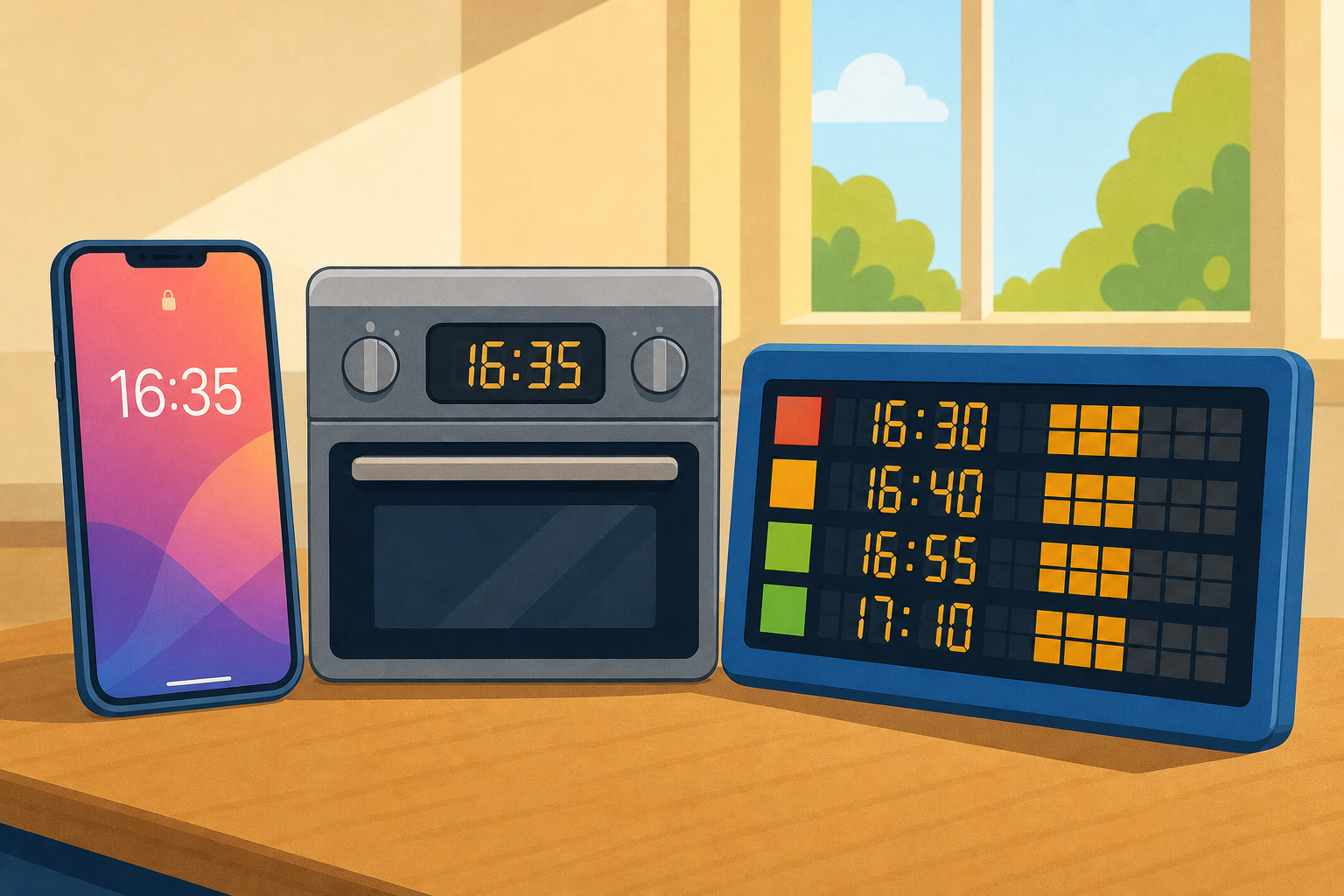
    A phone, an oven and a bus screen all show times in a way that might look a little strange. One of them reads 17:30. What time of day do you think that is? Is it morning, afternoon or evening?

    Talk it out

    Talk it out: how could you check whether 17:30 is breakfast time or teatime?

    2 - Watch and Notice ~10 mins

    9 o'clock in the morning

    Watch the clock show 9 o'clock in the morning. On the 24-hour clock this is 09:00. Morning hours stay exactly the same.

    3 o'clock in the afternoon

    Now watch the same clock show 3 o'clock in the afternoon. Here we add 12: 3 + 12 = 15, so this is 15:00. After midday the hours keep counting on instead of starting again at 1.

    Half past two in the afternoon

    Watch the clock show half past two in the afternoon. We add 12 to the hour: 2 + 12 = 14, and the minutes stay as :30, so this is 14:30. The minutes never change, only the hour.

    3 - Try It Together ~9 mins

    Today we find the matching 24-hour time for everyday times together. The 24-hour partner just means the matching 24-hour time, not a person you team up with.

    We will work through these three times together. For each one, we set the hands and then decide what it looks like on the 24-hour clock:

    • ten in the morning
    • half past four in the afternoon
    • six in the evening

    Set the time, then find its matching 24-hour time

    4 - Write the Pairs in Your Copy ~3 mins

    COPYBOOK MOMENT

    In your maths copy, rule a two-column table. On the left write the 12-hour time; on the right write its 24-hour partner. Fill in these four:

    • 8 a.m.
    • 1 p.m.
    • 6 p.m.
    • 11 p.m.

    Remember: morning times stay the same, and afternoon or evening times add 12.

    5 - Class Challenge ~8 mins

    Today we work through these 24-hour times together: 07:00, 13:00, 18:30 and 21:00. For each one, decide whether it is a morning time that stays the same or an afternoon time where 12 was added, then set the clock to match.

    Worked example

    To go from a 24-hour time back to a p.m. time, we take 12 off the hour. For example, 18:30 is in the evening, so 1812 = 6, which is half past six in the evening (6:30 p.m.). The minutes stay as :30.

    Show each 24-hour time

    6 - What Did We Notice? ~3 mins

    MATHS TALK

    Why do timetables and phones often use the 24-hour clock instead of a.m. and p.m.? What mix-up does it stop from happening?

    7 - What's Next ~2 mins

    What we learned today

    • Morning hours stay the same on the 24-hour clock (9 a.m. is 09:00).
    • Afternoon and evening times add 12 (3 p.m. is 15:00).
    • To go back, take 12 off the hour (19:00 is 7 p.m.).
    • 12:00 is noon and 00:00 is midnight, where the count rolls over.

    Coming up

    Next we look at the units of time and how seconds, minutes, hours, days and weeks pack neatly into one another.

    Pupil practice
    Module 6 · Time and Money Shape & Space
    Lesson 62 · The 24-hour Clock, an Introduction
    Download Activity Book page (PDF)
    End of lesson
    123learn · Online learning platform

    Unlock the full learning experience

    You're previewing this lesson. Get full access to this lesson and hundreds more — each one ready to teach, with interactive activities, printable resources and pupil progress tracking built in.

    Hundreds of curriculum-aligned lessons
    Interactive activities in every lesson
    Printable resources & progress tracking
    Copyright Notice
    This lesson is copyright of 123Learn.ie 2017 - 2025. Unauthorised use, copying or distribution is not allowed.
    🍪 Our website uses cookies to make your browsing experience better. By using our website you agree to our use of cookies. Learn more