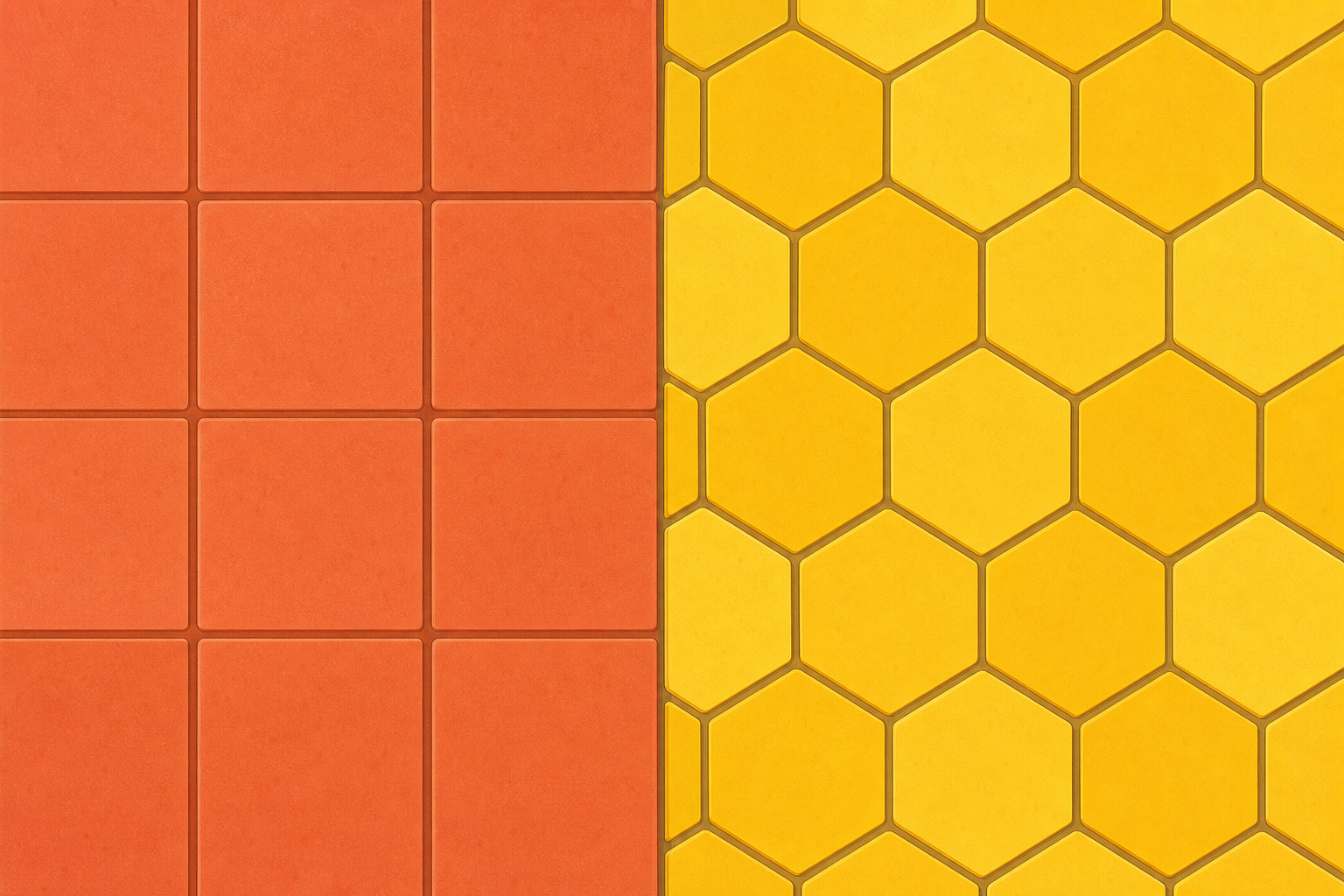
Look at this tiled floor and this honeycomb. What do you notice about the way the shapes fit together?
Is there any empty space left between them, or do they fit snugly with nothing to spare?
Look at these three surfaces. First, squares. Then hexagons, like the honeycomb. Then circles.
As you look at each one, ask yourself: are there any gaps, and do any shapes overlap? That is the test for tessellation.
Today we tile a floor together on the board using squares, laying them one at a time so each meets the next edge to edge with no gaps. First, predict: will squares fill the space with no gaps left over?
Watch as copies of the square are laid to fill the space, each one meeting the next edge to edge. Look for gaps and overlaps, and call out what you see.
Squares have straight edges, so they close up the space. Later, in your copy, you will draw a shape with three or six straight edges and see the same thing happen.
In your maths copy, choose one shape that tessellates — a triangle, a square or a hexagon — and draw at least six copies of it fitting together with no gaps, like floor tiles.
Make each copy the same size and let the edges touch, so there is no empty space between them.
You're previewing this lesson. Get full access to this lesson and hundreds more — each one ready to teach, with interactive activities, printable resources and pupil progress tracking built in.