Mathematics
Advanced
50 mins
Teacher/Student led
+120 XP
Teacher-led from the board. Pupils do not need a device, but can follow on one.
What you need:
IWB/Projector/Large Screen
Pattern blocks

Tessellate a Quilt Block

Explore which shapes fit together with no gaps or overlaps. Build tessellating quilt blocks using squares, learn why the corner angles must add to 360°, then verify with paper shapes and discover why some shapes work and others leave holes.
Teacher Class Feed

Load previous activity
    Your turn
    Your teacher is running this lesson on the board. Here is the part you can try yourself.
    Pattern blocks

    1 - Getting Started ~4 mins

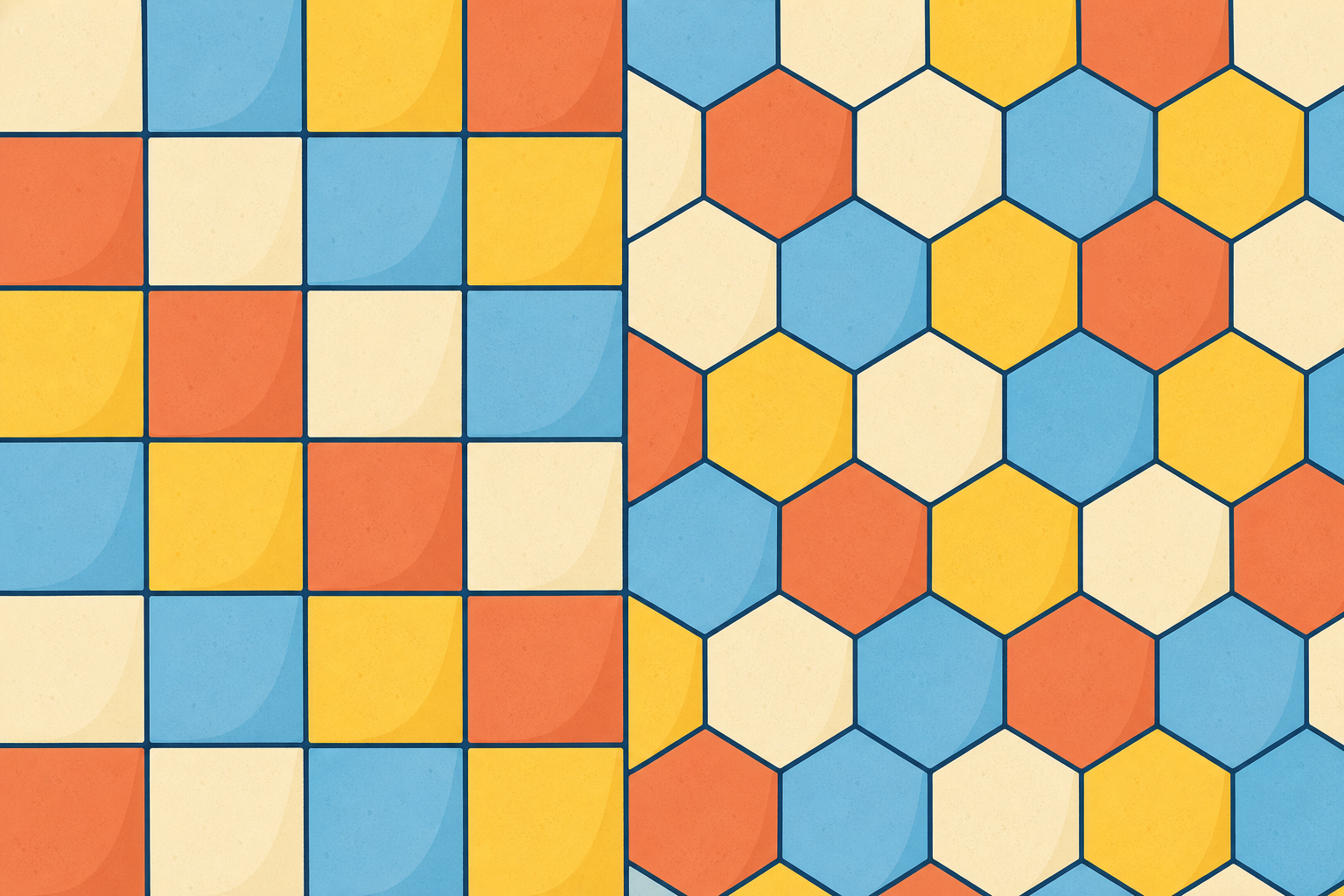
    Illustration for Getting StartedLook at these two pictures: a tiled bathroom floor and a honeycomb. What is the same about them? In each one, the shapes fit together with no gaps and no overlaps. Which shapes do you think can do that, and which ones leave a hole?
    2 - Watch and Notice ~9 mins

    Look at the corner where shapes meet — that is where a shape either closes up neatly or leaves a hole. The interactive and the labelled picture show several shapes meeting at a point. Watch how many corners meet each time, and whether their angles make a full turn or fall short.

    3 - Try It Together ~7 mins

    Now we fill an area together on the board with squares. As each square goes down, tell me whether the corner where it meets the others still adds up to a full turn. Each square corner is 90°, and four of them meeting make 360°, so the block fills with no gaps.

    Key point

    Remember the mixed corner we saw in the labelled picture, where squares and triangles shared one point and still made 360°. That is the same rule we are using here, just with one shape. Whatever meets at a corner, the angles have to add to a full turn or a gap appears. So as we drop each square, we are really checking the same thing every time: do the corners still make 360°?

    Fill the strip together

    4 - Turning a Design: Symmetry and Transformations ~5 mins

    Illustration for Turning a Design: Symmetry and TransformationsBefore you design your own block, two ideas to name. First, the three ways we move a shape around a design: a translation slides it across without turning it, a reflection flips it like a mirror, and a rotation turns it around a point.

    Key point

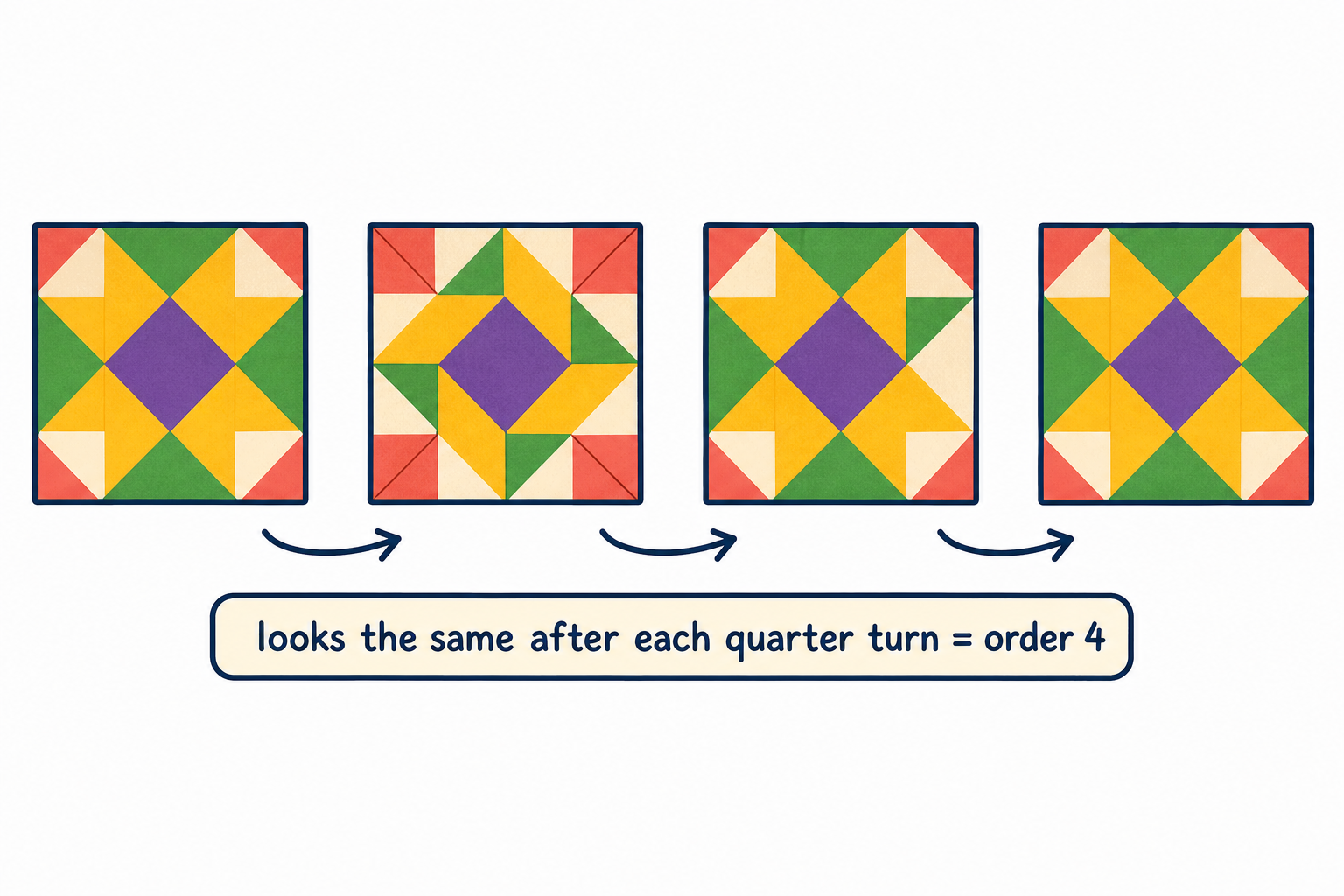
    Second, rotational-symmetry order. That is the number of times a design looks exactly the same as you turn it once all the way round. Look at the four pictures of the block on the board. Each picture shows the same block turned a quarter of a full turn further round than the one before it. If the block looks exactly the same in all four pictures, it has rotational symmetry of order 4, because it matches itself four times in one full turn. A design that only looks the same once you turn it the whole way round has order 1.

    Pupil practice
    Module 6 · 2D and 3D Shape, Angles, Symmetry Shape & Space
    Lesson 91 · Tessellate a Quilt Block
    Download Activity Book page (PDF)
    123learn · Online learning platform

    Unlock the full learning experience

    You're previewing this lesson. Get full access to this lesson and hundreds more — each one ready to teach, with interactive activities, printable resources and pupil progress tracking built in.

    Hundreds of curriculum-aligned lessons
    Interactive activities in every lesson
    Printable resources & progress tracking
    Copyright Notice
    This lesson is copyright of 123Learn.ie 2017 - 2026. Unauthorised use, copying or distribution is not allowed.
    🍪 Our website uses cookies to make your browsing experience better. By using our website you agree to our use of cookies. Learn more