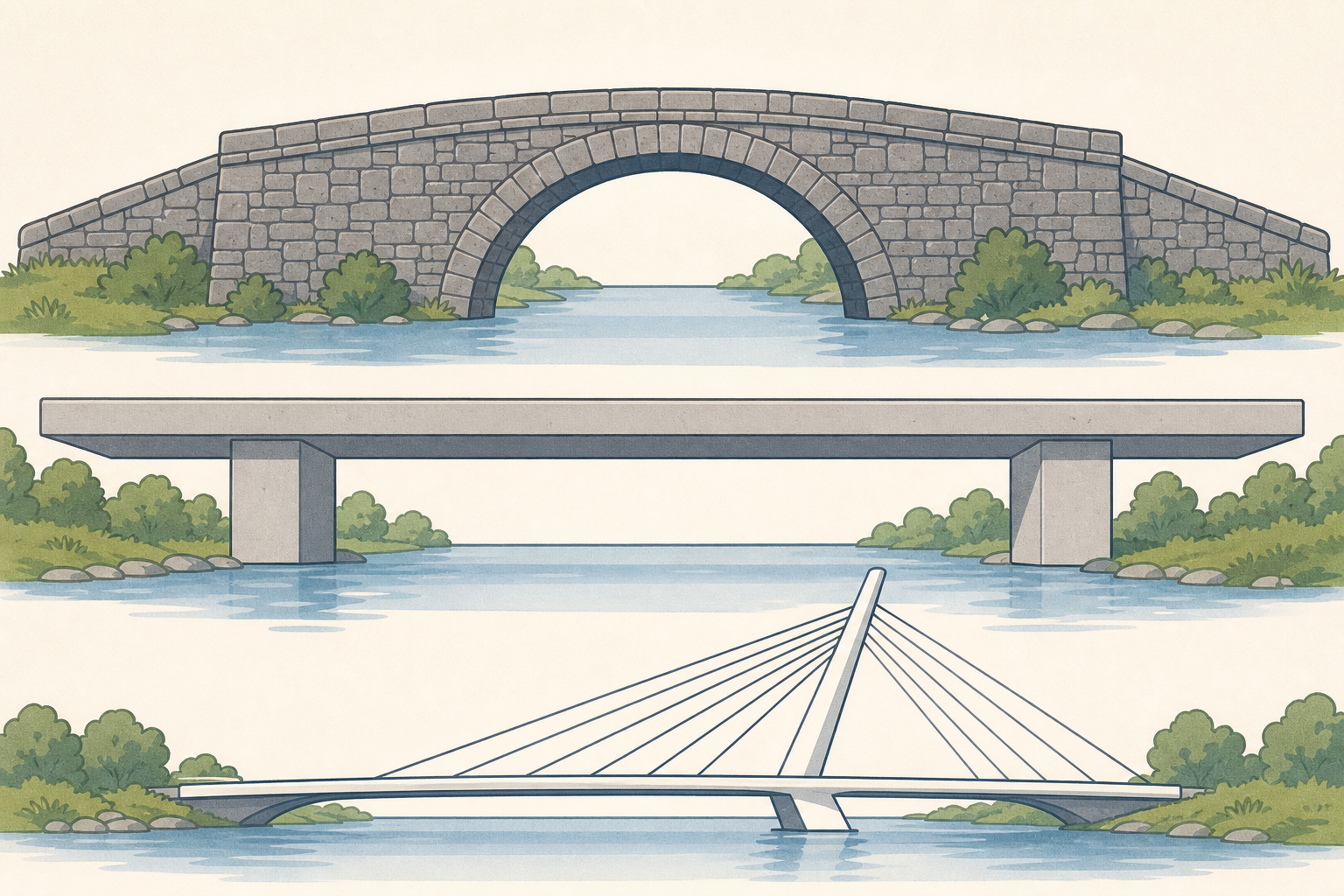
 Think of a stone arch like many older Irish road bridges, versus a flat beam bridge or a modern cable-stayed bridge such as the Samuel Beckett Bridge in Dublin. Why do engineers bother with different shapes?
Today we will build four paper bridges across the same gap and find out which shape holds the most load before it fails.
 Our question: Which bridge shape holds the most load before it fails?
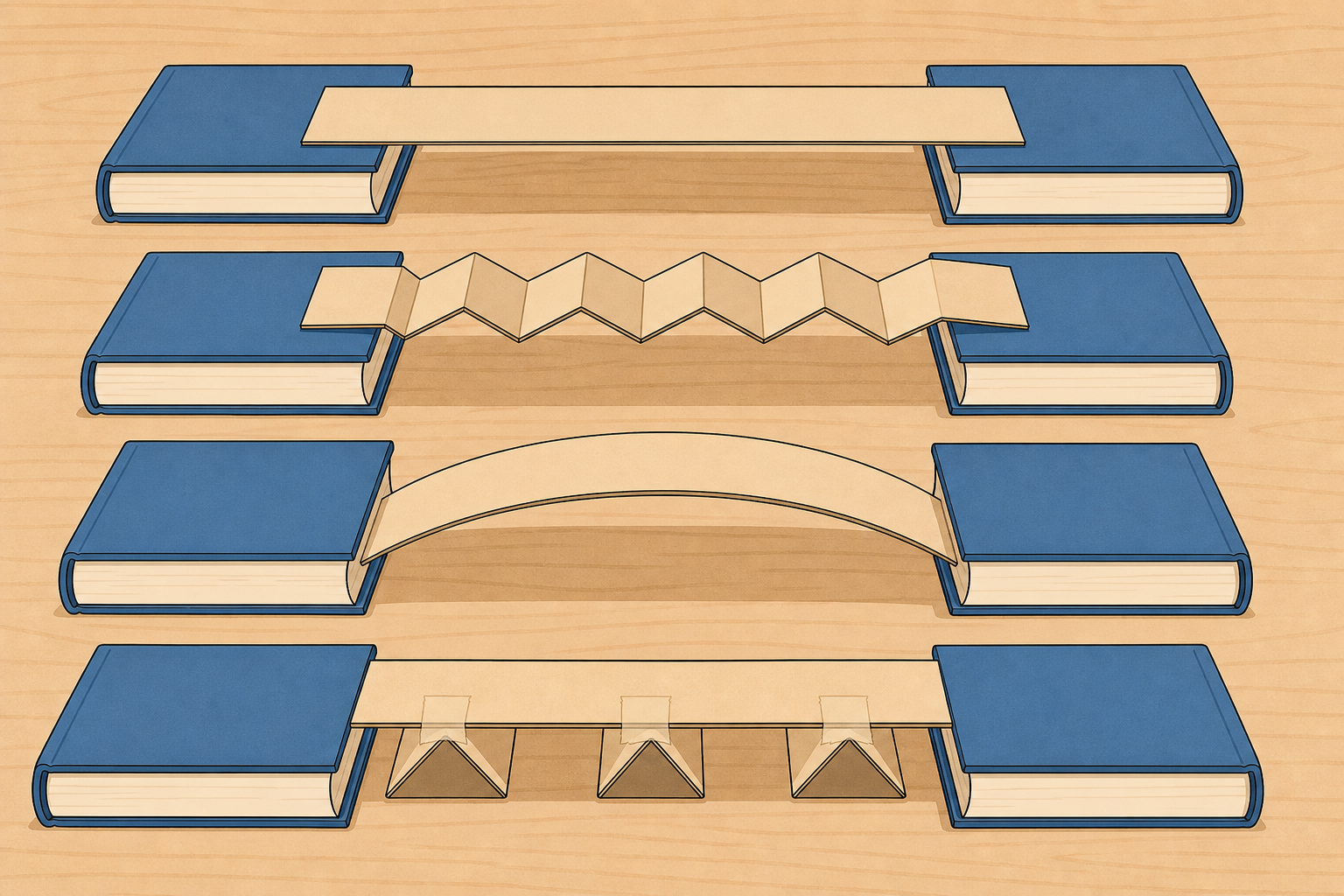
These are the four forms you will build:
- Flat — a plain strip laid straight across, like a simple plank.
- Folded — a strip with zigzag ridges along it (like corrugated roofing) that still reaches both ends.
- Arched — a strip bent into a smooth curve, like a rainbow over the gap.
- Trussed — a top path with triangles taped under or beside it to share the weight.
We build all four from one group card budget (a fixed pile of equal strips you share). We keep the same span (the gap between the book stacks) and the same way of adding weight. Flat, folded and arched each use about one strip; the truss may use the leftover strips as braces. So we are testing shape and how the card is arranged, not four bridges with identical amounts of card.
Predict with your group: which shape will hold the most? Say why you think so.
In your group, build four bridges from your equal card strips across the same gap. All four bridges, plus any braces or end wedges, must come from your group's strip budget only.
Strip plan (keep this in mind so the truss is not left short): about 1 strip each for flat, folded and arched; keep about 5 strips for the truss deck, triangle braces and any tiny arch wedges.
Before you cut or fold, write one design choice on your Investigation Journal page: how will you form the folded ridges, and how will you make the truss triangles from your leftover strips?
- Flat: one strip laid straight across the supports.
- Folded: fold one strip into even zigzag ridges along its length (like corrugated roofing), so the strip still reaches both supports at full span. Do not accordion-fold it into a short fan that no longer crosses the gap. Set the ridged strip across the supports.
- Arched: one strip bent into a smooth curve. Rest the ends on the supports. If the ends slip, tuck a small thin wedge of scrap card under each end so the arch stays put (not thick blocks or extra layers).
- Trussed: one strip as the top path, with triangle braces cut from the remaining strips and taped underneath or along the sides. Triangles should touch the top strip and the ends near the supports.
Check with the ruler that your supports stay 20 cm apart as you build, because every shape has to cross the same gap if the test is to be fair, and rest each bridge on its ends only, with nothing holding up the middle. Label all four as you finish them so you can tell one shape from another later, and leave the coins and washers where they are until every shape is built — the loading comes in the next step, when all four are ready for the same test.
 This is the exciting bit — listen for the creak and watch which shape gives way first.
Test one shape at a time. Place coins or washers gently in the centre of the bridge, one at a time. Count how many it holds just before it fails (sags to the table or collapses).
Keep the same: 20 cm span, same card budget, load always in the middle, same counting rule. Change the form you test.
As you finish each shape, write the load count on your Investigation Journal page straight away.
Aim for one clean trial of each shape. If you have time for a second trial of a shape, add the two counts and halve them, then record that number.
Your load counts should already be on your Investigation Journal page from the tests.
Now add one short note on the same page: which shape held most in your group, and whether that matched your prediction. Were you surprised, or did the winner match what engineers might expect? Keep what you measured separate from what you think it means.
Unlock the full learning experience
You're previewing this lesson. Get full access to this lesson and hundreds more — each one ready to teach, with interactive activities, printable resources and pupil progress tracking built in.
This lesson is copyright of 123Learn.ie 2017 - 2025. Unauthorised use, copying or distribution is not allowed.