 When you make a media project, the pictures and sounds have to come from somewhere. This lesson is about finding out whether you are allowed to use them.
- sort some examples into free to use or not free
- play Class Play, where everyone sorts the same examples on their own device
- collect pictures and sounds from websites that let you reuse them, and write down where each file came from
 Finding something online does not mean you may use it. You need a licence, which is written permission saying what you may do with a file. It also says whether you must give credit, which means naming the creator.
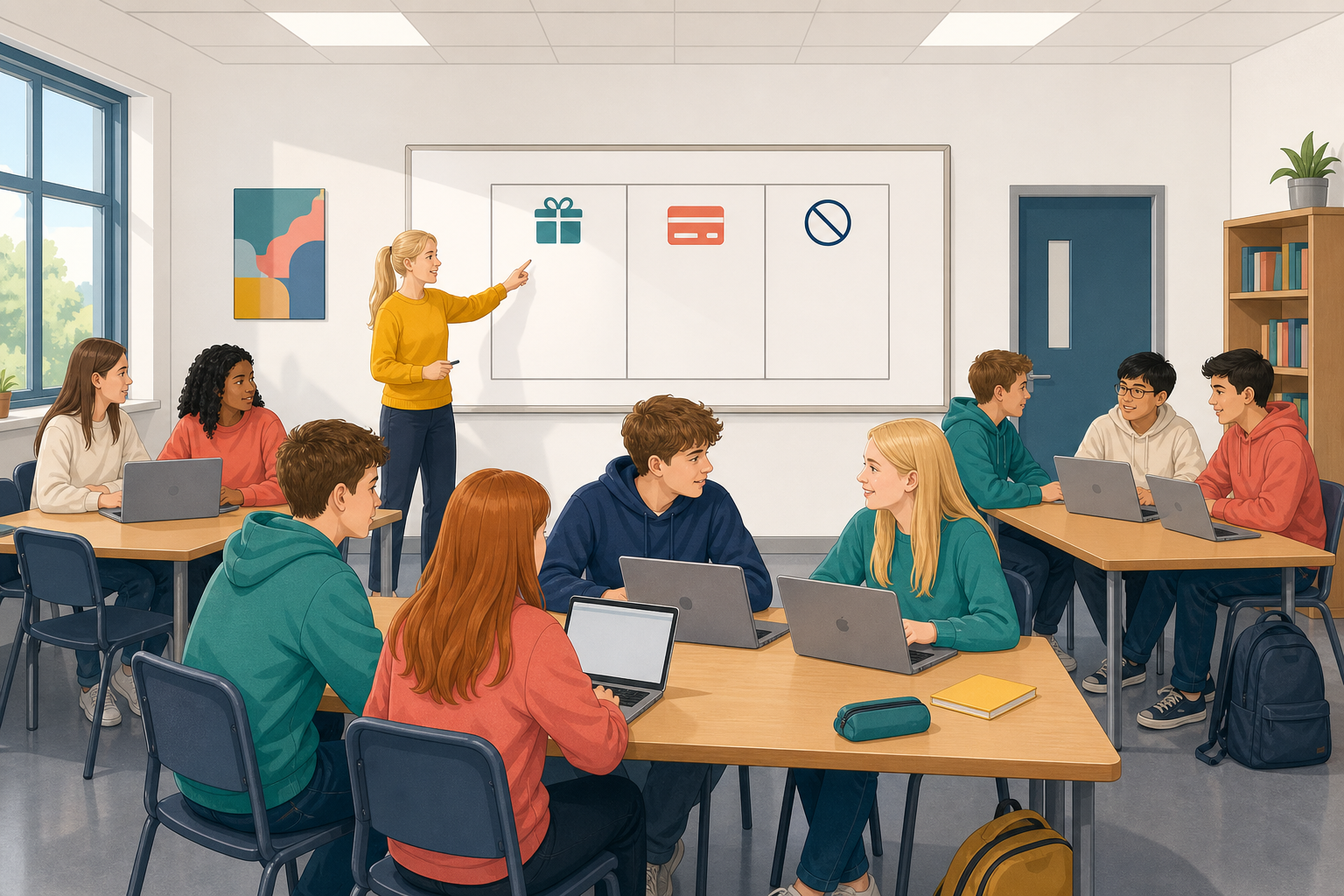
You will sort files into three groups: free without credit, free with credit and not free.
Pixabay has free pictures and sounds, and Freesound has free sound effects. Some files have a free Creative Commons licence. CC0 (C C zero) means it belongs to everyone, so it needs no credit. CC BY means it is free if you name the creator.
Each card describes where you might find a picture or a sound. We will do one card together: the photo on a free library page. Then you will sort all nine in Class Play.
CC BY means it is free if you name the creator. CC0 means public domain, so the file belongs to everyone and needs no credit. Attribution is another word for giving credit.
The three groups are:
- Free to reuse without credit: the licence says you do not need to name anyone.
- Free to reuse with credit: you must name the creator.
- Not free to reuse: there is no clear licence, someone else owns it, or it is a preview you have not paid for.
Free to reuse or not?
Your teacher will put a game code on the board: type it in on your device to join. Now everyone sorts all nine cards on their own device, starting with the card you just did together as a warm-up.
For each card, choose a group and say how sure you are: just checking, fairly sure or certain. This sets your stake, meaning how many points you risk. Certain risks the most and just checking risks the fewest. If you are right you win those points, and if you are wrong you lose them. You can change your answer until the time runs out. Your answers count towards your team's score, and the game puts you in a team at random.
Your teacher will ask why each card belongs where it does, because the reason matters more than the score.
Class Play
Unlock the full learning experience
You're previewing this lesson. Get full access to this lesson and hundreds more — each one ready to teach, with interactive activities, printable resources and pupil progress tracking built in.
This lesson is copyright of 123Learn.ie 2017 - 2026. Unauthorised use, copying or distribution is not allowed.