1 - Introduction ~5 mins
Welcome
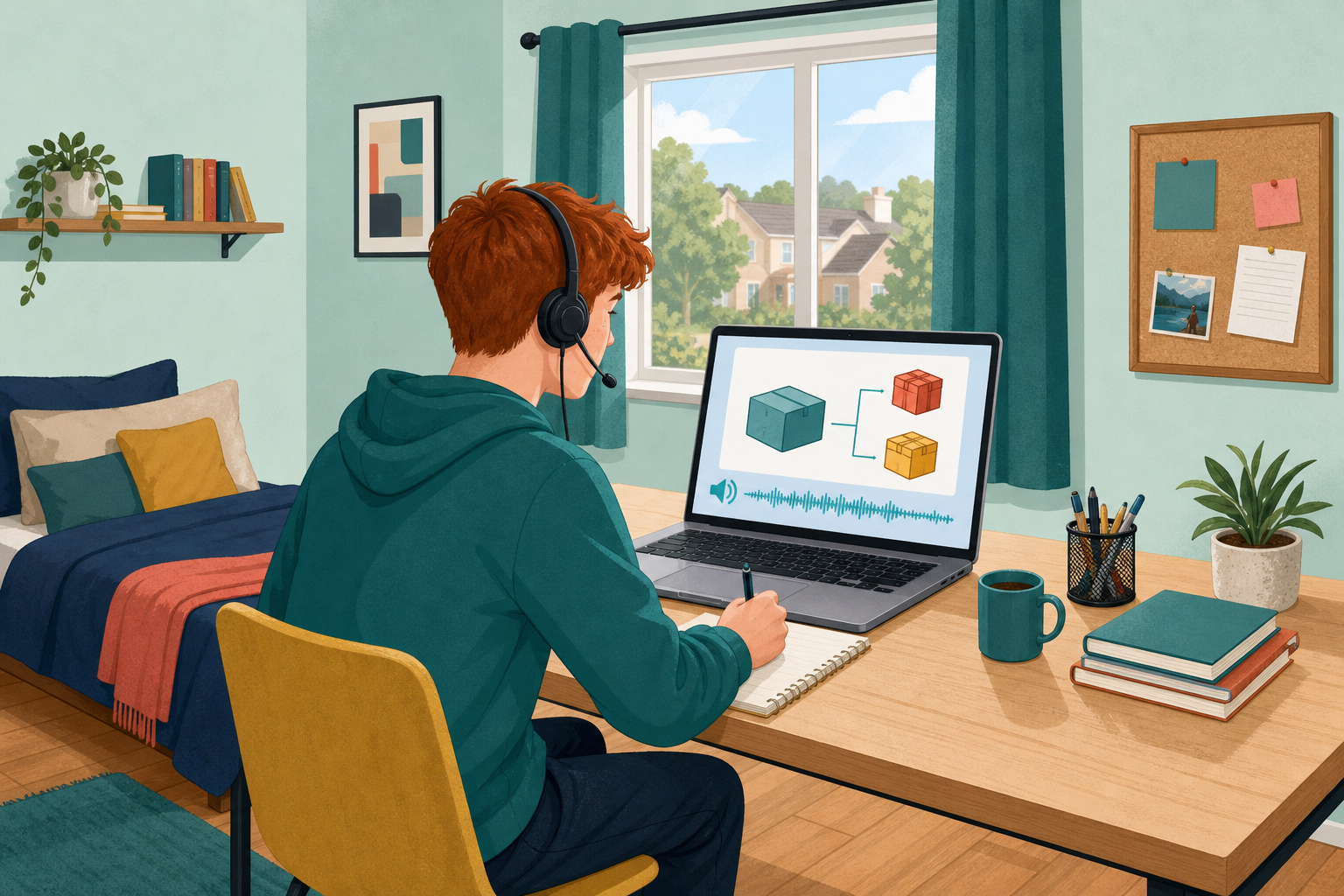 When you sit down to talk an examiner through your project, they need to hear you, not a loud track behind you. A short, clear voiceover — your own voice recorded and attached to a slide — can carry a chart or an opening slide when live words alone are not enough. Today you will write one short script, record it, put it into your presentation, and keep any music legal and quiet under your voice.
By the end of today you will be able to
- Decide when a spoken recording helps your presentation, your video or your podcast, and when it just gets in the way
- Balance the sound so your voice always sits clearly above any music
- Choose music you are actually allowed to use, and say where it came from
Warm-up
Think of one video or pitch where the sound helped you, and one where it got in the way. What was the difference between them? Have an answer ready to say aloud.
2 - Key Concepts ~5 mins
Listen first. Your teacher will read this model script aloud at a natural pace. Notice: one idea, one number, then stop.
Worked sample script (about 20 seconds): "I'm building a phone-based graduation photo service for local secondary schools. This slide shows three packages. The mid package at €45 covers a 30-minute outdoor shoot and ten edited shots — that is the one most families book."
Keep these four ideas beside you while you work:
| Concept | Why it matters | Example |
|---|---|---|
| Narration / voiceover — short spoken audio attached to a slide or clip | Carries a chart or hook when the examiner is looking at the screen | A calm 20-second line on your break-even slide, then live voice for the rest |
| Audio levels — how loud voice sits above any music bed | If music and voice fight, the audience hears neither | Music slider low until you understand every word with eyes closed |
| Royalty-free music — tracks you are licensed to use (often with credit rules) | Spotify or TikTok chart hits are almost never free for school or project work | Teacher class-drive sample or built-in stock audio only |
| Copyright-aware practice — treat other people's audio as owned unless a licence says otherwise | Work you keep in your portfolio can be shared well beyond this classroom | If you cannot name the licence in one sentence, use silence or your own voice |
When audio helps: explains something hard to read fast, supports accessibility, or sets a short professional tone.
When it hurts: repeats the bullet list word for word, plays a loud commercial track, or runs longer than the point it serves.
3 - Step-by-step Task ~18 mins
Today's work goes into your own project folder. Open your main project file in {{code:sm2/}}, or open the ready-made practice file {{code:sm2_audio_practice}} in the same folder — either one is fine today, and you should tell your teacher which you are using. Your teacher will first demonstrate a short narration on a sample slide, including one take that is too quiet or noisy and then a clean one, and there will be a single insert path written on the board for you to copy down before you start.
The work comes in two parts, and you stop between them. In Part A you write a script of about 15 to 30 seconds, record it, get the file onto the school device, and upload it into {{code:sm2/}}; once you can see the file sitting in the folder, you are finished with Part A and you wait. In Part B, which starts when your teacher releases the room, you put the audio into your slide, set it to play on click, and listen back to check your voice is clear. Background music is not part of today's core work; if you want to try it, that comes later in independent practice and only with a royalty-free track your teacher has approved.
- Write and record the same 15–30 second script, then transfer and upload {{code:sm2_narration_practice}} into {{code:sm2/}}, exactly as in Part A above.
- Open your project in CapCut or your school audio editor.
- Import {{code:sm2_narration_practice}} and place it on the timeline under that section.
- Keep any music quieter than the voice — about one-quarter on the slider, and every word still clear with your eyes closed.
- Export the updated file back into {{code:sm2/}} with a clear name, then play the section once to check the levels.
4 - Common Issues ~4 mins
Common Issues
| Issue | Solution |
|---|---|
| Insert Audio is greyed out or missing | Use the single path your teacher locked for this room. In Google Slides, upload the file to Drive first. In PowerPoint, use desktop Insert → Audio if the browser build is limited, or insert from OneDrive after upload. |
| I recorded on my phone and cannot find the file on the school PC | Email the memo to your school account, open it on the school device, save to Downloads, then upload into sm2/. Or use the cable / Nearby Share / AirDrop route your teacher allows. If phones are banned, re-record with the school mic app. |
| The recording is too quiet or full of room noise | Re-record closer to the mic (about 15 cm) in a quieter corner. Do not fix a bad take only by maxing volume. Shorten the script so you can speak steadily in one breath group. |
| Audio will not play in Slide Show / Present mode | Check the file still sits in the same cloud folder, playback is set to on click, and the icon is still on the slide. On shared machines, allow the browser media permission if prompted. |
| I wanted a popular song as background | Do not use it. Pick a teacher-provided royalty-free track or use no music. Write a one-line licence note beside any track you do use. |
5 - Independent Practice ~18 mins
Independent Practice
- Open your presentation in {{code:Project_Portfolio/09_specialism/sm2/}}, or open {{code:sm2_audio_practice}} in {{code:sm2/}} — both are valid today. Tell your teacher if you are on the practice file.
- Decide whether audio genuinely helps here, or whether silence is smarter.
- If audio helps on slides, write a short script for one real section or for the Package choice practice slide. Record it, transfer it if needed, upload it to {{code:sm2/}}, insert it using only the board path, set On Click, and check that the voice is clear at normal volume.
- If your project is a video or a podcast, open it in CapCut or your school audio editor, import your narration, place it under that section, keep any music quieter than the voice, and export the update back into {{code:sm2/}}.
- If silence is better (for example a silent infographic), complete this stem in speaker notes or a small text box: "Silence is better here because… / What the slide already shows… / What live voice will cover in the interview…" Then tighten one existing section instead of adding sound.
- Stretch only if you have time and a teacher-approved royalty-free track: add a quiet music bed under the voice. Look-fors: music slider near 25%; voice still clear with eyes closed; if not, lower music before touching voice volume. No commercial songs.
- Save in {{code:sm2/}} and play the section once for your teacher.
- Your presentation file (or the {{code:sm2_audio_practice}} fallback) in {{code:sm2/}} is updated and opens with the new audio decision visible — either the clip is there, or there is a clear written reason for silence in that same file
- Any narration is short, understandable at normal volume, and tied to one real section of the project you have been building all term, or to the Package choice practice slide
- If music is used, it is royalty-free, quieter than the voice, and you can name the licence source in one sentence
- Playback is under your control for the interview — on click, or some other deliberate start, rather than a surprise auto-blast
Unlock the full learning experience
You're previewing this lesson. Get full access to this lesson and hundreds more — each one ready to teach, with interactive activities, printable resources and pupil progress tracking built in.
This lesson is copyright of 123Learn.ie 2017 - 2025. Unauthorised use, copying or distribution is not allowed.