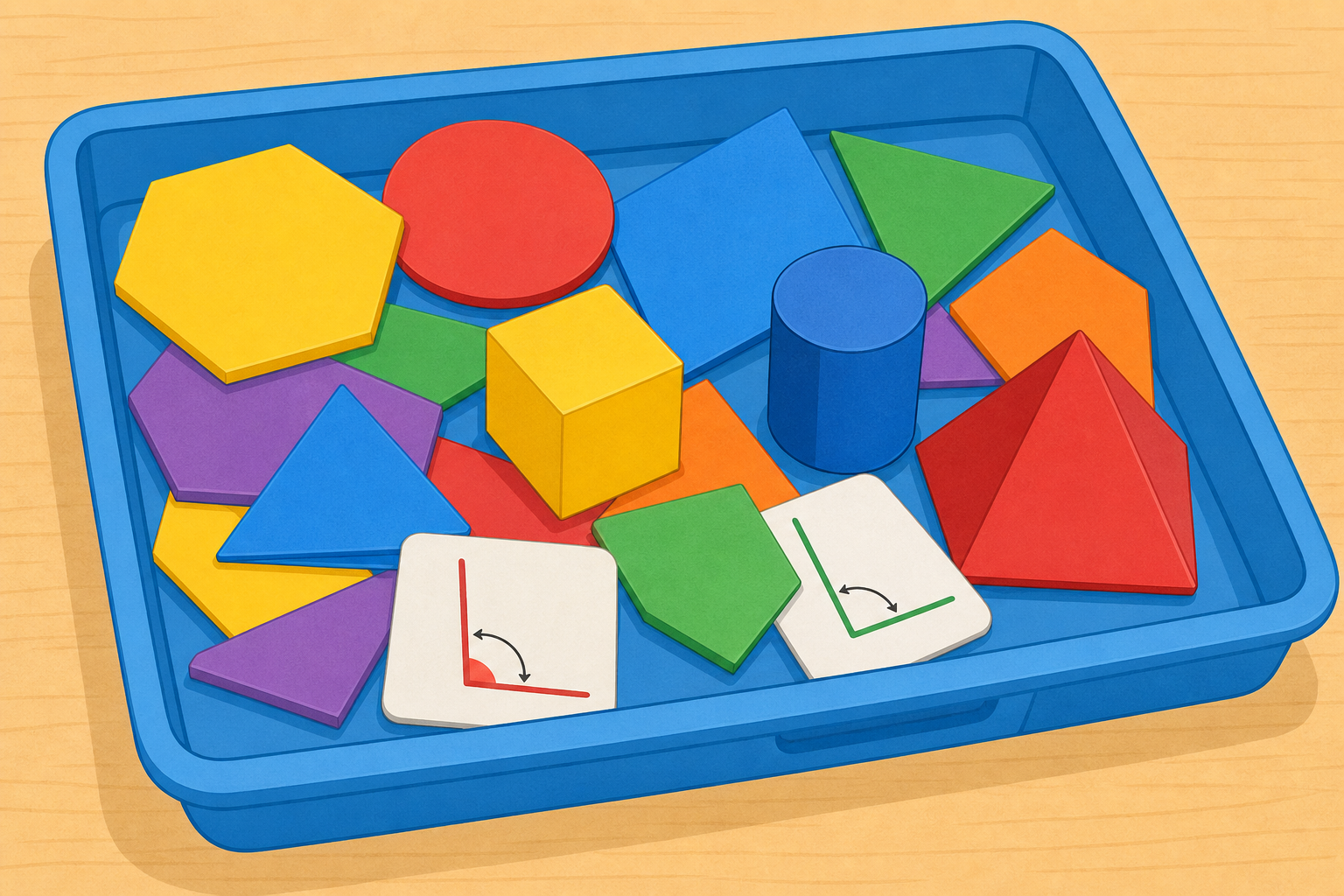
On screen is a mixed tray: some flat shape cards, some solid shapes, and some angle cards, all jumbled together.
If you had to sort every one of these into groups, what is the very first question you would ask about each one to help you decide?
Watch the sorts on the board. Each one starts with a single property question. As each card is placed, get ready to say what question decided its group.
First we sort the flat shapes by how many sides they have. Watch a six-sided shape go into its group.
Now the question changes. To tell solid shapes apart we stop counting sides and start counting faces, edges or vertices.
Watch one full sort of solids by number of faces. We count every face of a cube: 6 faces, so the cube goes in the 6-faces group. Next, every face of a square-based pyramid: 5 faces, so the pyramid goes in the 5-faces group. The same method works with edges or vertices when that is the better question.
One good property question leads straight to the name and the group.
Today we sort this mixed set together on the board. The rule is: is it a right angle or not a right angle?
We will place these in turn:
Watch the ruler's edge carefully when you apply the square-corner test.
Before each card lands, say whether it fits the square-corner test or not.
In your maths copy, pick any one flat shape, one solid shape and one angle from the lesson.
Beside each one, write one true property sentence — for example, a cube has 6 faces, a pentagon has 5 sides, or this angle is smaller than a right angle, so it is acute.
You're previewing this lesson. Get full access to this lesson and hundreds more — each one ready to teach, with interactive activities, printable resources and pupil progress tracking built in.