1 - Introduction ~5 mins
Welcome
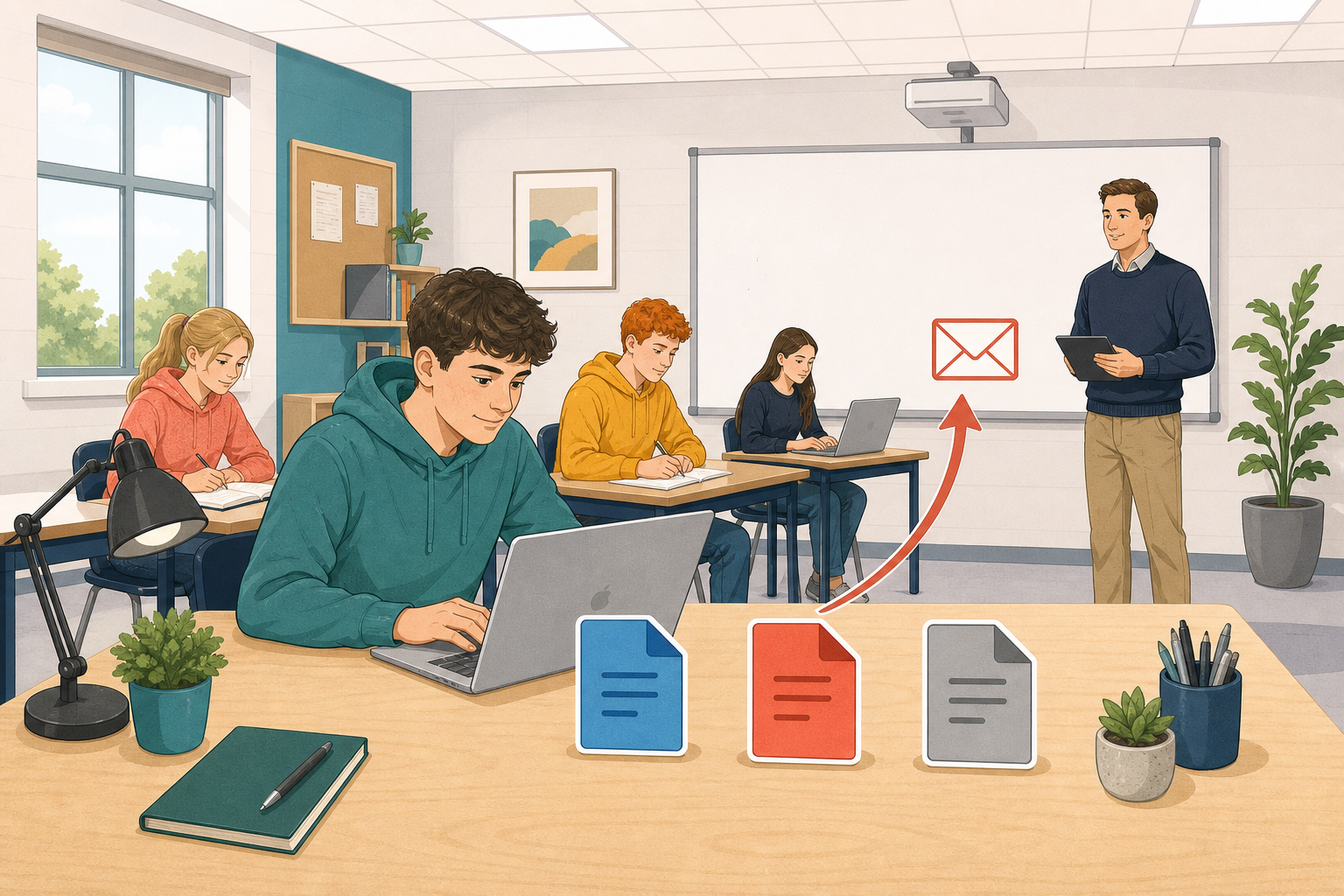 You already have a project document started from a template. Today you learn how to send that work out in the right file format so a supervisor, examiner, or employer can open it without drama. Choosing .docx, .pdf, or .rtf is a professional habit, not a technical detail.
Before we start
- Open {{code:Project_Portfolio/09_specialism/sm1/}}.
- Open {{code:sm1_doc1_from_template.docx}} (your Word file or Google Doc built from a template).
- If it is missing, make a short new document from a template in {{code:sm1}} — a title and a few lines of text is enough to work with — and name it exactly {{code:sm1_doc1_from_template.docx}}, then continue.
Your teacher will check the path on the board first. If your master is still only in {{code:03_finished}}, move or copy it into {{code:sm1}} when they say so.
What you will be able to do by the end of today
- Pick the right format when a file is still being worked on, when it is finished, and when the other person's computer is fussy
- Turn the same document into a .docx, a .pdf, and a .rtf copy
- Open each copy in a second app to prove it really works
Warm-up
Think of a time someone sent you a file you could not open, or you sent one that looked broken on their phone. What went wrong: the app, the format, or both? Keep that moment in mind as we match each format to a job.
2 - Key Concepts ~5 mins
File format is a decision about who needs the file next and whether they should still edit it.
Quick decision guide
- Still editing? Stay on .docx (or keep the live Google Doc and download .docx when you need a Word copy).
- Handing in or sending outside school? Prefer .pdf.
- Stuck with a picky old system? Try .rtf as the fallback.
| Concept | Why it matters | Example |
|---|---|---|
| .docx (working) — editable Word format for drafts | Keeps styles and comments so you and a supervisor can still change the text | Work Experience draft stays .docx until sign-off |
| .pdf (finished) — fixed layout on almost any device | Stops headings and spacing shifting on a phone or different laptop | Email a community proposal PDF to a local club secretary |
| .rtf (fallback) — older editable format; basic text and simple bold survive | Rescue option when .docx will not open; not for logos or complex tables | Older workplace PC rejects .docx; .rtf still carries CV headings |
| Convert and verify — export a copy, then open it in a second app | Export can drop images or change fonts; a short check beats a failed hand-in | Open the PDF in the browser before you attach it |
Also know (optional today): .odt is an open editable format that free office suites open cleanly. You can try it in the extension if you finish early.
Today’s path: keep the editable master, then create {{code:sm1_doc1_from_template.pdf}} and {{code:sm1_doc1_from_template.rtf}} beside a portable .docx copy in {{code:sm1}}.
3 - Step-by-step Task ~22 mins
With your teacher’s demo on the screen, export your template-based project document into three formats (portable .docx, .pdf, and .rtf) from the master in {{code:sm1}}, then open each export to prove it works. Follow the tab that matches your suite.
Watch-outs before you start
- Browser downloads land in Downloads first — upload each export into {{code:Project_Portfolio/09_specialism/sm1/}} straight away.
- Do not rename a file extension by hand (for example turning .pdf into .docx). Always re-export.
- If Word Online has no RTF option, use the numbered Google Docs route in the Microsoft steps — that is normal, not a mistake.
Work in this order. Make the portable .docx copy first, then the PDF, which everyone must also open and check. Leave the RTF until last. Your teacher will stop the room after the PDF to see it on your screen before anyone starts the RTF.
4 - Common Issues ~2 mins
Common Issues
| Issue | Solution |
|---|---|
| I only see files in Downloads, not in my portfolio | Browser downloads land locally first. Upload or move each export into {{code:Project_Portfolio/09_specialism/sm1/}} so your teacher can find the evidence later. |
| The PDF looks fine but the .rtf lost my table or logo | That is normal for RTF. Keep PDF for layout-perfect hand-in and treat RTF as a text rescue format, not a design format. |
| Word Online has no Rich Text Format option | Use the numbered Google Docs path in the Microsoft steps: upload the .docx, open with Google Docs, then {{menu:File -> Download -> Rich Text Format (.rtf)}}. Desktop Word is fine if available. |
| The second app says the file is corrupt or empty | Check you did not rename the extension by hand (for example turning .pdf into .docx). Re-export from the original document instead of editing the extension. |
| Two files have nearly the same name and I am not sure which is which | Use the shared stem {{code:sm1_doc1_from_template.docx}} and let the real extension (.docx / .pdf / .rtf) show the format. Delete accidental duplicates named “Copy of…”. |
5 - Independent Practice ~15 mins
Independent Practice
Use your real project document ({{code:sm1_doc1_from_template.docx}}) — for example a Work Experience report, a CV, or another hand-in your teacher names. On the last checklist column, name who you would send each format to.
Look in {{code:Project_Portfolio/09_specialism/sm1/}} for {{code:sm1_format_skills_checklist}}, which your teacher will usually have left there with a blank five-column table (Format | Purpose | Opened in | Pass or issue | Real hand-in use). If it is not in your folder, make a new document in that folder titled exactly {{code:sm1_format_skills_checklist}}, insert a table with five columns and four rows, and type those headers in the first row.
Your teacher will name one default recipient for the room (usually a Work Experience supervisor). Choose someone else only if your own project topic is already set. Copy the sample rows below, then replace the sample wording with your own checks for your three exports (.docx, .pdf, .rtf).
| Format | Purpose | Opened in | Pass or issue | Real hand-in use |
|---|---|---|---|---|
| .docx | working draft | Word Online / Google Docs | Pass — styles still editable | Keep editing with my teacher before hand-in |
| finished hand-in | browser preview | Pass — headings and spacing intact | Email PDF to Work Experience supervisor | |
| .rtf | fallback | Google Docs (Open with) | Pass — body text readable; logo dropped (expected) | Send if their PC will not open .docx |
- Aim to have {{code:sm1_doc1_from_template.docx}}, {{code:sm1_doc1_from_template.pdf}}, and {{code:sm1_doc1_from_template.rtf}} all sitting in your {{code:sm1}} Specialism folder; if the clock beats you, the PDF must at least be in {{code:sm1}} today
- {{code:sm1_format_skills_checklist}} is saved in the same folder, with a completed row for each format you finished — all three if you got them all done, and the PDF row at the very least
- At least one checklist line names a real recipient or office (the person your teacher named, usually a Work Experience supervisor) and the format you would send
- You can point to the PDF on screen and show it opens with layout intact
Unlock the full learning experience
You're previewing this lesson. Get full access to this lesson and hundreds more — each one ready to teach, with interactive activities, printable resources and pupil progress tracking built in.
This lesson is copyright of 123Learn.ie 2017 - 2025. Unauthorised use, copying or distribution is not allowed.