Mathematics
Intermediate
50 mins
Teacher/Student led
+65 XP
Teacher-led from the board — pupils need no device

What you need:
IWB/Projector/Large Screen

Rounding Whole Numbers to Estimate in Context

Learn to round whole numbers to a sensible place, then use your estimate to check if your exact answer is reasonable. Explore why a rough estimate is often more useful than working out every detail.
Teacher Class Feed

Load previous activity
    Your turn
    Your teacher is running this lesson on the board. Here is the part you can try yourself.

    1 - Getting Started ~4 mins

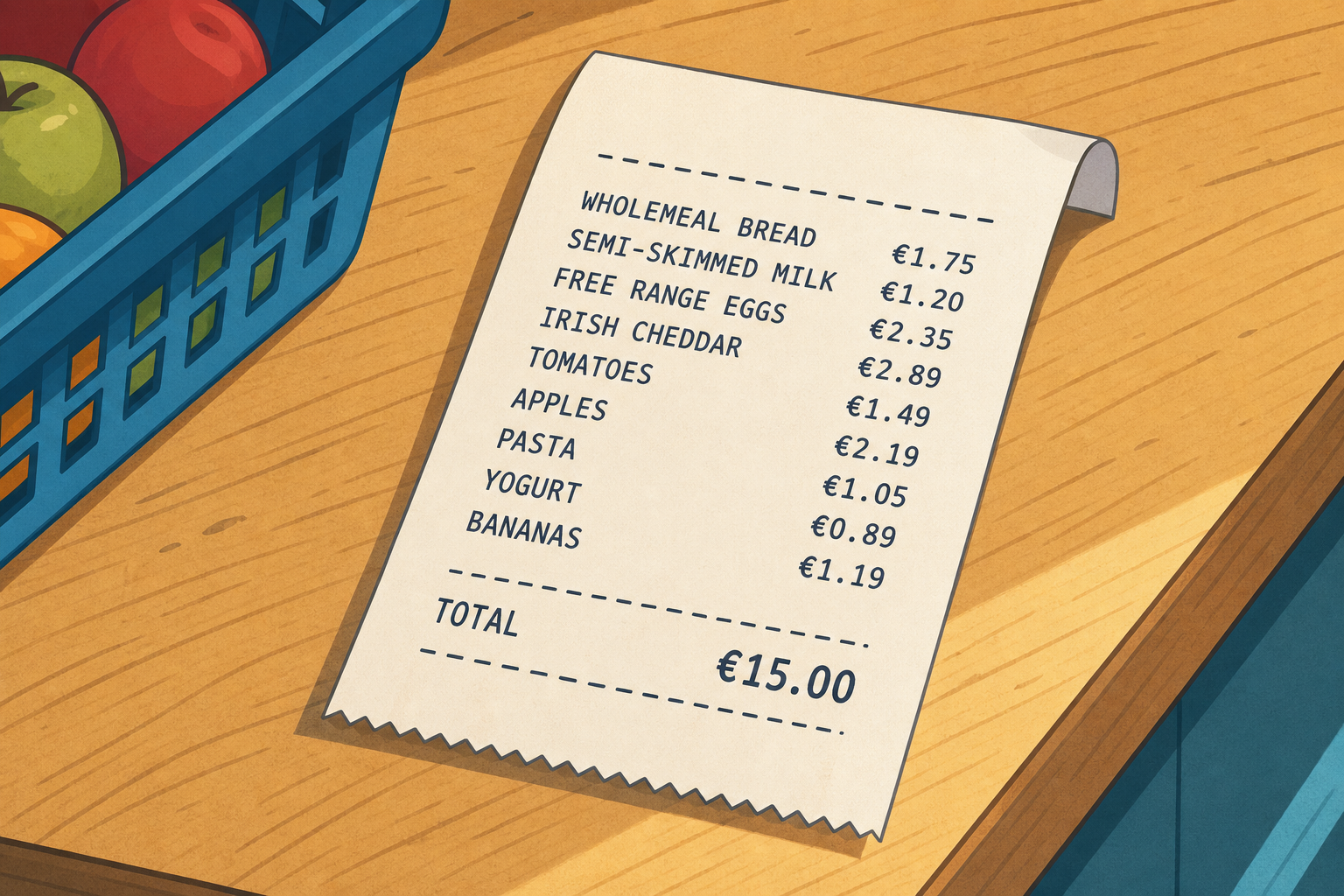
    Illustration for Getting StartedLook at this shopping receipt. The total at the bottom says €38.95. You hand over two €20 notes. Roughly how much change should you get back? Would rounding the total to €40 be close enough to check the change is right, before you count every cent?

    2 - Watch and Notice ~10 mins

    Four estimates are worked one at a time, and you have the numbers here so you can try each one before it is shown:

    • 487 + 312 — a sum to round to the nearest hundred.
    • 6,180 ÷ 3 — a division where you pick a friendlier number first.
    • 23,742 people at a match — a crowd, where the sensible place to round is bigger than you might expect.
    • 198 × 4 — a multiplication where one number is nearly a round number.

    For each one, notice what gets rounded and to which place, then check that the exact answer looks sensible sitting next to the estimate.

    Round first, then estimate

    3 - Try It Together ~8 mins

    Your teacher will hold up a jar of counters. Before anyone counts a single one, decide roughly how many you think are inside. A few estimates go up out loud, the class says whether each one sounds sensible, and then the real count is revealed. Afterwards, ask yourself two things: was your number a sensible rough guess, and how far off the real total did it land?

    4 - Estimate Then Check in Your Copy ~3 mins

    COPYBOOK MOMENT

    In your maths copy, write each problem, then your rounded estimate, then the exact answer. For the third item the exact answer is the number itself. Underneath each one, note in a single line how close your estimate came.

    • 516 + 289
    • 4,050 ÷ 5
    • 31,608 (round to nearest thousand)

    5 - Class Challenge ~9 mins

    Today we work through three real Irish-context estimation tasks together, then a stretch. In your copy work each one: round to a sensible place, write the estimate, then find the exact answer and compare.

    1. The school orders 1,180 copybooks to split evenly among 6 classes. Estimate first, then work out how many each class gets.
    2. A concert sells 47,300 tickets across 4 nights. Estimate the tickets per night, then find the exact figure.
    3. A farmer harvests 2,985 kg of potatoes over 5 days. Estimate the daily harvest, then calculate it exactly.
    4. Stretch: Which of your three estimates would you trust enough to plan with, and why?

    Round to a sensible place to estimate, then calculate exactly, across three Irish-context division tasks.

    1. The school orders 1,180 copybooks to split evenly among 6 classes. Estimate first, then work out how many each class gets.
    2. A concert sells 47,300 tickets across 4 nights. Estimate the tickets per night, then find the exact figure.
    3. A farmer harvests 2,985 kg of potatoes over 5 days. Estimate the daily harvest, then calculate it exactly.

    Ways to start:

    • Round the total to a friendly number first — what is the sensible place?
    • Say roughly what the answer will be before you divide exactly.

    Stretch:

    • Which of your three estimates would you trust to plan with, and why?
    Answers & strategies (teacher)
    1. The school orders 1,180 copybooks to split evenly among 6 classes. Estimate first, then work out how many each class gets. — Estimate about 200 each (1,200 ÷ 6). Exact: 196 each, with 4 copybooks left over.
    2. A concert sells 47,300 tickets across 4 nights. Estimate the tickets per night, then find the exact figure. — Estimate about 12,000 each (48,000 ÷ 4). Exact: 11,825 tickets per night.
    3. A farmer harvests 2,985 kg of potatoes over 5 days. Estimate the daily harvest, then calculate it exactly. — Estimate about 600 kg each (3,000 ÷ 5). Exact: 597 kg per day.
    • Round the dividend to the nearest hundred or thousand, then divide by a known fact.
    • Predict whether the exact answer is a little more or a little less than the estimate.
    Pupil practice
    Module 1 · Place Value, Decimals and the Number System Number
    Lesson 6 · Rounding Whole Numbers to Estimate in Context
    Download Activity Book page (PDF)
    123learn · Online learning platform

    Unlock the full learning experience

    You're previewing this lesson. Get full access to this lesson and hundreds more — each one ready to teach, with interactive activities, printable resources and pupil progress tracking built in.

    Hundreds of curriculum-aligned lessons
    Interactive activities in every lesson
    Printable resources & progress tracking
    Copyright Notice
    This lesson is copyright of 123Learn.ie 2017 - 2025. Unauthorised use, copying or distribution is not allowed.
    🍪 Our website uses cookies to make your browsing experience better. By using our website you agree to our use of cookies. Learn more