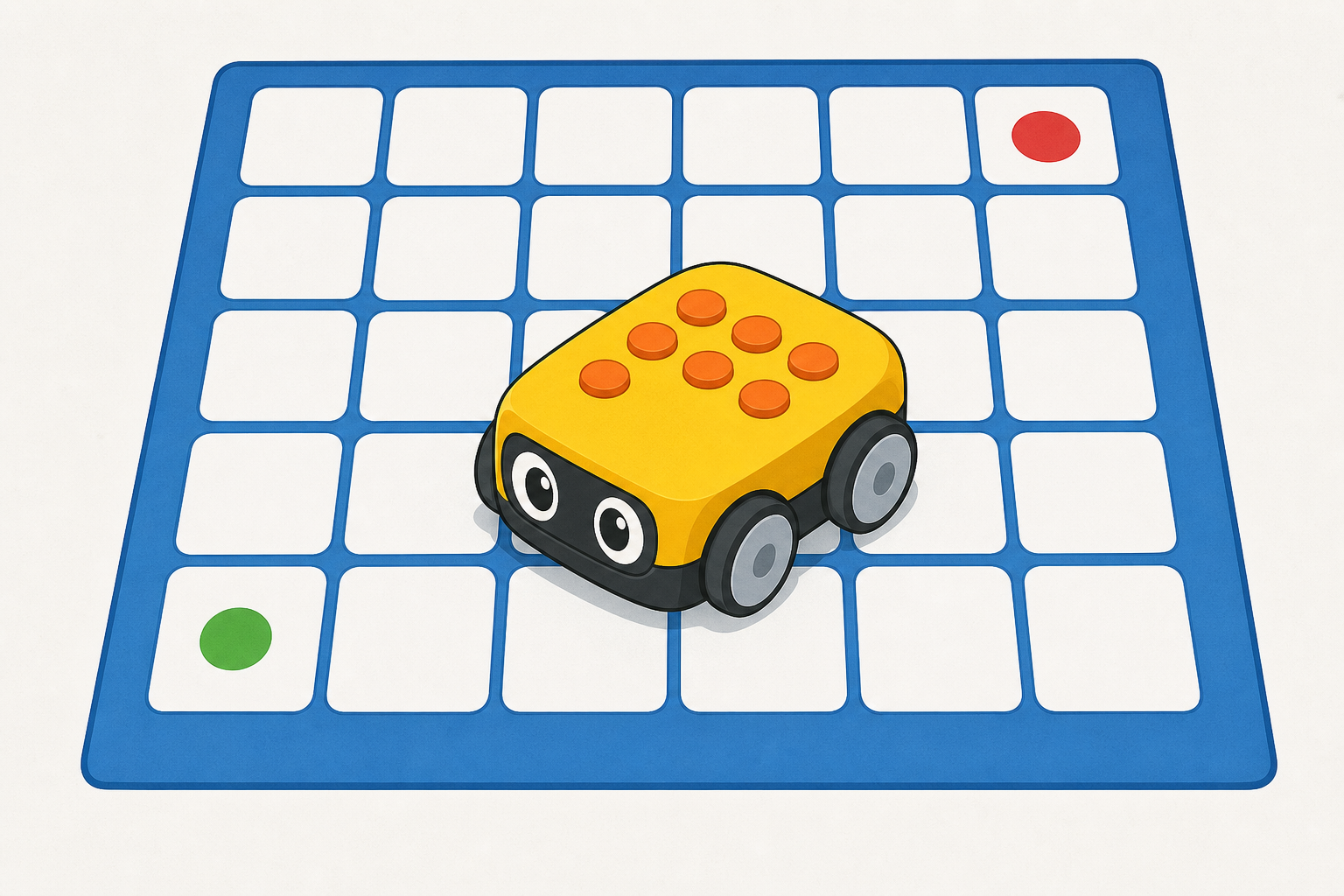
 This robot cannot think for itself. It does exactly what we tell it, one step at a time. So if it goes the wrong way, is the robot broken? Or is there a mistake in our steps?
Arrows in order are a program. A wrong arrow is a bug. The same arrow more than once is a repeat, like three forwards.
Today we will send the robot on a mission with a turn and a repeat, predict where it stops, and fix any bug.

Here is a program for our robot. Put your finger on the robot in the picture and follow the arrows in order. A forward moves the robot one square. A turn spins it on the spot.
Where do you think it will stop? Point to the square, then call out your prediction before the robot moves.
Did it stop on the star? If not, which arrow would you change?
Watch the robot on the grid on the board. Your job is to call out the next step and watch the run. I will put the arrows in order and press Run.
For the first challenge, use 6 steps or fewer. If the robot misses the goal, say where the bug is and which step we should change.
Get the robot to the goal

Get the robot from Start to the star, and keep out of the puddles. Your program must have a turn, and three forwards in a row.
Plan your program with your arrow cards. Test it on your desk grid, moving your paper robot one card at a time. Then say your program in order and point to where it will stop. On your turn, run it on the real robot. If it misses, find the bug, change one step and try again.
There are two good routes. If yours works first time, can you find the other one?
Unlock the full learning experience
You're previewing this lesson. Get full access to this lesson and hundreds more — each one ready to teach, with interactive activities, printable resources and pupil progress tracking built in.
This lesson is copyright of 123Learn.ie 2017 - 2026. Unauthorised use, copying or distribution is not allowed.