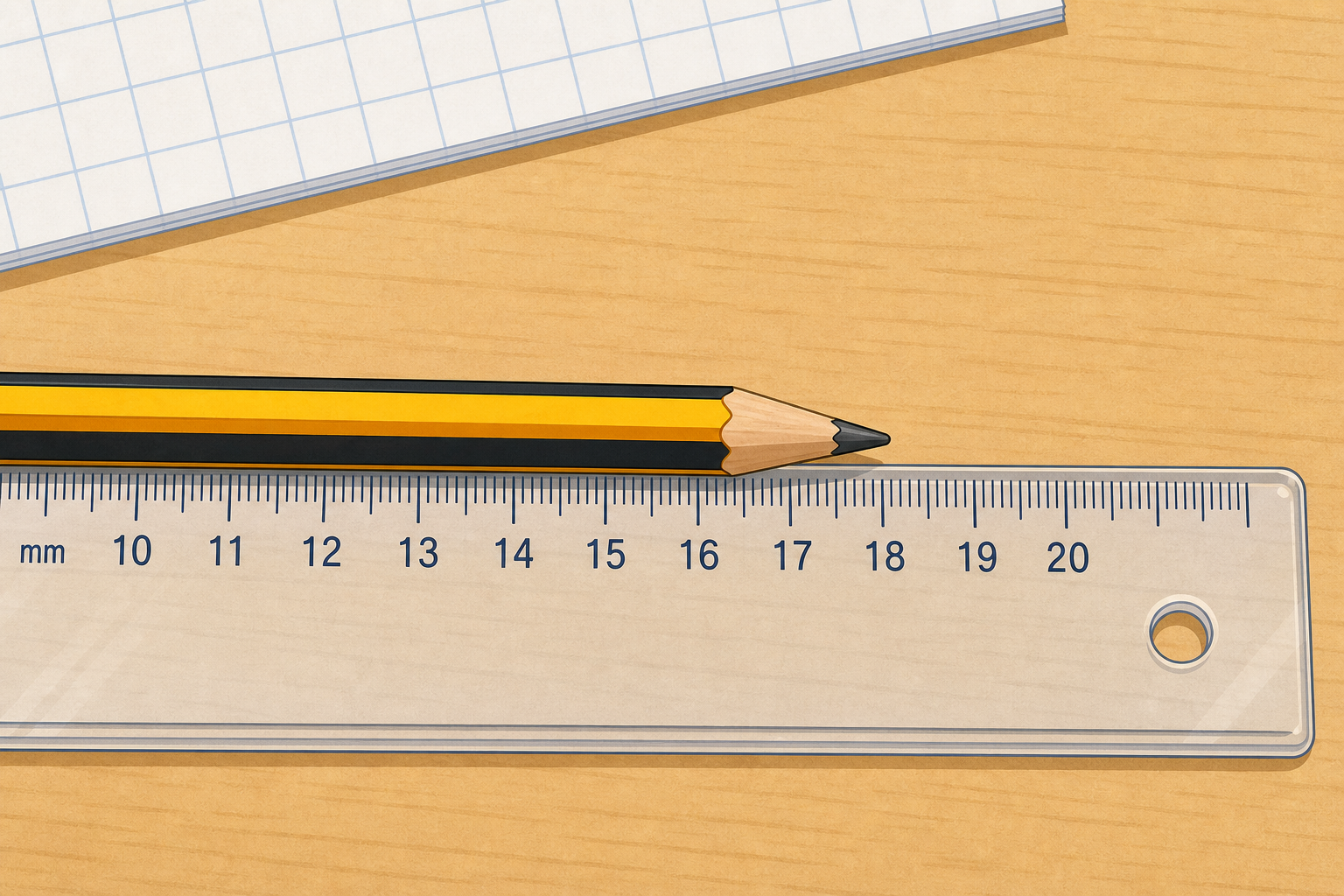
Here is a photo of a pencil lying along a ruler. The tip is sitting somewhere between the 16 and 17 centimetre marks. How long is this pencil, as exactly as you can read it? Hands up: what number would you write down?
Display the ruler-and-pencil photo as pupils settle. Take three hands-up answers, not open call-outs. Listen for anyone who reads the tiny marks between 16 and 17 — that is the millimetre reading we are after today. Don't confirm the answer yet; the demonstration ruler will settle it.
Watch closely at the front. The ruler in my hand has long lines for the centimetres and tiny lines in between — those tiny ones are the millimetres. There are ten of them in every centimetre.
I'll lay a pencil against the ruler. Its end reaches the twelfth centimetre line and four small marks more, so it is 12.4 cm, the same as 124 mm. I'll do the same with a couple more objects so you can see the routine.
Now watch my eyes. When I lean to one side, the line seems to slip a millimetre. When I look straight down, square over the mark, the reading is true. Eye square over the mark — every time.
This is a real demonstration ruler at the front, not an on-screen widget. Lay each pre-measured object flat against the ruler one at a time.
Do not solve the Getting Started photo for them — they'll read their own objects next.
Now it is your turn at your own desk. Take your own ruler and measure three things: your pencil, your eraser, and your maths copy. For each one, read it to the nearest millimetre.
Say each length aloud two ways: in centimetres with a decimal (like 13.8 cm) and in whole millimetres (like 138 mm). Remember to look straight down, eye square over the mark, before you read. We will compare our readings and sort out any that disagree.
This round is for pupils to measure at their desks with their own rulers — circulate and catch alignment slips on the spot. The class reads aloud and you reconcile any disagreement as you circulate.
Look-fors as you walk the room:
Take a few readings aloud at the end; where two pupils disagree on the same kind of object, re-measure one together at the front.
In your maths copy, sketch ONE of the readings you just took. Write the length two ways underneath your sketch: in centimetres with a decimal, and in whole millimetres. Then circle the millimetre digit on each one.
Walk the room glancing at the two unit versions and the circled millimetre digit — this is whole-class copybook practice, not marking. The circle should land on the decimal digit in the cm version and the units digit in the mm version, since those are the same millimetre count.
Six real objects are set out as stations at the front: a crayon, an eraser, a glue stick, a highlighter, a marker, and a colour pencil. In your maths copy, rule three columns and head them Object, cm, mm. When it is your turn at a station, measure that object with your own ruler to the nearest millimetre.
Write each object's name and its length two ways in your copy: in centimetres with a decimal and in whole millimetres. Look straight down, eye square over the mark, every time. At the end we will read each one aloud and agree the true length.
This round is the practice bank — run the six real objects as rotation stations at the front. Pupils come up in turns and read each object they reach with their own ruler; they record straight into the three-column table they ruled in their maths copy. There is no printed sheet to prepare.
Pupils read as many objects as they can reach in the time rather than a fixed number; keep the rotation moving so as many as possible get a turn, and confirm each reading aloud at the end.
Approximate true lengths for confirming the final readings: crayon ≈ 8.6 cm (86 mm), eraser ≈ 4.7 cm (47 mm), glue stick ≈ 15.2 cm (152 mm), highlighter ≈ 13.8 cm (138 mm), marker ≈ 14.5 cm (145 mm), colour pencil ≈ 17.3 cm (173 mm). Your own objects may differ by a millimetre or two — what matters is that readings agree across the class.
Where did the reading get harder today? Was it the longest objects, the ones whose end fell between two marks, or the ones where it was tricky to look straight down? Where does the precision start to drop off?
Listen for pupils naming the between-the-marks ends as the hardest — that is where precision genuinely drops, because there is no exact mark to land on. Revoice a strong answer: so when the end sits between two marks, we take the nearest one — we can't read half a millimetre on this ruler. Also draw out anyone who names the eye-square lean as the thing that wobbled their reading.
Next we will take these millimetre, centimetre and metre readings and convert between them — moving the digits along as we change from one unit to the next.
Keep this brisk. The millimetre-reading skill feeds straight into the unit-conversion lesson that follows.
You're previewing this lesson. Get full access to this lesson and hundreds more — each one ready to teach, with interactive activities, printable resources and pupil progress tracking built in.