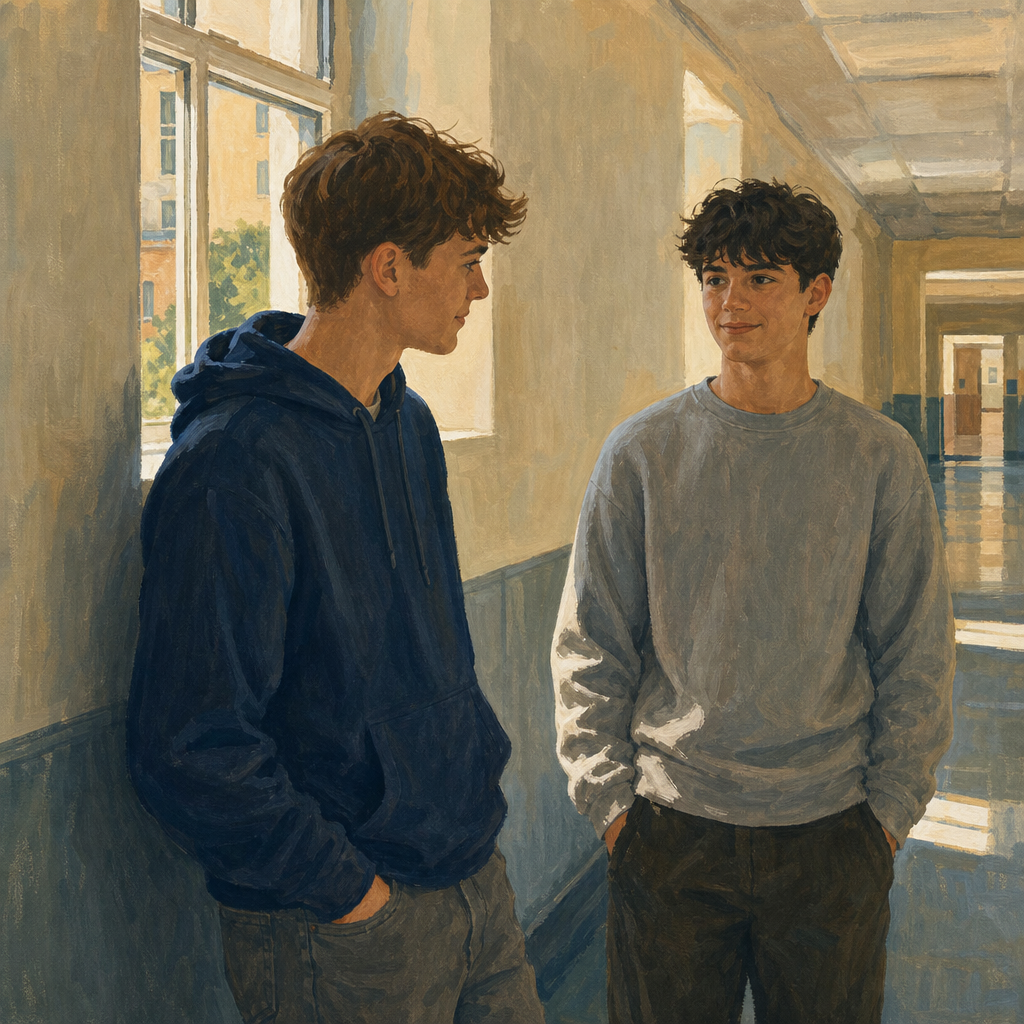
 You already read people without them spelling everything out. On an Irish bus you have seen it: someone puts a bag on the empty seat, hood up, eyes on their phone. Nobody needs a speech to know that seat is taken.
Writers use the same cues on the page. Today you will practise on a short scene, then annotate a full one for at least six character or relationship cues. That six-cue annotation is the piece you save to your Communication Portfolio.
Writers rarely announce a character. They leave cues. A character cue is any detail that shows who someone is, what they want, or how they feel about someone else. Some cues show identity (who someone is, how they protect themselves). Others show relationship (how two people stand with each other).
There are six kinds of cue, and you will use these same six for the rest of the lesson.
| Cue | What it means | Example |
|---|---|---|
| Speech | What they choose to say out loud | "I can stand if you want the seat" |
| Silence | What they leave out, delay, or refuse to answer | He waits. She says nothing. |
| Action | What a body does: bag, phone, hands, seat | Bag left on the seat beside her |
| Reaction | How the other person responds, or fails to | Looking at the floor when a name is mentioned |
| Subtext | What sits under the words | "Fine" when the pause shows it is not |
| Identity | Who they are, or how they protect themselves | Hood up, arrived early, sitting at the end |
Worked example (from the scene you will annotate later): "She does not move the bag. He waits." The bag on the seat is an action cue, and it tells you about identity: she is holding her space, and she is not making room for him yet. His waiting is the reaction. The relationship is guarded before either of them says much.
Read this short scene in the chipper. It is about half a page.
The first two questions quote a moment and ask what kind of cue it is. Choose from the same six you have just met. The last two are your own reading of the scene.
Nothing from this step goes in your portfolio. It is here to get your eye in before the one that counts.
Outside the chipper: two cues
You’re making: a character-cue annotation, at least six cues.
Where: on this page. Mark the scene, and name each cue as you go.
When you’re done: copy it into your Communication Portfolio folder as m1_l7_character_cues_AB.
The scene below is called Bus stop, half seven. It is longer than the chipper clip you just watched, and this time the work counts. Drag across the words that show character, identity or relationship, and name each cue as you go. Find at least six. Make sure one of them shows identity — who someone is, or how they protect themselves — and not only how the two of them get on.
Then write your six strongest cues in the work box below: quote, kind of cue, what it reveals, plus one sentence on the relationship overall. The work box is your Portfolio artefact. Save that page into your Communication Portfolio as m1_l7_character_cues_AB (AB stands for your own initials).
Six cues in a short scene
Talk this through with the person beside you, or sit with it for a minute:
- Which cue on the bus-stop scene told you the most about the relationship, and why?
- Where this week did you read a cue like the ones on the page, without anyone saying the thing outright?
If you want a longer think, put one honest paragraph in your Reflective Journal after class.
Unlock the full learning experience
You're previewing this lesson. Get full access to this lesson and hundreds more — each one ready to teach, with interactive activities, printable resources and pupil progress tracking built in.
This lesson is copyright of 123Learn.ie 2017 - 2025. Unauthorised use, copying or distribution is not allowed.