Mathematics
Intermediate
50 mins
Teacher/Student led
+75 XP
Teacher-led from the board — pupils need no device

What you need:
IWB/Projector/Large Screen

Profit, Loss and Best-value Shopping

Learn to calculate profit and loss, and discover how to find the best-value shopping option by working out the unit price of different pack sizes.
Teacher Class Feed

Load previous activity
    Your turn
    Your teacher is running this lesson on the board. Here is the part you can try yourself.
    Best buy compare

    1 - Getting Started ~4 mins

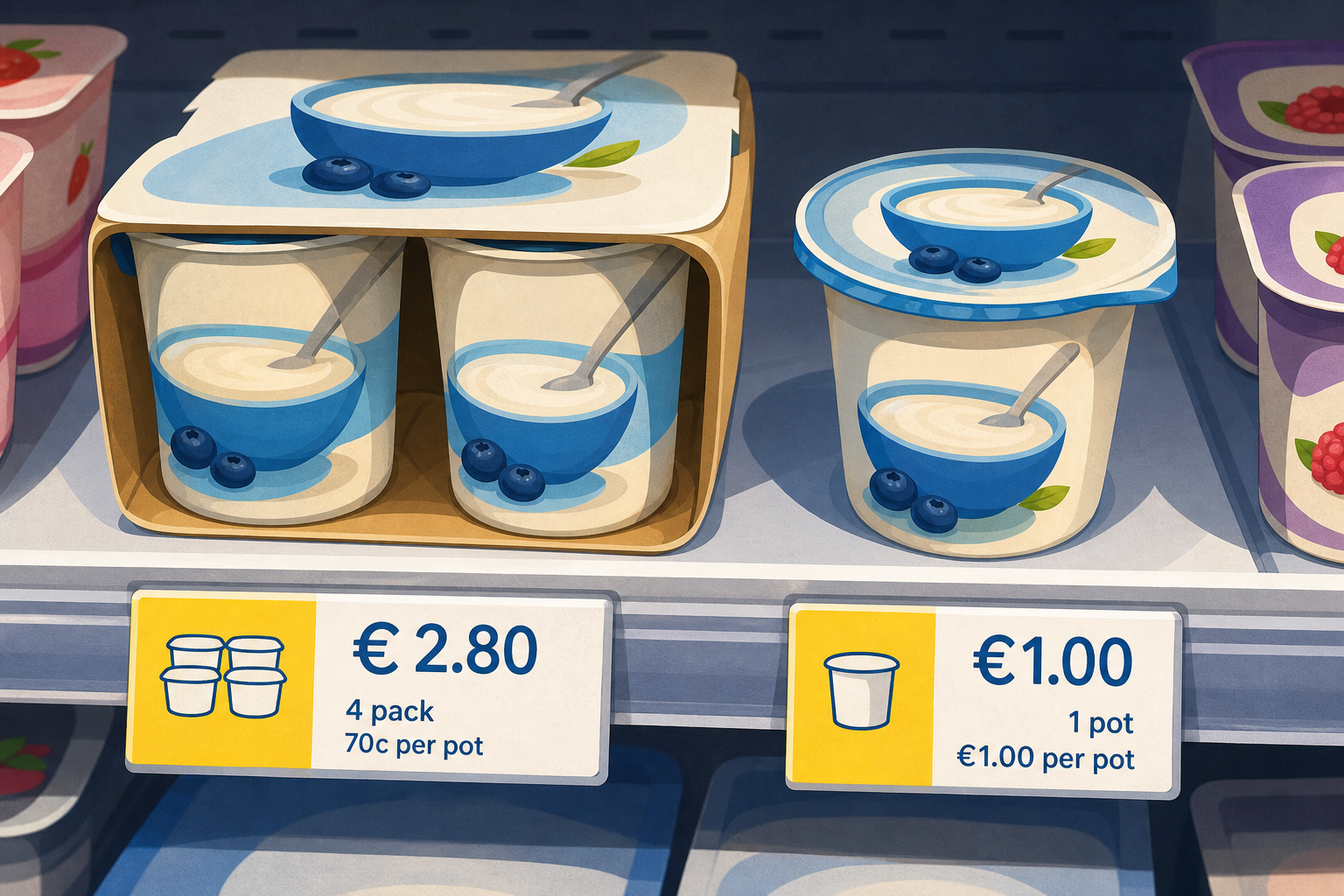
    Illustration for Getting StartedHere are two ways to buy the same yoghurts: a 6-pack for €2.40, or single pots at 45c each. Hands up: which one do you think is the better buy? And how could you actually prove it, rather than just guessing?

    2 - Watch and Notice ~9 mins

    You are about to compare four pairs of shelf tags. For each pair, share the pack price out to find what just one item costs, the unit price, then say which side wins and why. On the last pair, call the winner before the working appears. After that you meet a fundraising stall and work out what profit and loss mean.

    The bigger pack loses

    3 - Try It Together ~10 mins

    Key point

    Remember: profit is selling above what something cost, and loss is selling below what it cost.

    We work the first pair on the interactive together, then work the rest on the board:

    • On the interactive: €3.00 for 5 bars vs €4.55 for 7 bars
    • On the board: €4.50 for 3 bottles vs €7.00 for 5 bottles
    • On the board: Stall — a badge bought for €2, sold for €3.20
    • On the board: Stall — a scarf bought for €6, sold for €5

    Which is the better buy?

    4 - Work It in Your Copy ~3 mins

    COPYBOOK MOMENT

    First we work one pair together on the board so everyone sees the full method. Then in your maths copy, for each pair of shopping options write the unit price of both and circle the better value. After that, for each profit-and-loss example write three things one under the other:

    • Cost
    • Sale
    • Profit or Loss

    Work out and label each one.

    Board example first: €2.80 for 4 apples against €3.60 for 6 apples.

    In your copy, pairs:

    • €4.00 for 8 yoghurts vs €2.70 for 5 yoghurts
    • €6.00 for 5 notebooks vs €3.60 for 4 notebooks

    In your copy, profit and loss:

    • A badge costs €1.50 and sells for €2.25
    • A scarf costs €5 and sells for €4.20

    5 - Class Challenge ~8 mins

    Key point

    Today we work through four comparisons on the board in order: a 6-pack against a 4-pack of the same drink, then two washing-powder boxes of different sizes, then a 20-pack of pens against a 10-pack, and finally a battery-pack twist.

    After the four comparisons, we work a total-profit sum together on the board: a fundraising stall buys 20 wristbands at €2 each and sells them all at €3.50 — what is the total profit?

    Best value and total profit

    Pupil practice
    Module 6 · Time and Money Measures
    Lesson 71 · Profit, Loss and Best-value Shopping
    Download Activity Book page (PDF)
    123learn · Online learning platform

    Unlock the full learning experience

    You're previewing this lesson. Get full access to this lesson and hundreds more — each one ready to teach, with interactive activities, printable resources and pupil progress tracking built in.

    Hundreds of curriculum-aligned lessons
    Interactive activities in every lesson
    Printable resources & progress tracking
    Copyright Notice
    This lesson is copyright of 123Learn.ie 2017 - 2025. Unauthorised use, copying or distribution is not allowed.
    🍪 Our website uses cookies to make your browsing experience better. By using our website you agree to our use of cookies. Learn more