Here is a co-ordinate pair on the board: (−5, −2). You already know how to plot points that go right and up. Now both numbers can carry a minus sign. So which way do we travel for each number in this pair — and how far?
Take two or three hands-up answers, not open call-outs. Listen for whether pupils connect the minus sign to direction (left / down) rather than to a smaller number. This is the one new idea for the lesson — both co-ordinates can now be negative, not just one.

Watch as this point is plotted. We start at zero, go five squares left because of the minus, then two squares up. It lands in the top-left.
Now a positive x and a negative y. Three squares right, then four squares down. This one lands in the bottom-right.
Both numbers are negative this time. Six left, then one down. Bottom-left corner.
This dot is already placed for you. Look across first, then up or down. We will read its co-ordinate pair together, and then the answer appears so you can check it: (4, −2).
Walk each example aloud, one at a time.
Today we'll work these out together at the board, one pupil at a time while everyone else watches and agrees. First the grid shows a point with its label hidden, and we read off its co-ordinate pair. Then I'll call out a pair and one of us will plot it. We'll swap between reading and plotting so both skills get a turn.
This round is for talking it through together — one pupil acts at the board at a time and the class agrees or corrects out loud.
Alternate the two skills deliberately: place a point with its label hidden and ask the class to read it (reveal the label only once they agree), then call a pair and ask a pupil to plot it. Rotate four pupils. Watch for the swap error — a pupil who reads (4, −2) as (−2, 4) has read up-before-across. Revoice: 'always across first, then up or down'.
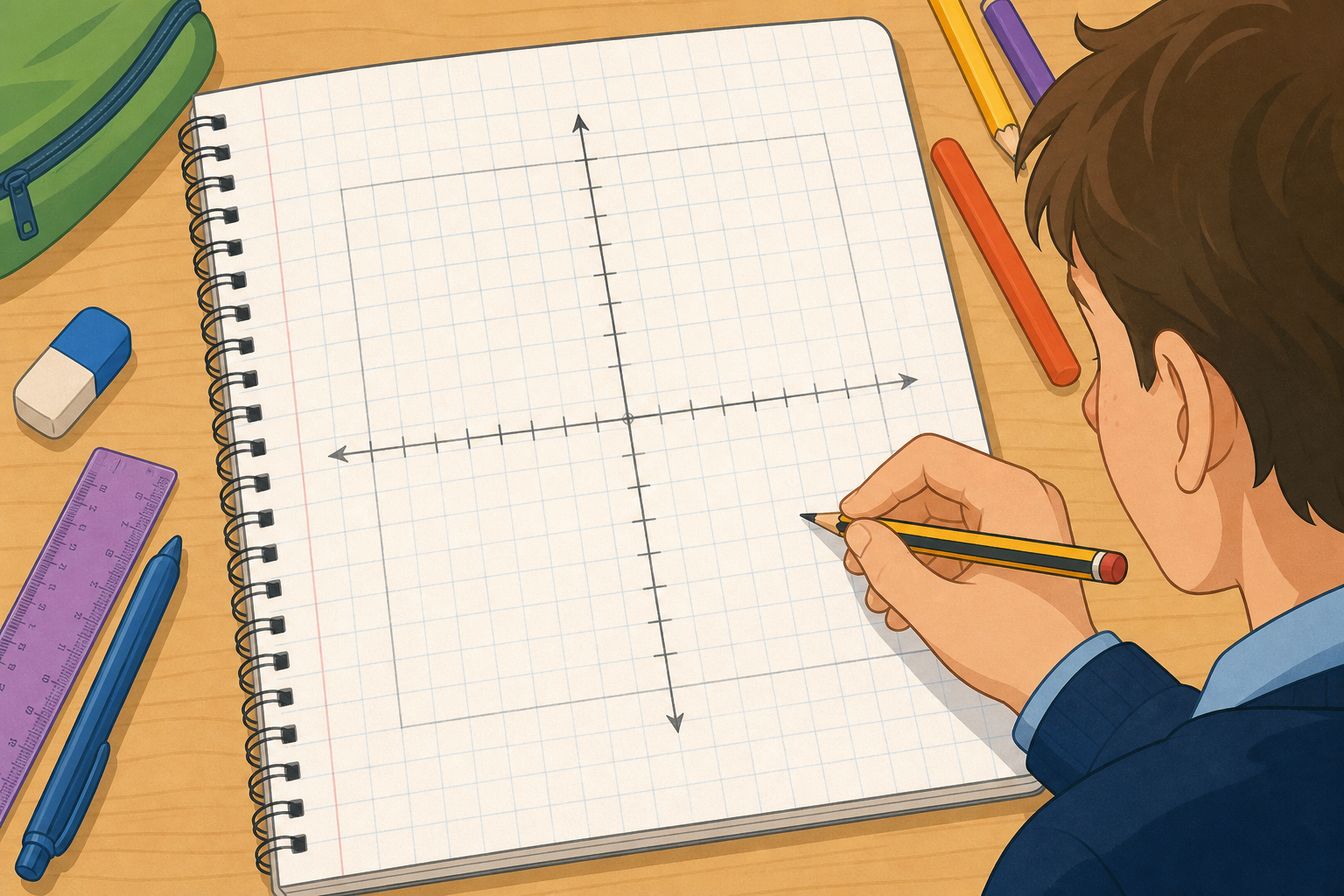
In your maths copy, rule a four-quadrant grid from −6 to 6 on each axis. Plot each of these points and label it:
Then read the three points I place on the board and write their co-ordinate pairs underneath your grid.
Walk the room glancing at whether pupils go across before up, and whether the minus signs land in the right direction — no marking, this is whole-class copybook practice. When most have plotted the three given points, place three fresh points on the board for them to read and record.
Today we'll work through these together at the board. First we'll plot some mixed-sign points. And for the tricky one, three corners of a rectangle are placed and we'll work out where the fourth one goes.
This round is the practice bank — pupils take turns at the board, check each answer, and the class confirms before moving on. Keep the board work brisk rather than over-explaining.
The first three are straight plotting, mixing the signs. The fourth rehearses reading a placed point and then plotting from it, both skills already practised today. The complete-rectangle challenge is the high ceiling: pupils must reason about which corner is missing rather than transcribe a pair. Let the class predict each answer before the pupil at the board taps Check.
How is (−3, 4) different from (4, −3)? They use the same two numbers and the same minus sign — so do they land in the same place, or somewhere different?
Listen for pupils naming the order as what changes everything — across first, then up or down. Revoice a strong answer: '(−3, 4) is three left and four up, so top-left; (4, −3) is four right and three down, so bottom-right — opposite corners.' Head off the idea that the points are 'the same because the numbers are the same'.
Next we will slide whole shapes around this four-quadrant grid, reading off the new co-ordinates of every corner after the move.
Recap the across-first rule one last time before pupils move to the activity book. The reading-and-plotting fluency built here is the foundation for translating shapes next lesson.
You're previewing this lesson. Get full access to this lesson and hundreds more — each one ready to teach, with interactive activities, printable resources and pupil progress tracking built in.