How many pupils do you think there are in a really big school, all the children added together? Could it reach a thousand? Hands up with your best guess.
Take three hands-up guesses, not open call-outs. Give five seconds of quiet think-time first. Jot two or three pupil-suggested numbers under 9,999 on the board to revisit in Watch and Notice.

Watch as I gather up ten hundred-flats and swap them for one single thousand-block. They are worth exactly the same. We needed a brand-new column on the left to hold it. The screen shows the finished thousand-block sitting in its new column.
Now watch this number built up. Read it with me, one column at a time: two thousand, three hundred, four tens, five units.
Look hard at the tens column on this one. Hands up: what do you notice sitting there, and what is holding its place? I'll take two answers.
This time the empty column has moved. Hands up: which column has nothing in it now? I'll take two answers before we check.
The screen snapshots are static end-states, not animations. Perform the trade live with the apparatus while the board shows the finished block.
Let's build some numbers together on the mat. I'll call a four-digit number, one of you comes to the board and builds it, and the rest of us check each column out loud. Watch the thousands column carefully each time. We'll build 3,628 first, then the trickier 5,030.
This round is for talking it through together — pupils take turns at the board and the class agrees or corrects out loud.
An individual pupil builds each called number in the Th/H/T/U columns, then reads it back. Rotate so several pupils get a turn. Start with the no-zero number (3,628) before moving to one with an awkward zero (5,030). Listen for pupils naming the empty column rather than skipping it.
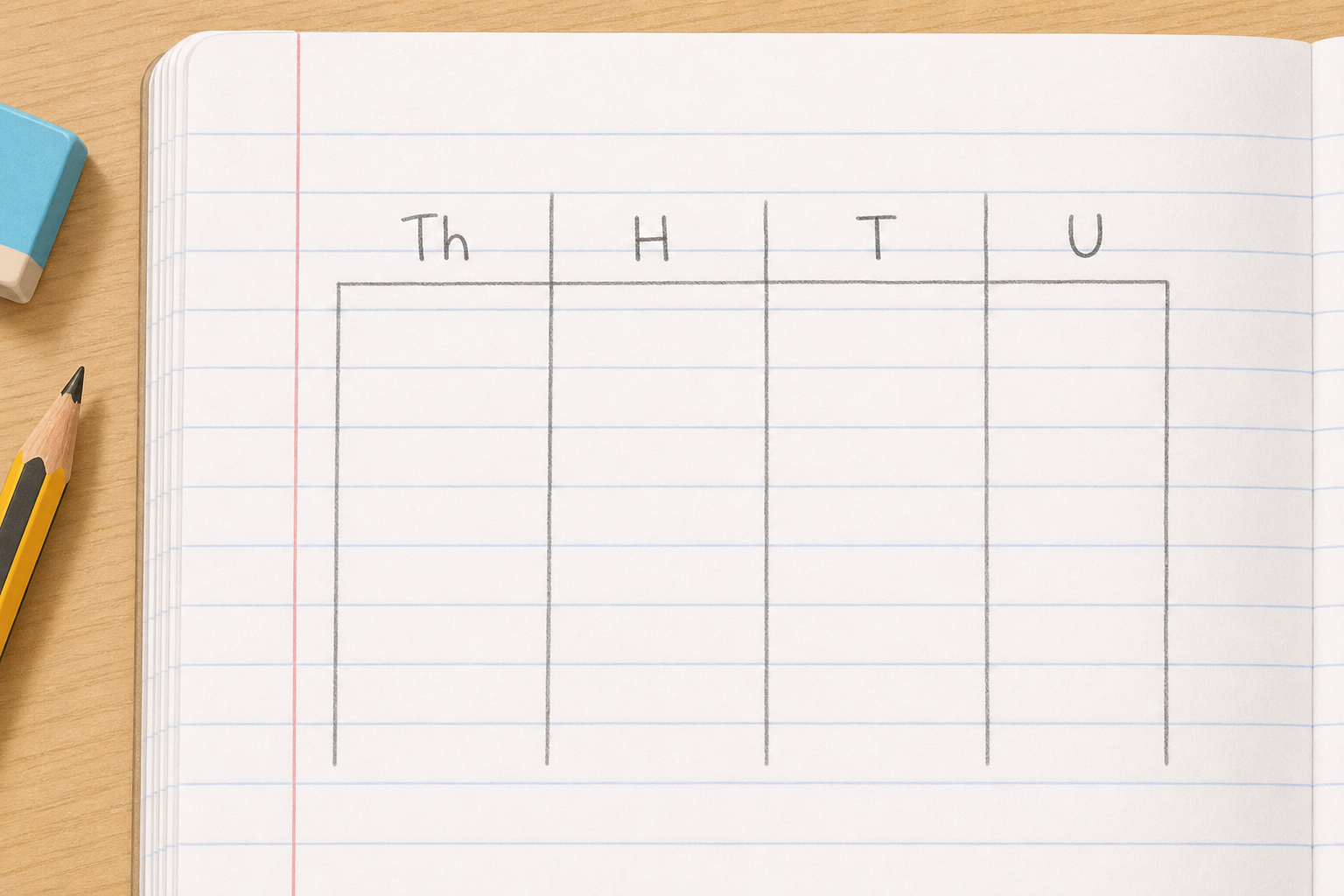
In your maths copy, sketch four place-value columns and label them Th, H, T and U. Then write each of these numbers into the columns, one under the other. Read each number aloud after you write it.
Walk the room glancing at column labels and alignment — no marking, this is whole-class copybook practice. Watch for the zeros landing in the correct empty columns.
Now we build these numbers together at the board: 3,012, then 5,600, then 7,083, then 9,009. The zeros catch people out, so before a pupil checks each one we'll all name the empty column out loud together first.
Pupils take turns at the board; the class confirms each answer before moving on. Keep the board work brisk rather than over-explaining.
Each number hides a trickier zero than the last. On 9,009 ask the class which two columns are empty before a pupil builds it. Have the whole class name the empty column aloud together before the pupil at the board checks — this gives every pupil a consistent part to play on all four numbers.
Each column to the left is worth ten times the one beside it. Remember we swapped ten hundreds for one thousand — that is why each new column is ten times bigger. Why do you think that pattern keeps going? What do you predict happens when the number grows one column bigger again, past nine thousand?
Listen for pupils linking the ten-times rule to the trade they saw (ten hundreds make one thousand). Revoice a strong answer: so every step left is ten of the column on its right. If a pupil predicts a ten-thousands column, affirm it — that is exactly where the next lesson heads.
Next we say four-digit numbers out loud, turning the digits into words and the words back into digits.
Keep this brisk. Recap the trade idea (ten of one column makes one of the next) as the bridge into reading numbers aloud.
You're previewing this lesson. Get full access to this lesson and hundreds more — each one ready to teach, with interactive activities, printable resources and pupil progress tracking built in.