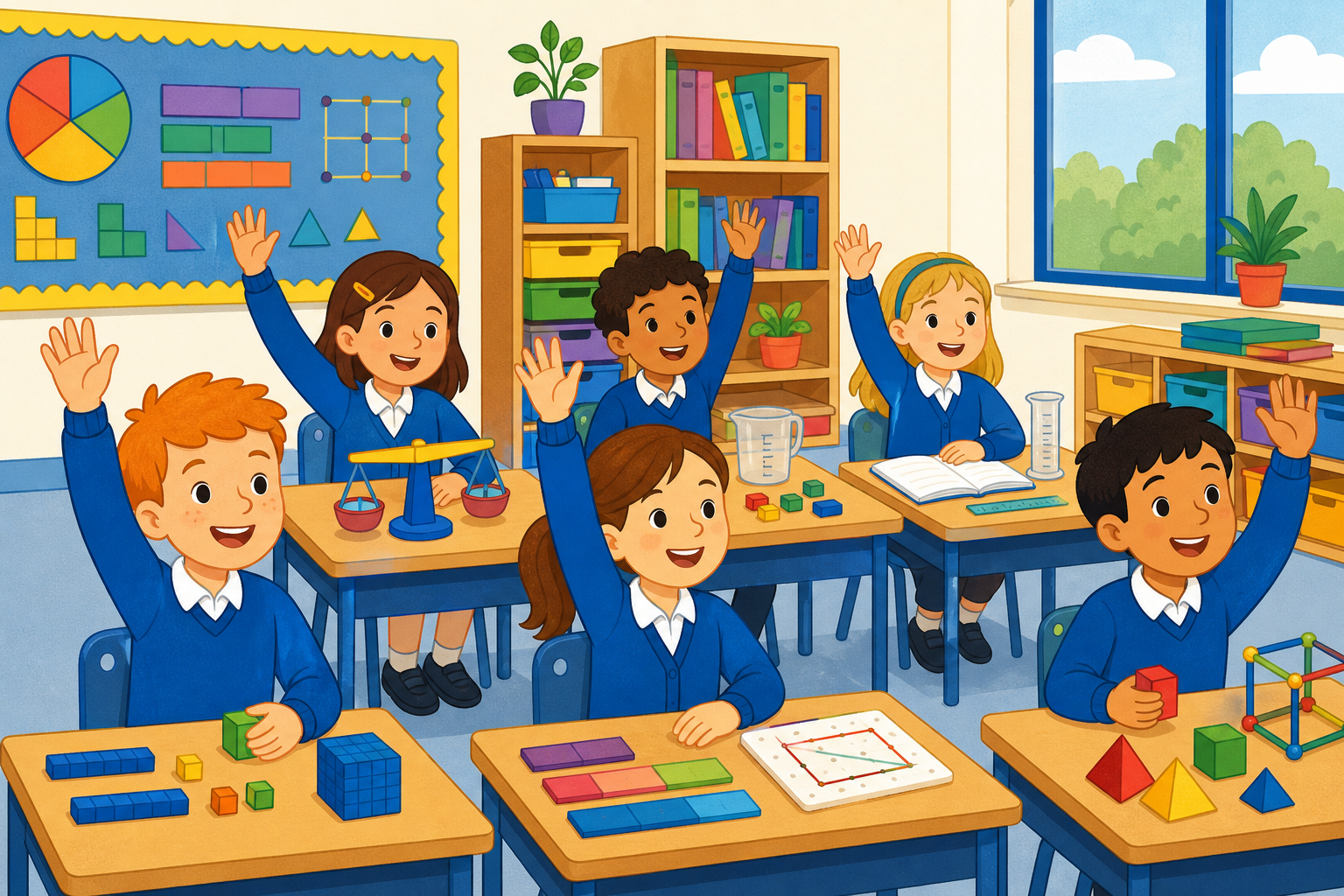
Hands up: how many fingers do you think there are in our whole class, if everyone holds up all ten? Could that number pass one hundred?
Now look at these three numbers. What is the same and what is different about them? 234, 305, 470.
Take three hands-up answers for the finger question, not open call-outs. Give five seconds of quiet think-time before any hands go up.
Then put the three numbers on the board and ask what's the same, what's different — you are listening for pupils noticing they all have three digits, and that two of them have a zero. Don't resolve the zero yet; that is the lesson.

Watch what happens when we have ten ten-rods. We trade them in for one hundred-flat. Ten tens make one hundred, just like ten units made one ten.
Now look at this number built with blocks. Two hundred-flats, three ten-rods and four units. We read each column in turn: two hundred, thirty, four.
Look hard at the tens column on this one. What do you notice sitting there?
This time the empty column has moved. Which column has nothing in it now?
Walk each example aloud, one at a time.
The zero is the make-or-break idea — do not move on until the class can say what the zero is doing in 305 and 470.
Let's build some numbers together. I'll call out a number, one of you builds it on our place-value mat in the hundreds, tens and units columns, and then we'll all read it back and check the columns are right. While one of you is at the board, the rest of us watch the mat and get ready to read the number aloud together.
This round is for talking it through together — one pupil builds at the board while the rest of the class watches the mat and reads the answer back aloud.
Call a number under 1,000, have one pupil build it on the mat, then ask the class to read it back and confirm. Rotate four pupils through. Deliberately include one number with a zero in the tens (e.g. 206) and one with a zero in the units (e.g. 340) so the class keeps practising the place-holder idea. Revoice a strong answer: so the zero keeps the tens column empty, and that keeps the 2 in the hundreds.
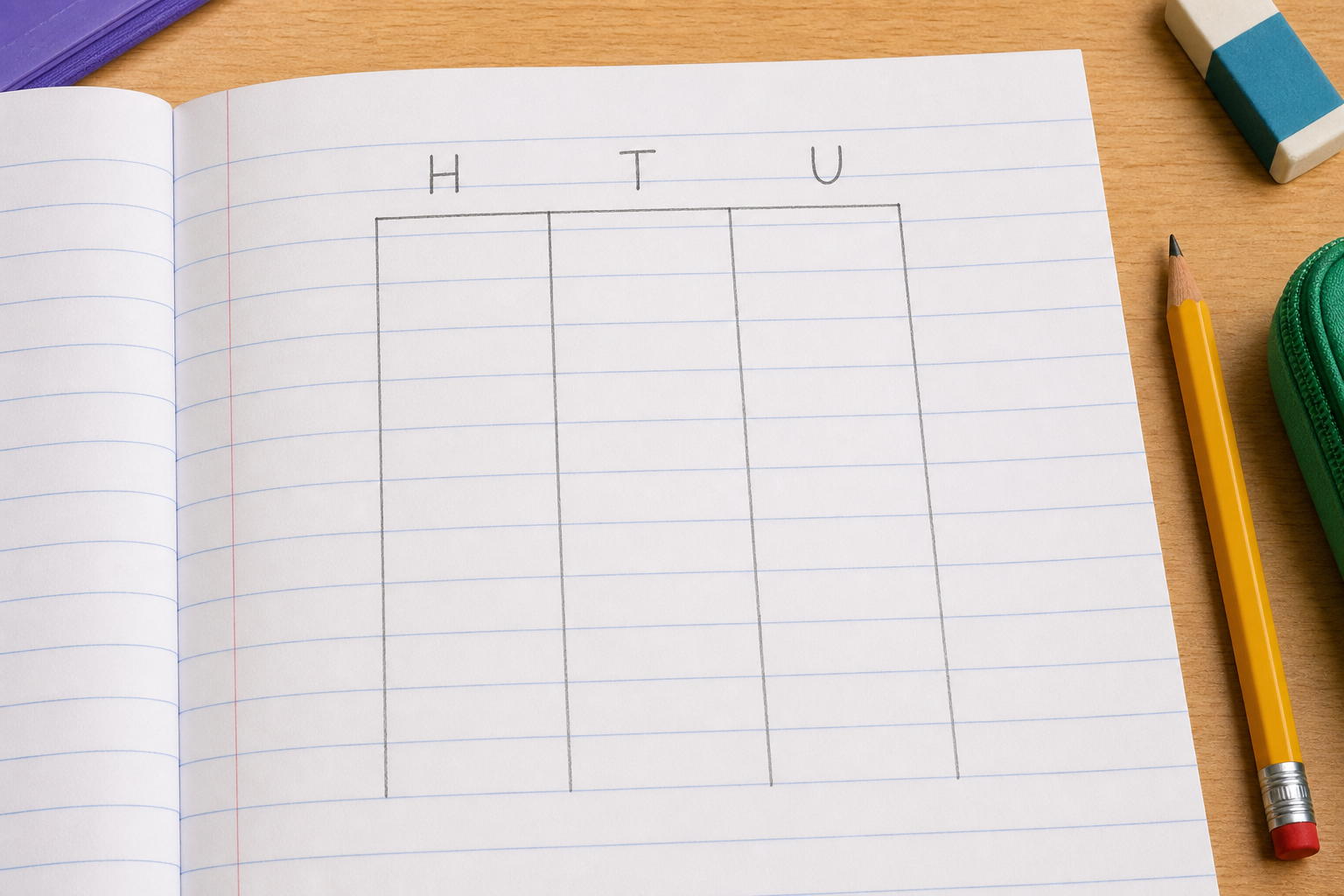
In your maths copy, sketch the three place-value columns and label them H, T and U. Then write each of these numbers into the columns, one under the other. Read each number aloud after you write it.
Walk the room glancing at column labels and alignment — no marking, this is whole-class copybook practice. Watch that pupils put the zero in 308 and 450 in the right column rather than leaving a gap or dropping it.
Now we'll build some fresh numbers together: 206, then 540, then 803, then 707. Before a pupil builds each one at the board, the whole class predicts the columns out loud. Then the pupil builds it and presses Check, and we all read it aloud. The zeros catch people out, so listen carefully for where each zero sits.
This round is the practice bank — one pupil builds at the board, presses Check, and the class confirms before moving on. Keep the board work brisk rather than over-explaining.
For each target ask the class to predict the columns first, then a pupil builds and presses Check. The callout for this bank: what's tricky about the zero here? 206 has the zero in the tens; 540 has it in the units; 803 has it in the tens; 707 has the zero in the middle. Confirm the ✓ each time with a quick yes — that's it.
One pupil says the value of a number is decided by its biggest digit. Another says it is decided by where the digit sits. Who is right, and how would you settle it?
Look at these two numbers. They use the very same digits, 3, 0 and 5. Are they the same number?
In 305 the 3 sits in the hundreds, so it is worth three hundred. In 350 the 3 still sits in the hundreds, but the 5 has moved to the tens. The column does the deciding.
Listen for pupils naming position as the decider, not the size of the digit. Point to 305 and 350 side by side: same digits, very different numbers. Revoice a strong answer: so the 3 is worth three hundred in 305 because it sits in the hundreds column — the column does the deciding.
Next we look at the two ways of writing every three-digit number — in digits and in words — and how the two must always match.
Quick recap on the three points. The pupil activity-book page on this lesson gives them the pencil-and-paper practice on building and reading three-digit numbers with zeros.
You're previewing this lesson. Get full access to this lesson and hundreds more — each one ready to teach, with interactive activities, printable resources and pupil progress tracking built in.