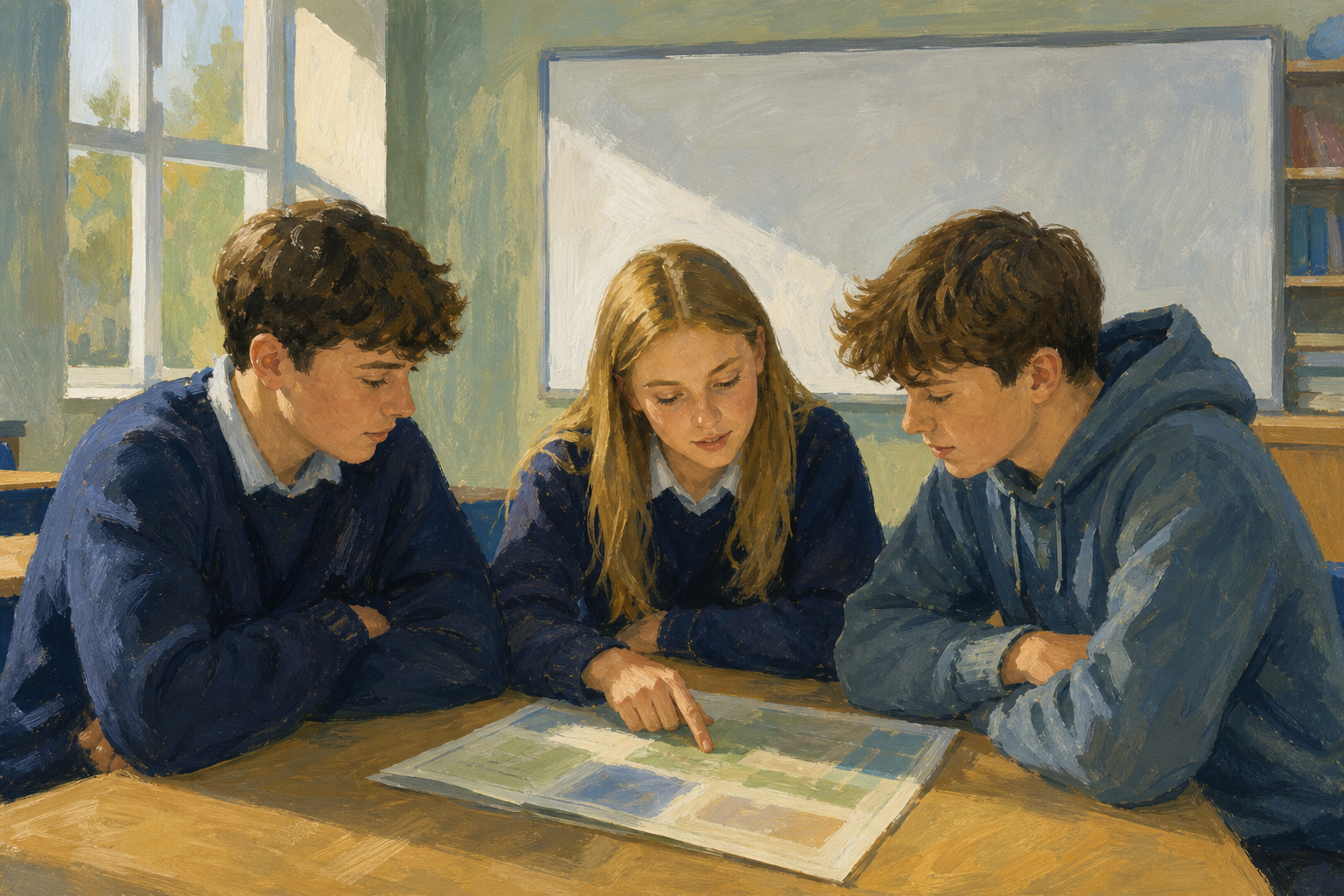
 Today is about people who changed something for human rights. Not because they were famous, but because a specific thing was different afterwards, for other people, because they acted.
You will work in threes, take one real story, and tell it clearly in under two minutes. By the end you should be able to say what the situation was, what the person or group did, and what changed.
A human rights story for this class has three parts, and all three matter.
- The situation: whose rights were missing, ignored or under attack?
- The action: what did one person, or a small group, actually do?
- The change: what was different afterwards for other people, not just for the person who acted?
Fame is not the test. A quiet court case that changes a rule can matter more than a famous speech that changes nothing. Working alone is not the test either. Many of the strongest stories involve people who organised others, kept going for years, or used the law when shouting was not enough.
Your job in a few minutes is not to admire a hero. It is to tell the three parts clearly enough that someone who never heard the name still understands what changed.
You work in threes. Your group gets one source card: your teacher gives you its number, and all nine are at the end of this step. Nobody swaps cards to find a "better" story.
Prepare (5 minutes)
Read your card together. Pre-assign roles before you start talking:
- Speaker 1: the situation
- Speaker 2: the action
- Speaker 3: the change
Agree the three parts in your own words, then rehearse once standing, keeping inside 90 seconds. You can look at the card while you speak, but do not read it out word for word. Add one sentence on why this story belongs in a human rights lesson, not just a history lesson.
Stay on situation, action and change. If a card feels heavy or upsetting, tell your teacher straight away.
Present to the class (about 8 minutes)
Your teacher will call about half the groups (roughly four or five). Each group has up to 90 seconds. When your group is done, sit down straight away so the next group can start. A visible timer is running.
Patterns so far (2 minutes)
When the first groups have finished, call out anything you have already heard in more than one story.
Story swap (about 5 minutes)
Groups that did not present to the whole class now tell their story in mixed pairs (two students from different groups). Listeners note one pattern they hear. This way, every group gets to tell its story.
The nine source cards
Card 1: Eleanor Roosevelt
- Situation: After the Second World War, the world had no shared written list of the rights every person should be able to claim from their government.
- What she did: As a leading member of a United Nations commission, she chaired and drove the drafting of the Universal Declaration of Human Rights, arguing the text had to be clear enough for ordinary people, not only for lawyers.
- What was different afterwards: In 1948 the UDHR was adopted. It became the foundation later human rights treaties, constitutions and court arguments still draw on.
Card 2: Rosa Parks
- Situation: In Montgomery, Alabama, local rules forced Black passengers to give up bus seats to white passengers and to sit in separate sections.
- What she did: In 1955 she refused to give up her seat when ordered to, was arrested, and then supported a long boycott of the city's buses with thousands of other people who walked or shared lifts instead of riding.
- What was different afterwards: The bus segregation rules were struck down. Her refusal became a widely copied example of peaceful resistance to an unjust local law.
Card 3: Nelson Mandela
- Situation: Under apartheid in South Africa, the law denied most people equal rights and equal political power because of race.
- What he did: He opposed that system, spent 27 years in prison for it, and after release helped lead a move toward a peaceful democratic settlement rather than revenge.
- What was different afterwards: Apartheid laws were dismantled. A new constitution promised equal rights, and he became president after the first election in which all adults could vote.
Card 4: Malala Yousafzai
- Situation: In her home region, girls were being stopped from going to school, and speaking for their right to learn was treated as dangerous.
- What she did: As a teenager she spoke and wrote publicly for girls' education. After a violent attack meant to silence her, she continued to argue that every child should be able to learn in safety.
- What was different afterwards: Girls' education was treated more clearly as a right in public debate worldwide. Governments and international bodies faced stronger pressure to protect girls' access to school, and she kept using that attention to press the case.
Card 5: Sophie Scholl
- Situation: In Nazi Germany, open criticism of the state was crushed, and many people stayed silent out of fear.
- What she did: With a small student group known as the White Rose, she helped write and distribute leaflets that named the regime's crimes and called on people to resist.
- What was different afterwards: After her death the leaflets were copied and passed on more widely. In postwar Germany her example was used in schools and public memorials as clear proof that some people had refused to pretend they did not know.
Card 6: Wangari Maathai
- Situation: In Kenya, communities faced serious deforestation, and many women had little voice in decisions that shaped their land and livelihoods.
- What she did: She organised ordinary people, especially women, to plant trees, restore local environments, and speak up for democratic rights when those rights were under pressure.
- What was different afterwards: Huge numbers of trees were planted and local groups gained practice in acting together. She showed that care for the environment and respect for human rights can strengthen each other, and she became the first African woman to win the Nobel Peace Prize.
Card 7: The Birmingham Six
- Situation: Six men from Northern Ireland living in Birmingham were convicted of pub bombings they did not commit, and spent years in prison under those convictions.
- What they did: From prison, with their families and lawyers, they kept challenging the evidence through the courts and public attention, refusing to accept a safe quiet life as the price of a false confession narrative.
- What was different afterwards: Their convictions were quashed. The case pushed harder scrutiny of police evidence and confessions in the UK, and showed how using the law, over years, can correct a catastrophic wrong.
Card 8: Hanna Sheehy-Skeffington
- Situation: In early twentieth-century Ireland, women were shut out of equal voting rights and treated as second-class in much of public life.
- What she did: She spoke, wrote, organised meetings and protested for women's right to vote and for women's full place in Irish public life, and she kept going through personal loss and opposition.
- What was different afterwards: Women won the vote and equal political rights became the normal legal position in Ireland. Her work is part of why a girl in your class today can take equal citizenship for granted.
Card 9: Frederick Douglass
- Situation: In the United States, slavery denied millions of people any legal rights over their own lives, labour or families.
- What he did: After escaping slavery he wrote, spoke and argued in public for abolition and for equal citizenship under the law, using his own experience as evidence.
- What was different afterwards: His arguments helped shift public opinion against slavery. After slavery ended he kept pressing for equal rights, insisting that freedom on paper was not enough without equal standing in law and public life.
Look at the patterns the class just heard.
Talk together:
- Which actions cost the person something real (time, safety, reputation, years of their life)?
- Which changes were rules or laws, and which were public attitudes?
- Where did somebody act with others, not only alone?
On your own, one sentence: Name the one thing your person or group did that you could imagine doing a smaller version of in your own school or community. Not the fame. The action.
Example shape: "They kept asking for a fair hearing when nobody wanted to listen, and I could do a smaller version of that by…"
Unlock the full learning experience
You're previewing this lesson. Get full access to this lesson and hundreds more — each one ready to teach, with interactive activities, printable resources and pupil progress tracking built in.
This lesson is copyright of 123Learn.ie 2017 - 2026. Unauthorised use, copying or distribution is not allowed.