1 - Introduction ~5 mins
Welcome
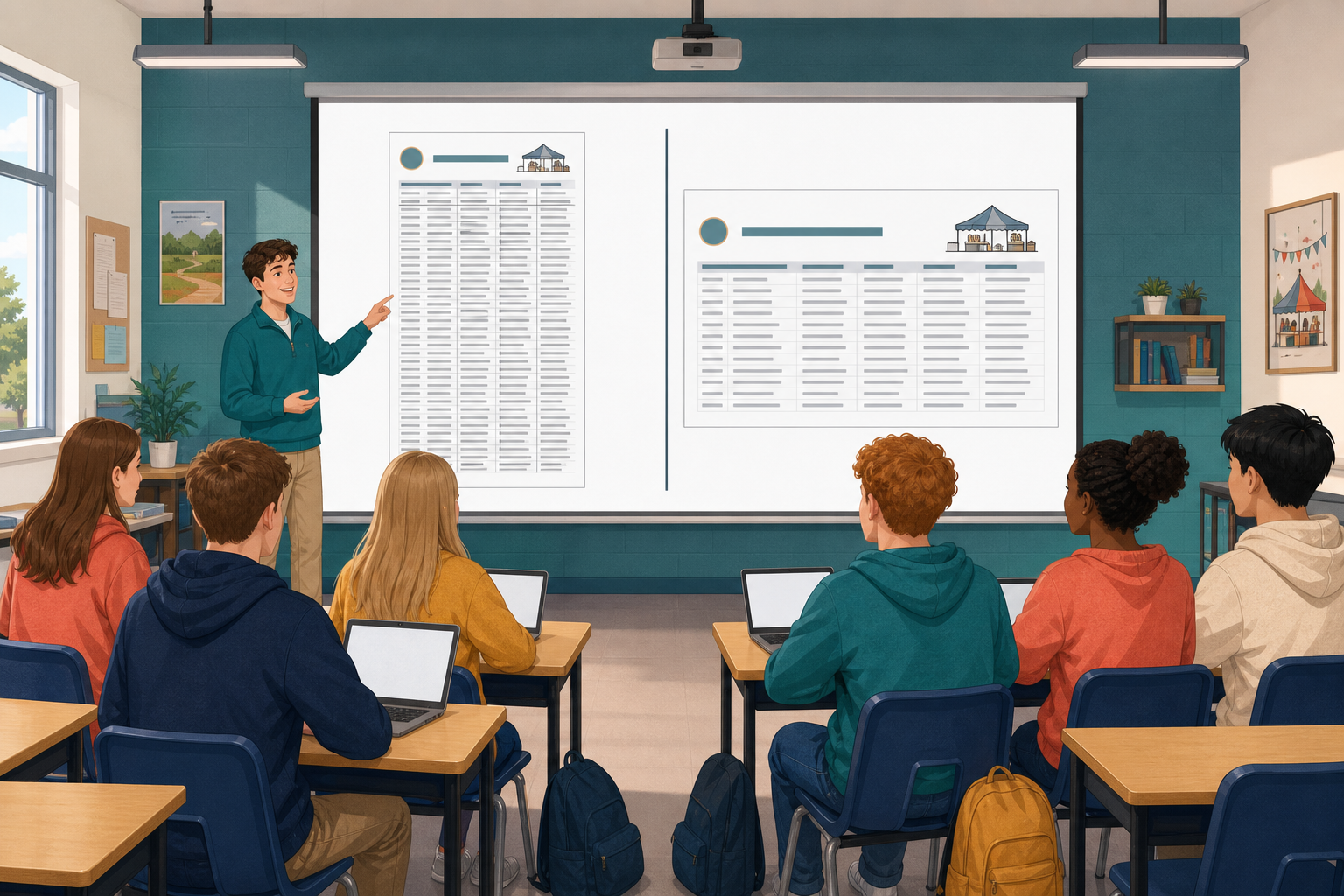 Some project content is too wide for a portrait newsletter page: a multi-column rota, a Work Experience week planner, or a wide evidence table. Today you will use section breaks so one page can sit in landscape while the rest stays portrait.
You will work on the newsletter you started earlier for your own real project, the one you are building for a real audience outside this room. That newsletter goes into your portfolio, and your teacher will check the landscape section against the success criteria at the end.
By the end of today you will be able to split a document into sections so portrait and landscape pages can sit in the same file, put a wide table or image on the landscape page while everything else stays portrait, and say why that page needed the extra width.
2 - Key Concepts ~6 mins
Mixed page orientation is not a whole-document setting. You split the document into sections, then set orientation on the section that needs the wider page.
| Concept | Why it matters | Example |
|---|---|---|
| Section break — a marker that splits one document into separately controlled parts | Without a section break, changing orientation usually flips every page, not just the wide one | Place a Next Page section break after your newsletter articles, then set only the new section to landscape for the stall roster |
| Apply to this section — the option that limits layout changes to the current section only | Stops a landscape fix from wrecking the rest of a polished portrait document | In Google Docs Page setup (or Word Page Setup), choose Apply to: This section before OK so only the roster page goes landscape |
Quick glance: Portrait suits most body text; landscape suits wide tables and side-by-side images. Use mixed orientation only when one piece of content is genuinely too wide for portrait (for example a Work Experience week planner), not for a short three-line notice.
Worked example you will build
In the step-by-step task you will create a short practice newsletter for a small side hustle, Harbour Side Snacks. You type a few portrait lines (or open a pre-seeded file), insert a section break, switch the next page to landscape, add a wide stall roster table, then return the following section to portrait. That is the same pattern you will then apply to your own Something Real newsletter.
3 - Step-by-step Task ~17 mins
If you are on Windows or Mac with Microsoft 365, open the file and then stay in desktop Word for every step after that, because Word in the browser cannot insert section breaks at all. If you are on a Chromebook, desktop Word is not available to you, so follow the Chromebook steps inside the Microsoft path (they open Google Docs) or use the Google Docs branch instead. Anyone else without desktop Word should also use Google Docs.
Follow the instructions for your word processor to add a landscape section and a wide stall-roster table to a short practice newsletter. Your teacher will demonstrate the section-break workflow on the classroom screen first, then you complete the same steps on your own machine.
If typing is slow for you: your teacher may have placed {{code:sm1_orientation_practice}} in your {{code:sm1}} folder with the portrait lines already typed. Open that file and start at the section-break step. What is being checked is the break, then the orientation, then the table, then the return to portrait, not how fast you type.
This is the fiddly bit — lots of people flip the whole document the first time. If that happens, undo, check the section break, and try again. You have not broken anything.
4 - Common Issues ~3 mins
Common Issues
If your screen looks wrong, it is almost always the break type or Apply to setting — use the row that matches what you see, fix it, and carry on.
| Issue | Solution |
|---|---|
| Every page became landscape, not just the new one | Undo the orientation change. Make sure you inserted a section break (Next Page / Section break next page) first, place the cursor in the new section, then change orientation again. In Google Docs, Page setup must say Apply to: This section. In desktop Word, open Page Setup with the small dialog-launcher arrow on the Layout tab (Page Setup group), or use Layout → Margins → Custom Margins; set Orientation to Landscape and Apply to: This section, then OK. |
| I only inserted a page break and nothing changed | A normal page break keeps the same section settings. Delete that page break and insert a section break instead, then set orientation on the new section. |
| My wide table still looks crushed on the landscape page | Check you really are on the landscape page (the page should look wider). Then widen columns by dragging the column borders, or reduce font size slightly on the table only. Avoid merging lots of cells in the data area. |
| I am on a Chromebook and desktop Word will not open | That is expected. Use Google Docs for this lesson (Chromebook steps under the Microsoft path, or the Google Docs branch). Do not use Word for the web — it cannot insert section breaks. |
5 - Independent Practice ~20 mins
Independent Practice
- Open the file. Open {{code:Project_Portfolio}} → {{code:09_specialism}} → {{code:sm1}} → {{code:sm1_doc2_newsletter.docx}}. If it is missing, create a short portrait starter (title, one heading, one short paragraph) and save it as {{code:sm1_doc2_newsletter.docx}} in that folder. Microsoft users on Windows or Mac: open it in desktop Word before any breaks. Chromebook and Google Docs users work in the browser as usual.
- Section break. Place the cursor after your last portrait content. Insert a next-page section break (not a plain page break).
- Landscape this section only. Set orientation to landscape for this section only. Scroll back and confirm earlier pages are still portrait before you build the table.
- Wide table. On the new landscape page, add a short title that names what the table is for, then a wide table with at least five columns of project information. Use real names and times if you have them; otherwise use a realistic draft you can replace later.
- Return to portrait. After the table, insert another section break and set the following section back to portrait.
- Save. Keep working in {{code:sm1_doc2_newsletter.docx}} in the same sm1 folder. Do not create a second copy or invent a new filename unless your teacher asks for one.
- Work Experience week grid (Day, Start, Finish, Task, Supervisor, Notes)
- Stall or enterprise price list
- Volunteer rota
- Practical Achievement materials list
- {{code:sm1_doc2_newsletter.docx}} is saved in {{code:sm1}} and includes at least one landscape page after the portrait content
- Earlier newsletter pages remain portrait; only the intended section is landscape; pages after the wide table return to portrait
- The landscape page holds a short title plus a wide table (five or more columns) with real or realistic project data that is easier to read than it would be in portrait
- From the title and table alone, someone can tell at a glance why that page needed landscape
Unlock the full learning experience
You're previewing this lesson. Get full access to this lesson and hundreds more — each one ready to teach, with interactive activities, printable resources and pupil progress tracking built in.
This lesson is copyright of 123Learn.ie 2017 - 2025. Unauthorised use, copying or distribution is not allowed.