1 - Introduction ~5 mins
Welcome
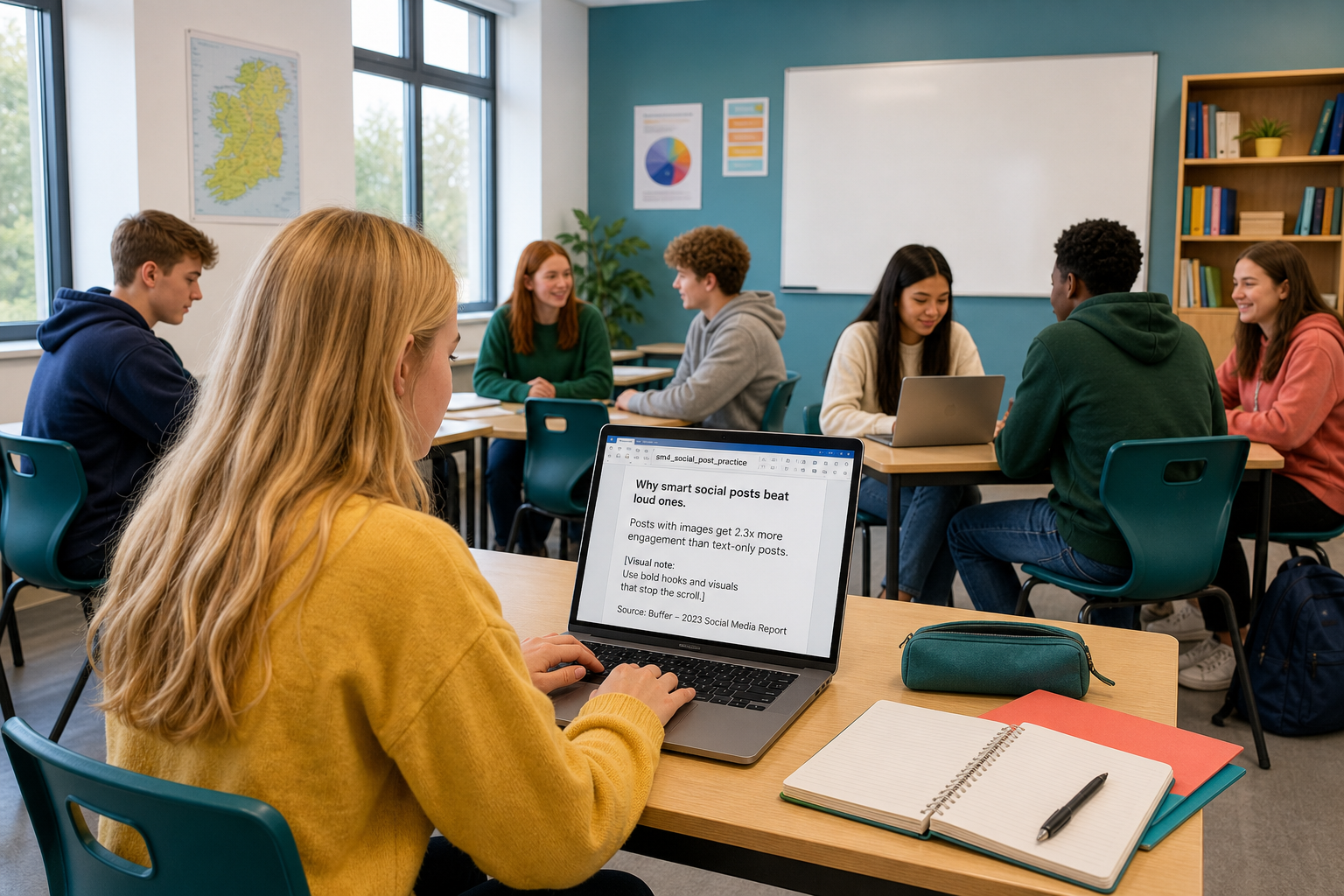 Your investigation already holds real findings. Today you shape one of those findings into a social-style post: short, hook-led, and built for a real audience, without posting to a personal account.
By the end of this lesson you will have a draft ready for a class platform, a document share-back, or for polishing later when you present your investigation.
By the end of this lesson, you will be able to:
- Write findings for social formats with brevity, hook, and visual
- Draft a safe class-only or document-based social-style post
- Present one investigation fact in platform-appropriate language
Warm-up
Think of the last post that made you stop scrolling. Was it the first line, the image, or a number that felt surprising? Hold that in mind: today's draft needs the same job, using one fact from your investigation.
If you do not have one clear fact yet: open the investigation folder you have been saving your work into, {{code:sm4}}, and pick one line from your search log or your references list. If nothing there is ready, use the class sample fact (the apprenticeship deadline mismatch) and note that you are practising with a sample fact today. You will still build a full draft.
2 - Key Concepts ~7 mins
Social posts are short documents with a job: stop the scroll, deliver one clear idea, and leave the reader knowing what to do next. Keep tone and length suited to where the post would live (LinkedIn-style is a few short paragraphs; an Instagram-style caption is tighter lines plus a visual note).
| Concept | Why it matters | Example |
|---|---|---|
| Hook — the first line that earns the next five seconds of attention | Without a hook, even a strong fact gets skipped | “Most Irish small operators still underprice VAT in their first year” beats “I researched pricing.” |
| One-fact rule — one post carries one claim the reader can hold onto | Crowding three findings into one post weakens all three | Pick one line from your investigation, not a summary of the whole topic |
| Visual note — a short label for the image, chart, or carousel slide that would sit with the text | Social formats are visual-first; text alone rarely carries the piece | “Image: simple bar chart of three supplier quotes in euro” |
| Safe draft space — school document or class-only platform, never a personal account for coursework | Keeps Key Assignment evidence controllable and protects your digital footprint | — |
Quick match (with your teacher)
Your teacher will read five draft lines from the board. For each line, say which job it does: Hook, Fact, Visual note, Close, or Tone that fits the platform. One line per job.
3 - Step-by-step Task ~15 mins
Model to copy (LinkedIn-style): Investigation fact — a student comparing local apprenticeship routes found that one ETB page listed application windows that closed two weeks earlier than a second “official-looking” site claimed.
- Hook: Two “official” pages, two different deadlines. Only one was still open.
- Fact: Cross-checking the ETB listing against the second site showed a two-week gap on the same apprenticeship route.
- Why it matters: If you only open the first result, you can miss a live window or chase a closed one.
- Visual note: Side-by-side screenshot labels (dates highlighted) — describe the visual; do not upload personal screenshots of private accounts.
- Source: ETB apprenticeship listing cross-checked against a second public page (use your own reference wording).
- Close: Before you trust a deadline online, open a second independent source. What deadline are you checking this week?
Build this sample structure in a word-processed document. After Hook and Fact are in, you will swap the Fact for one line from your own investigation (or the class sample). You will mirror the full layout with your own draft next.
4 - Common Issues ~3 mins
Common Issues
| Issue | Solution |
|---|---|
| My hook is just the topic title (“My investigation on pricing”) | Rewrite the first line as a claim or tension the reader cares about. Ask: what would stop a busy adult mid-scroll? |
| I packed three findings into one post | Cut back to one fact. Move the extras to a second draft or to a later carousel slide note. One post, one job. |
| I want to paste this straight onto Instagram or LinkedIn | Do not. Keep this practice work in {{code:sm4_social_post_practice}} (your own investigation version will be {{code:sm4_social_post_draft}} next), or the school’s class-only space. Personal posting is outside this lesson and risks your footprint and your evidence trail. |
| My fact is interesting but I cannot remember the source | Open your search log or references list in {{code:sm4}}, copy the source line under the Fact section as {{code:Source:}}, then keep writing. Unsourced claims do not belong in KA-ready work. |
5 - Your Draft ~20 mins
Independent Practice
On-screen checklist: Hook · Fact · Why it matters · Visual note · Source · Close · Platform choice
- {{code:sm4_social_post_draft}} sits inside {{code:sm4}} and opens cleanly
- The first line works as a hook a stranger could understand without your full investigation title
- The body carries exactly one clear fact, a short why-it-matters line, a visual note, a source line, and a close
- A platform-choice sentence is present, and the tone matches the platform you named
Unlock the full learning experience
You're previewing this lesson. Get full access to this lesson and hundreds more — each one ready to teach, with interactive activities, printable resources and pupil progress tracking built in.
This lesson is copyright of 123Learn.ie 2017 - 2025. Unauthorised use, copying or distribution is not allowed.