1 - Getting Started ~3 mins
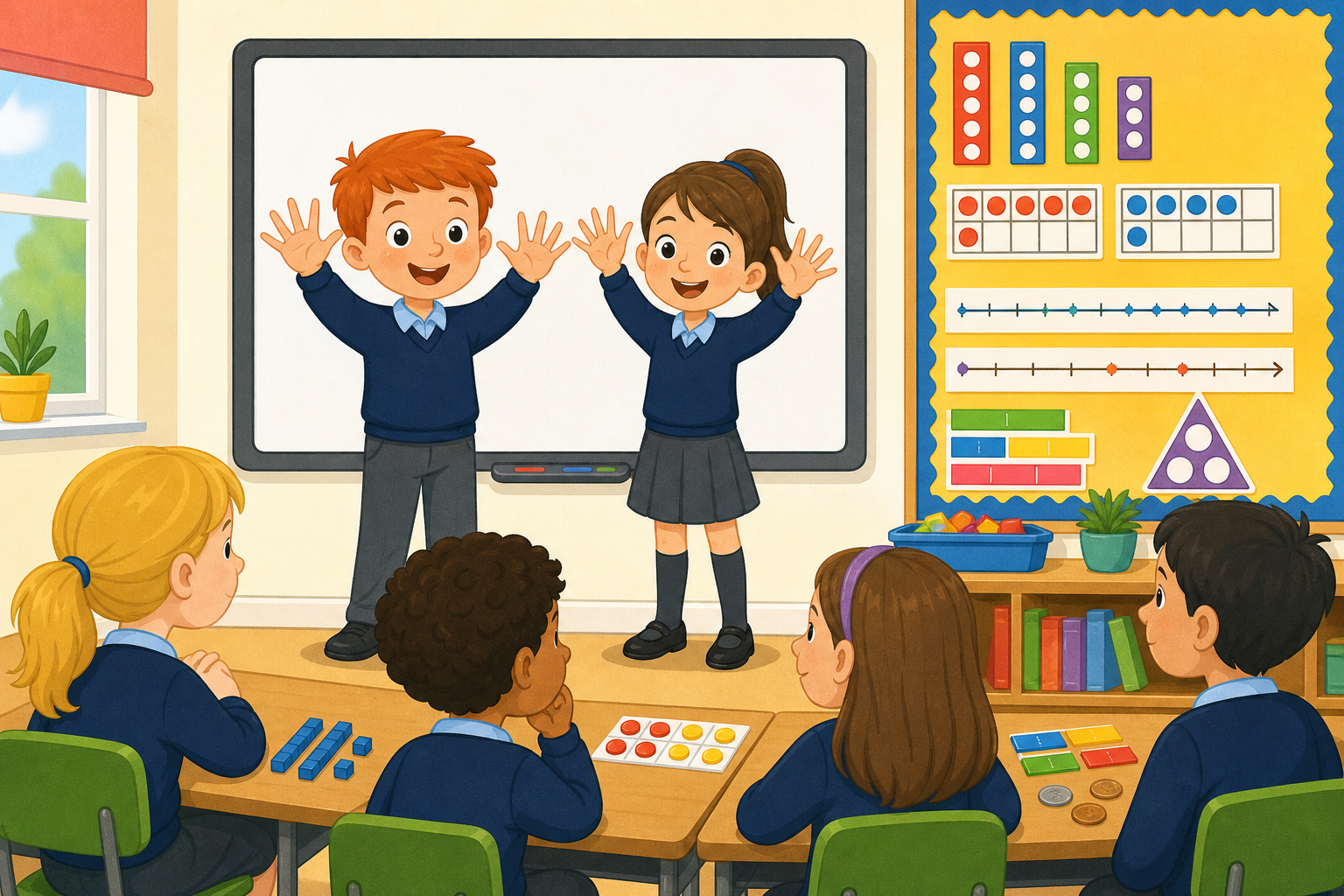 Two of you stand up. Count every finger you can see together — how many fingers altogether?
Could we count them a quicker way than one by one?
2 - Watch and Notice ~8 mins
Look at two ten-frames on the board. Here is 19: a full ten and nine more, with one empty space left.
Now watch what happens when that last space fills and both frames are full.
Both frames are full. That is two full tens.
The 2 at the start of 20 means those two tens. The 0 means no loose ones left.
Look at the number 20. Why do you think it starts with a 2?
3 - Try It Together ~9 mins
We will build a few numbers together on the board, one at a time. We will do 15, then 17, then 19, then 20. Each time, say how many spaces are still empty.
Build 15 to 20
4 - Write 19 and 20 in Your Copy ~4 mins
In your maths copy, write 19 and 20. Then draw two quick tens for 20: two simple bundles or two boxes of ten.
5 - Class Challenge ~9 mins
We will build these together on the board.
We will start by showing 19, then fill that last space to make 20. After that we will build 20 again, first from 16 and then from 12, counting how many more we need each time.
Each time: how many more fill every space?
Fill to twenty
Unlock the full learning experience
You're previewing this lesson. Get full access to this lesson and hundreds more — each one ready to teach, with interactive activities, printable resources and pupil progress tracking built in.
This lesson is copyright of 123Learn.ie 2017 - 2025. Unauthorised use, copying or distribution is not allowed.