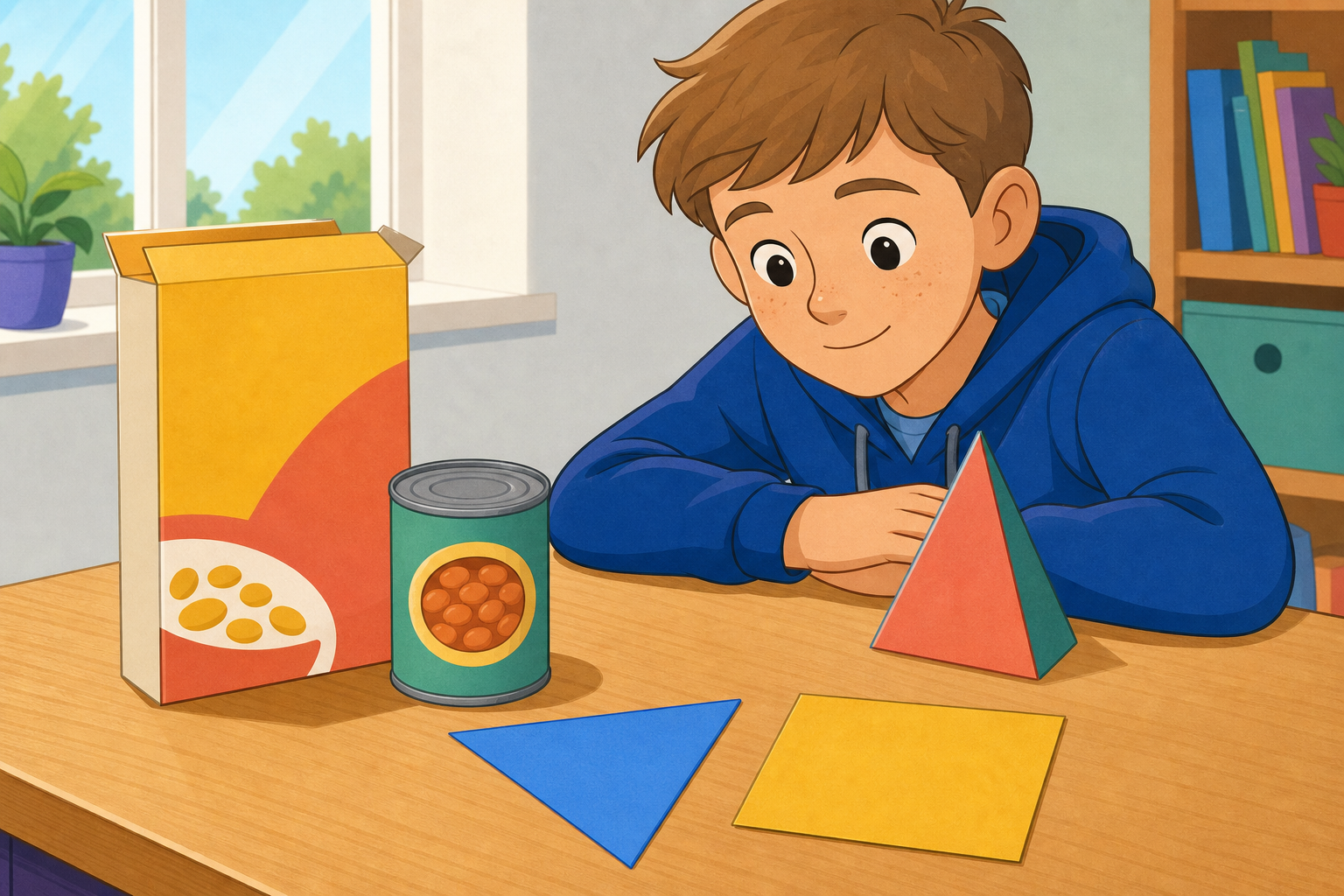
Look at these together: a flat triangle, a flat square, and three solid shapes shaped like a cereal box, a tin of beans and a triangular chocolate packet. What is the same about them, and what is different? If you had to put them into groups, what would you sort them by?
Take three hands-up answers, not open call-outs. The on-screen shapes (or the lesson photo) are the canonical opener; showing a real cereal box, tin and triangular packet beside the flat shapes is an optional upgrade if you happen to have them to hand.
Listen for the natural sorting ideas pupils offer (number of sides, flat vs solid, round vs straight) — you will return to these in the wrap.
Watch as each property is revealed one at a time. First the sides, then the corners (we call a corner a vertex, and more than one are vertices), then the lines of symmetry — these are the fold-lines, the lines you could fold the shape along so both halves match exactly. A triangle has three sides and three vertices.
Now the square. Look at the sides, the vertices and the fold-lines. Two of its sides are parallel — that means they run alongside each other and never meet, like the two rails of a train track. A square has four equal sides, four vertices, two pairs of parallel sides and four lines of symmetry.
This is a regular hexagon — every side is the same length. Notice how many fold-lines it has compared with the trapezium below.
The trapezium also has four sides, but they are not all the same. How many fold-lines does it have? Predict before the reveal.
Before we move on to the solid shapes, name one thing you have spotted so far that tells two four-sided shapes apart.
Now solids. Watch as we count the flat faces (the flat sides you could lay on a table), the edges where two faces meet, and the vertices (the corners). A cube has six faces, twelve edges and eight vertices.
A triangular prism has five faces, nine edges and six vertices — count them as each part lights up.
The cylinder bends the rules. The smooth round part wrapping around it is not a flat face — we call it a surface instead. Counting that curved surface and the two flat circles, a cylinder has three surfaces, two edges and no corners at all. Tap each part to count it — that makes the curved surface much easier to spot.
Walk each example aloud, one at a time, revealing one property before naming the next.
Now we try it together. The whole class predicts first, then the teacher brings a pupil up in turn to reveal and check — your job from your seat is to predict and agree, not to come up unless you are called.
For the flat shape on the board, call out its sides, its vertices, its parallel sides and its lines of symmetry, then a pupil reveals each property to check. Next we look at a solid shape, rotate it on screen, and count its faces, edges and vertices. Count along with the rotating shape on screen — and if your group has a box or polydron solid, count round that too.
This round is for talking it through together — the whole class predicts, you bring pupils up in turn, and the class agrees or corrects out loud.
Start with the 2D inspector: display the rhombus, have the class predict the count, then bring a pupil up to reveal and confirm. Rotate four or five pupils through.
Switch to the 3D inspector for the second half. As a pupil rotates the cuboid and taps to count faces, edges and vertices, the rest of the class verifies the same count on the rotating shape on screen, or on a real box or polydron solid if their group has one. Watch for pupils who lose track while rotating — encourage a system (count the top, then the bottom, then the sides).
In your maths copy, sketch a square on the left and a cube on the right. Beside the square, write its counts: sides, vertices, pairs of parallel sides, and lines of symmetry. Beside the cube, write its counts: faces, edges and vertices. Put them side by side so you can compare the 2D shape with the 3D shape at a glance.
Walk the room glancing at the labels and counts — this is whole-class copybook practice, not marking. Common slip: pupils write the cube's edges as 8 instead of 12; prompt them to count along the top, bottom and sides separately.
Today we sort a mix of shapes into groups. First we sort just the flat shapes by how many sides they have. Then we sort just the solids by how many faces they have. Next we group the flat shapes by how many lines of symmetry they have, and the solids by how many vertices they have.
One tricky one to finish: find ALL the 3D shapes that have twice as many edges as faces.
This round is the practice bank — pupils take turns at the board, check each answer, and the class confirms before moving on. Keep the board work brisk rather than over-explaining.
The first two rounds are the access tasks — everyone can sort flat shapes by sides, then solids by faces (the triangular prism and square pyramid each have five faces; the cube and cuboid each have six). Keeping sides and faces in separate rounds means nobody has to bucket two different counts under one rule.
The lines-of-symmetry round is harder: the scalene triangle has none, the rectangle has two (not four — a common error), the square has four.
For the stretch, expect more than one answer: the cube (12 edges, 6 faces) AND the cuboid (12 edges, 6 faces) both qualify, while the triangular prism (9 edges, 5 faces) and square pyramid (8 edges, 5 faces) do not. Let pupils reason each one out and check; revoice the correct reasoning and confirm that two shapes can both be right.
A square, a rhombus and a trapezium all have four sides. So which property tells them apart? And of our three 3D counts — faces, edges and vertices — which one is hard to apply to a sphere or a cylinder?
Listen for pupils naming the distinguishing 2D properties — parallel sides and lines of symmetry are what separate the four-sided shapes, since side-count alone does not. Revoice: 'so counting sides isn't enough — we have to look at the symmetry and the parallel pairs too'.
For the 3D part, draw out that a sphere has no flat faces, no edges and no vertices, and the cylinder's curved surface stretches the meaning of 'face' — which is why these shapes feel like rule-benders.
Next we take the solids apart and lay them flat. We will discover how a flat shape called a net folds up into a cube or a cuboid, with no gaps and no overlaps.
Keep this brief. Pupils now move to their Activity Book page for paper practice while you circulate.
You're previewing this lesson. Get full access to this lesson and hundreds more — each one ready to teach, with interactive activities, printable resources and pupil progress tracking built in.