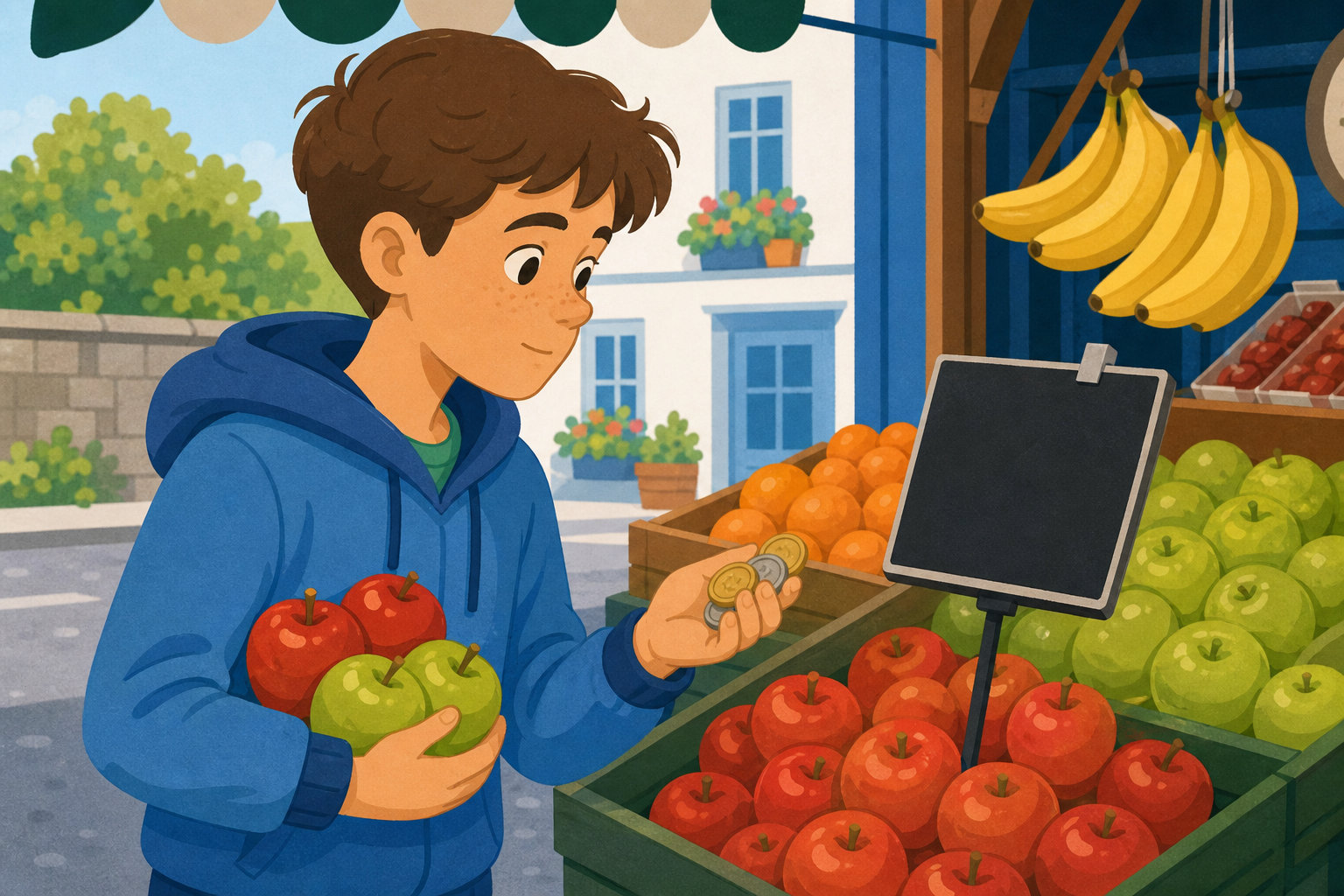
Here is a shopping question. A shop sells apples at €0.60 each, and you buy 4 of them. Before we work anything out: hands up, do you think you will pay more than €4 or less than €4? Give me a reason for your guess.
Each display draws the multiplication as a rectangle: the two numbers are the sides, and the area inside is the answer. We work with the whole numbers first, with the decimal point taken out, and then we put the point back in. Watch where it lands each time, and count how many figures sit after the point in the question.
Today we work through these together, building the whole-number core on the area model and then counting the point back in: 6 × 4, then 8 × 7, then 25 × 4. For each one, before we place the point we say the decimal version aloud and predict how many places back we need: 0.6 × 4, then 0.8 × 7, then 0.25 × 4. Watch how the last one surprises us when the point lands.
In your maths copy, write each calculation as a whole-number product first, then count and insert the decimal point. Beside each one, note how many decimal places you counted.
Before we start, let's warm up our estimating: 0.35 is a bit more than 0.25 and a bit less than 0.5, so 0.35 × 8 should land somewhere between 2 and 4.
Now we build our way to a target using decimal multiplication. Work through these in order, each a little trickier than the last: 0.35 × 8, then 2.04 × 7, and finally 1.6 × 9. Before each one we estimate roughly what it should be, so we know where the point belongs. If you finish early, there is a stretch: 1.25 × 6.
You're previewing this lesson. Get full access to this lesson and hundreds more — each one ready to teach, with interactive activities, printable resources and pupil progress tracking built in.