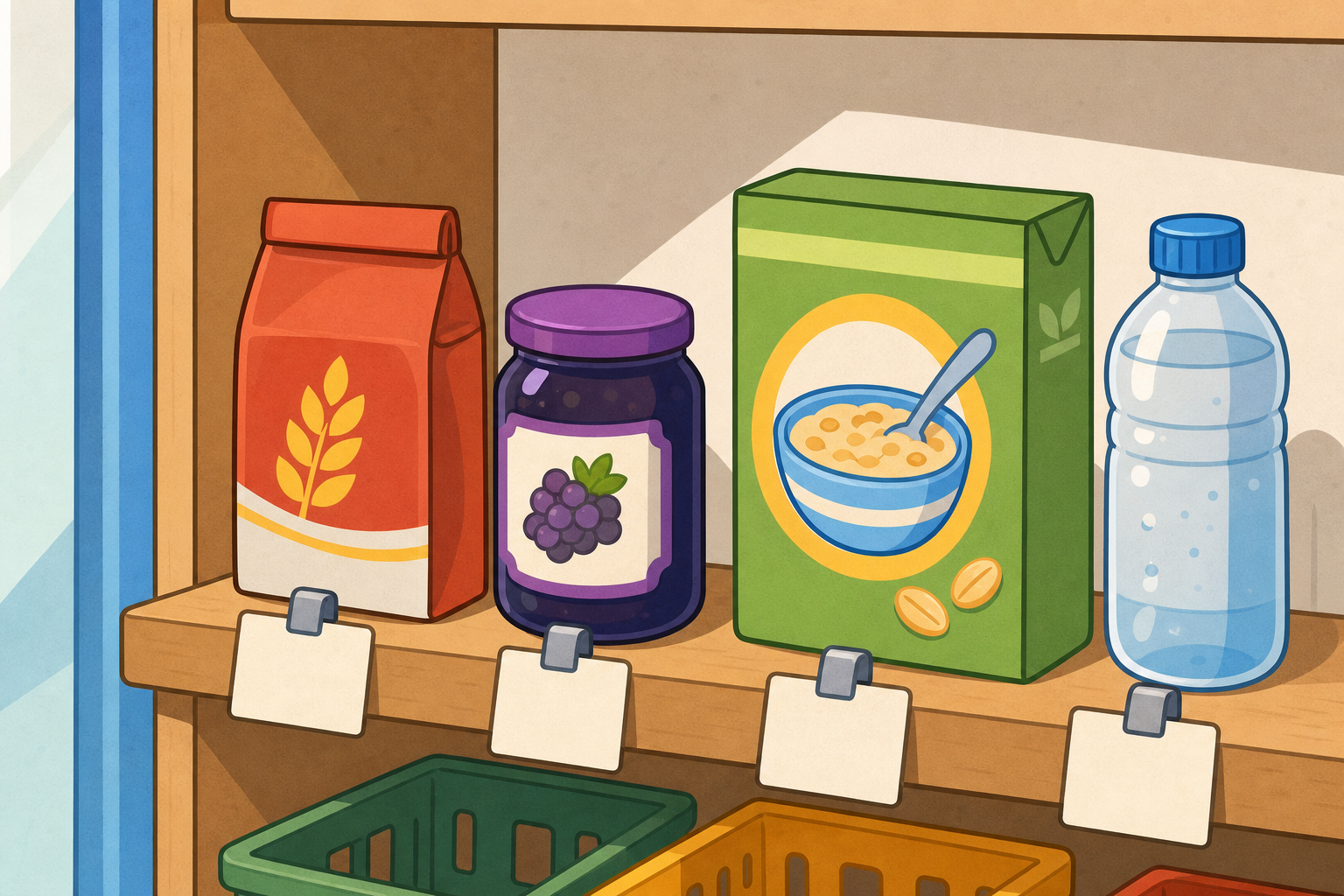
Here is our class fraction shop. Every price is written a bit differently: some are fractions of a euro, some are decimals, and some are marked with a percent off.
Here is today's challenge, and it's a real puzzle: can you spend exactly €10 in this shop, not a cent more or less? Before we work anything out, what would we need to know about each item to be sure we've spent precisely €10?
Here is our first item. Watch how we read the price tag. The tag says 50% off, and 50% is just another way of writing one half. Half of €4 is €2, so this item really costs €2. We turned the percent into the fraction that was easiest to work with.
Now the trickier one. This voucher is worth €20 and the tag says a quarter off. A quarter of €20 is €5, so the discount is €5. But careful, that's the amount we take away, not the price we pay. Twenty take away five leaves us paying €15. Predict before I reveal the next one: if the tag had said 0.25 off instead of a quarter off, would anything change?
Here is the key one. A quarter, 0.25 and 25% are the very same amount. That is why the voucher answer is identical whichever form the tag uses. In our shop, the form on the tag is just a disguise. The real price underneath never changes.
Let's build one €8 basket together on the board using items from our shop list. Today we work through these three in order, saying each one's real price aloud before we add it on:
We'll find each real price, keep a running total on the board, and see whether these three land us exactly on €8 — or whether we need to swap one out. If we overshoot, we can swap the snack at €1.50 for the juice at 50% off €1 and see what that does to the total.
Find the real price of each of the three shop items, keep a running total, and decide whether they make exactly €8.
Ways to start:
Stretch:
In your maths copy, sketch the shop's price list as a small table. Give each item its own row, and write that item's price in all three forms across the row: as a fraction, as a decimal, and as a percent. Then circle the one form on each row that you would actually use to work out the price.
Start with the comic row together on the board. The tag is a plain amount, €2.50, so the three forms are:
Circle the decimal on that row, because the price is already ready to add. Then complete the other five rows yourself from the shop list. For tags written as a fraction or a percent off, write that same amount as a fraction, a decimal and a percent, the same way we swapped between the three forms on the board a few minutes ago. Circle the form you would actually use to find each real price.
Now for the main challenge, working only from our shop list on the board:
Turn each disguised price into its real euro amount, then find three different combinations that each total exactly €10. Work them in your copy, keeping a running total as you add each item. The stretch asks whether you could ever buy five of the six items for exactly €10.
Turn every shop tag into its real euro price, then find three different baskets that each total exactly €10.
Ways to start:
Stretch:
You're previewing this lesson. Get full access to this lesson and hundreds more — each one ready to teach, with interactive activities, printable resources and pupil progress tracking built in.