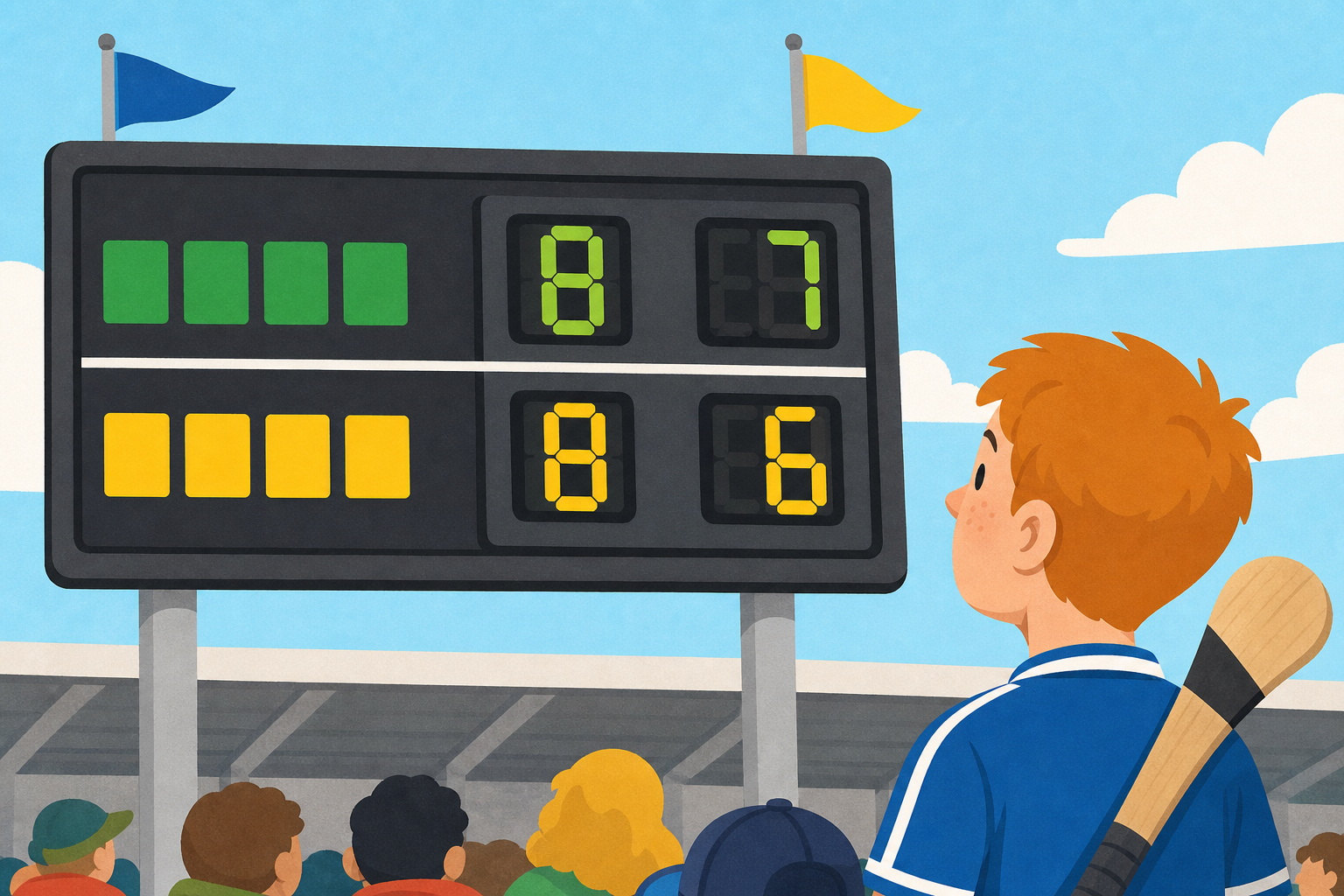
Here is a subtraction from a hurling scoreboard: 53 − 48.
One way is to count back: start at 53 and take away forty-eight, jump by jump. Another way is to count up: start at 48 and see how far it is up to 53. Which way would you pick, and why?
Put your hand up to share. There is no wrong answer yet — we are just thinking out loud.
Display the two numbers and take two or three hands-up answers. Don't resolve which is better yet — let the noticing sit. The point pupils should land on: 48 and 53 are close, so jumping back forty-eight times is a lot of work.
Give five seconds of quiet think-time before any hands go up.

Watch as we take away five in small back-jumps. We start at 47 and hop back one at a time until five are gone. Where do we land?
Now one big back-jump of thirty. There is no need for thirty little hops when one tidy jump does it.
This time the two numbers are close together. Instead of counting back forty-seven, we jump up from 47 to 52 to find the gap. How big is that gap?
Again the numbers are close. We jump up from 79 to 84. The size of the gap is our answer.
Walk each example aloud, one at a time.
For the last two, ask why would counting back forty-seven be silly here? before revealing the jump.
Let's work one together at the board: 46 − 4. We decide first — count back to take away, or count up to find the gap? Then a pupil makes the jumps and reads the answer.
While we work, everyone decides the route in your own head. Thumbs up if you agree with the answer on the board, thumbs sideways if you would change something.
After that we call out three more together: 80 − 20, then 63 − 58, then 71 − 67. For each one, say whether you would count back or count up before anyone answers.
This round is for talking it through together. Run only 46 − 4 on the board interactive (its range fits 40–50). The other three — 80 − 20, 63 − 58 and 71 − 67 — are decided and called aloud as a class; do not re-range the board for them. Sketch them quickly on the IWB pen if you want a visual.
Before each one, ask the class: are the numbers far apart or close together? Far apart with a small take-away (46 − 4) suits counting back; close together (63 − 58) suits counting up. Revoice a good choice: so because 58 is nearly 63, counting up is the quick route.
Watch for the common slip on count-up subtractions: pupils read the landing number (63) instead of the gap (5). Catch it by asking how far did we jump?
In your maths copy, write three of the lesson's subtractions, one under the other:
Beside each one, write whether you counted back or counted up, and one word on why you chose that route.
Walk the room glancing at each pupil's choice and reason — this is whole-class copybook practice, not marking. Look for pupils naming "close together" or "small gap" as the reason for counting up.
Now you spot the smart route. We work through these one at a time: 38 − 6, then 70 − 30, then 61 − 58, then 95 − 88. The numbers get closer together as we go, so watch for the moment the gap is small enough that counting up wins.
Decide your route in your head before the pupil at the board starts. Thumbs up when you are ready with a choice.
This round is the practice bank — pupils take turns at the board, check each answer, and the class confirms before moving on. Keep the board work brisk rather than over-explaining.
The bank is ordered so 38 − 6 invites counting back (small take-away, numbers far apart) while 61 − 58 and 95 − 88 strongly reward counting up. For each close pair ask is the gap small enough to count up? before the pupil starts. Confirm each answer with the Check button as part of your narration — yes, that's it.
One pupil says counting up can never really be subtracting, because you are adding jumps. Are they right? Where is the subtraction answer hiding when we count up to find the gap?
Listen for pupils explaining that the length of the gap is the answer — the jumps add up to the difference between the two numbers. Revoice a strong answer: so when we jump up from 58 to 61, the three steps we counted IS the answer to 61 minus 58.
Head off the lingering confusion that the landing number (61) is the answer; steer them back to how far did we travel?
Next we move from jumps in our heads to writing addition down in tidy tens-and-units columns, carrying a ten when a column fills up past nine.
Keep this brief. Recap the one big idea: look first, then choose count back or count up.
You're previewing this lesson. Get full access to this lesson and hundreds more — each one ready to teach, with interactive activities, printable resources and pupil progress tracking built in.