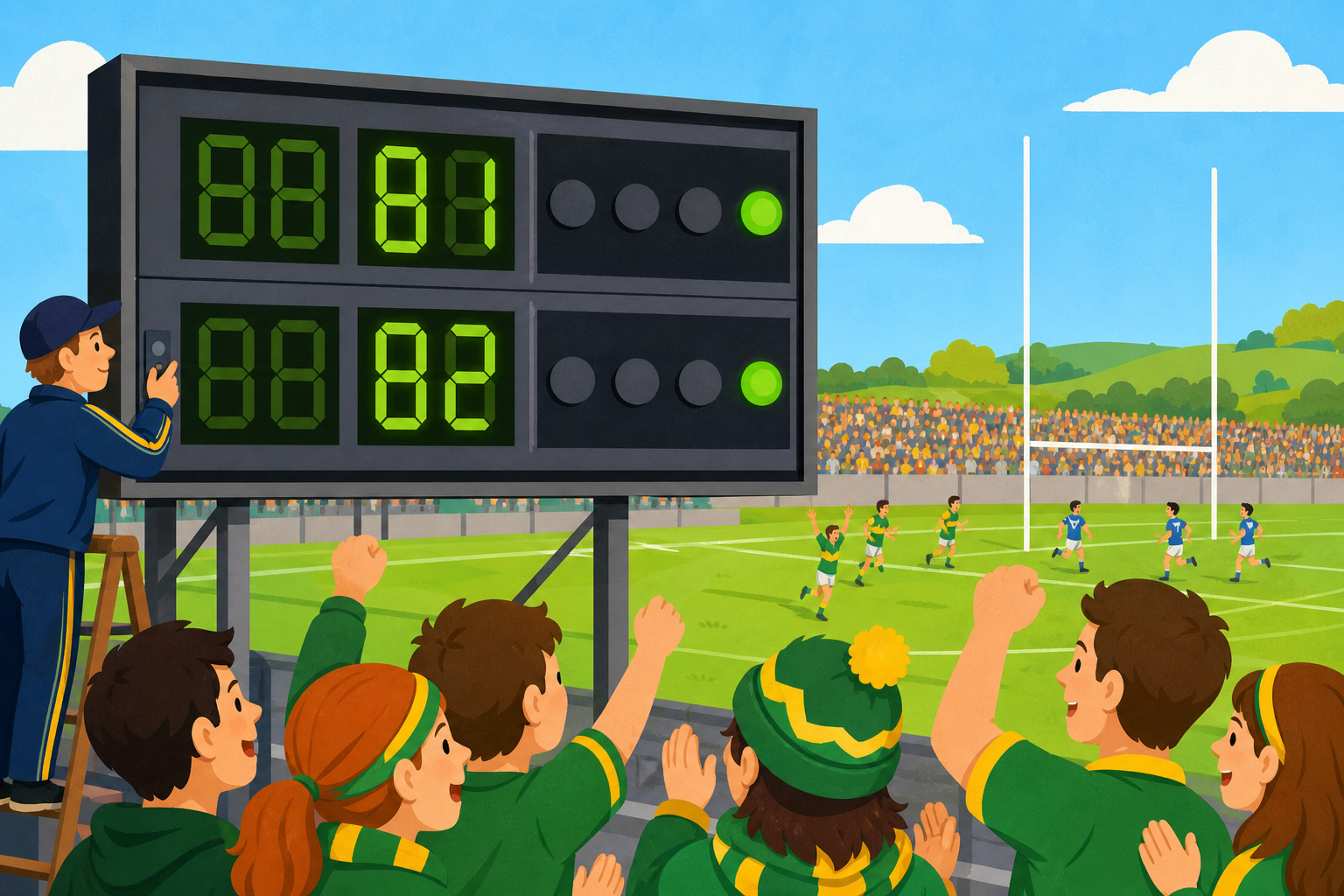
A team has 32 points and scores 9 more. Roughly, what is their new total? You already know how to count on in ones, so think about how you would get there. Would you count on nine ones from 32, or is there a faster route hiding in those numbers?
Counting on is our familiar route from before. Today we add two brand-new routes that can be even faster, and we pick the one that saves us the most steps.
Pose 32 + 9 and take two or three hands-up routes, not open call-outs. Listen for 'count on' versus 'add ten, take one back'. Revoice both as valid — the point is that smart adders choose a route, they don't always count in ones.
Counting on is the route you already know. Today watch how partitioning and the near-double can be quicker. Before each jump is revealed, predict the landing number in your head.
Watch the jumps. We start at 46 and hop forward 7 in ones to land on 53. These are small jumps, but there are a lot of them.
This time the second number is a tidy 20, so we make one jump of twenty straight to 55. That is far fewer steps than counting on.
Watch how we split the 27 into 20 and 7. First we jump 20 to reach 48, then we jump 7 more to land on 55.
These two numbers are almost the same. We use the double 24 + 24 = 48, then add one more to reach 49. A double we already know does most of the work.
Walk each example one at a time, pointing at the arcs as you narrate. Before each jump is revealed, pause and ask the class to predict the landing number, then confirm it together.
The big idea: the numbers tell you which route is fastest.
Today we work through these additions together on the number line: 33 + 8, 42 + 30, 26 + 27, and 23 + 24. One pupil works at the board for each addition while the rest of the class follows along and predicts the landing number before it is confirmed. For each one, we choose a route first, then draw the jumps to land on the total.
This round is for talking it through together — one pupil works at the board for each addition and the class agrees or corrects out loud.
Before each addition, ask the class which route they would pick and why. Let the pupil at the board draw their chosen jumps; the rest predict the landing number before it is confirmed.
In your maths copy, show your strategy for these two additions. Beside each one, draw a quick jotting on a number line: a jump for counting on, a split for partitioning, or a near-double if the numbers are close.
Walk the room glancing at the jottings — is the route sensible for the numbers? This is whole-class copybook practice, not marking. Look for pupils still counting in ones when a tidier route is sitting there.
A scoreboard is adding up totals: 43 + 6, 38 + 20, 27 + 28, and 49 + 49. We work through these together at the board. For each one, choose the route that saves the most steps, then draw the jumps and check.
This round is the practice bank — pupils take turns at the board, check each answer, and the class confirms before moving on. Keep the board work brisk rather than over-explaining.
When does counting on in ones become the slow way, and a partition or a near-double the smart way? For which of today's additions would counting on in ones be the slow way?
Listen for pupils naming the size of the second number as the clue — a big tidy number wants one jump, two close numbers want a near-double. Revoice a strong answer: 'so the numbers themselves tell you which route is fastest.' Head off the idea that counting on is always wrong — it is perfectly smart for 43 + 6.
Next we turn this thinking around and look at smart ways to subtract within 100: counting back, and counting up to find the gap.
Close briefly. Reassure pupils that there is no single 'right' route — the skill is choosing one that fits the numbers in front of them.
You're previewing this lesson. Get full access to this lesson and hundreds more — each one ready to teach, with interactive activities, printable resources and pupil progress tracking built in.