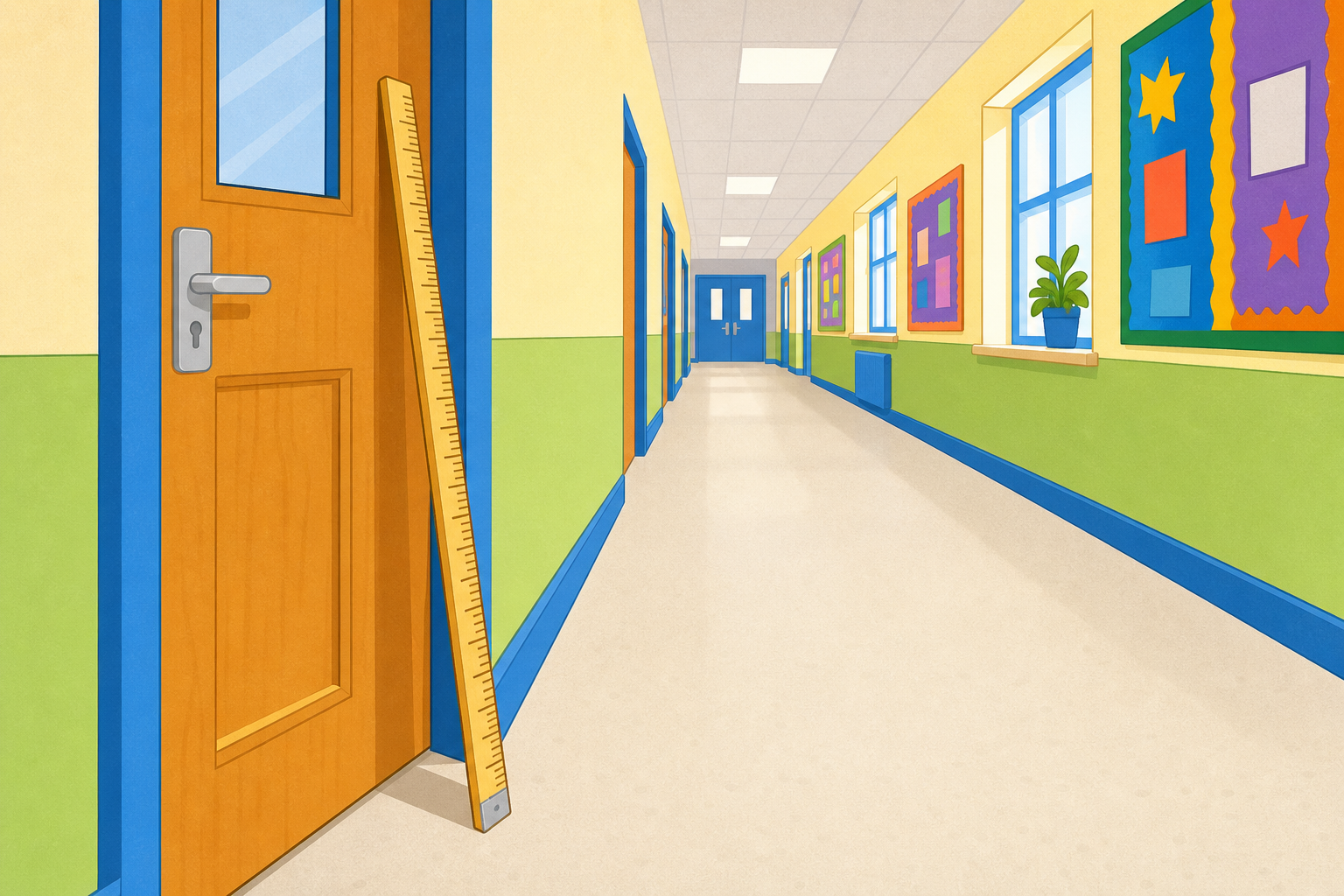
Look at the metre stick standing beside the classroom door. Would you measure how long our corridor is in centimetres, or in metres? Hands up: which one would be easier, and why?
Stand a real metre stick beside the door as pupils settle. Take three hands-up answers, not open call-outs. Steer toward metres are easier for big things without naming the rule yet — that comes in the next step.
Watch the metre ruler on the screen. A whole metre lines up exactly with the metre stick — one stick, one metre. A length of corridor takes two metre sticks laid end to end. Now look at the ruler the teacher is holding: a desk is about 60 centimetres, less than one metre stick, and a pencil is only about 12 centimetres. The long things suit metres; the short things suit centimetres.
The screen shows only the metre-scale lengths the ruler can display — one metre lining up with the stick, and a corridor taking two sticks. Hold the real metre stick against the screen for these.
For the short-things half of the contrast, hold up the real classroom ruler at the front: a desk is less than one metre stick; a pencil is tiny. The short examples are carried by your real ruler, not the screen.
Do not move on until the class can say which examples suit metres and which suit centimetres.
Whole class in whatever flat space your school has room in — yard, hall, or corridor — split into three groups, each with its own metre stick and a copybook to record. Before the lesson, choose three lengths to measure: a Short one (a bench), a Medium one (the width of the space), a Long one (about 10 metres along the longest wall).
If the yard is unusable, run the same Short / Medium / Long structure indoors — a bench for the Short length, the width of the hall for the Medium, the full length of the corridor for the Long.
This round is for pupils to measure with the metre stick in your school's open space. Split the class into three groups, each with its own metre stick, all measuring in parallel — that way every pupil gets a hands-on turn within the eleven minutes. Circulate and catch slips on the spot; the group reads each count aloud and you reconcile any disagreement as you pass each group.
Before the lesson, choose a flat space with room for a stretch of about 10 metres (yard, hall, or corridor) and the three lengths: a bench (Short), the width of the space (Medium), and a long wall about 10 metres (Long). Within each group, one pupil lays the metre stick end over end while the rest count whole metres aloud, then they swap for the next length. Watch for the stick lifting before the next mark is made — the slip that loses a metre.
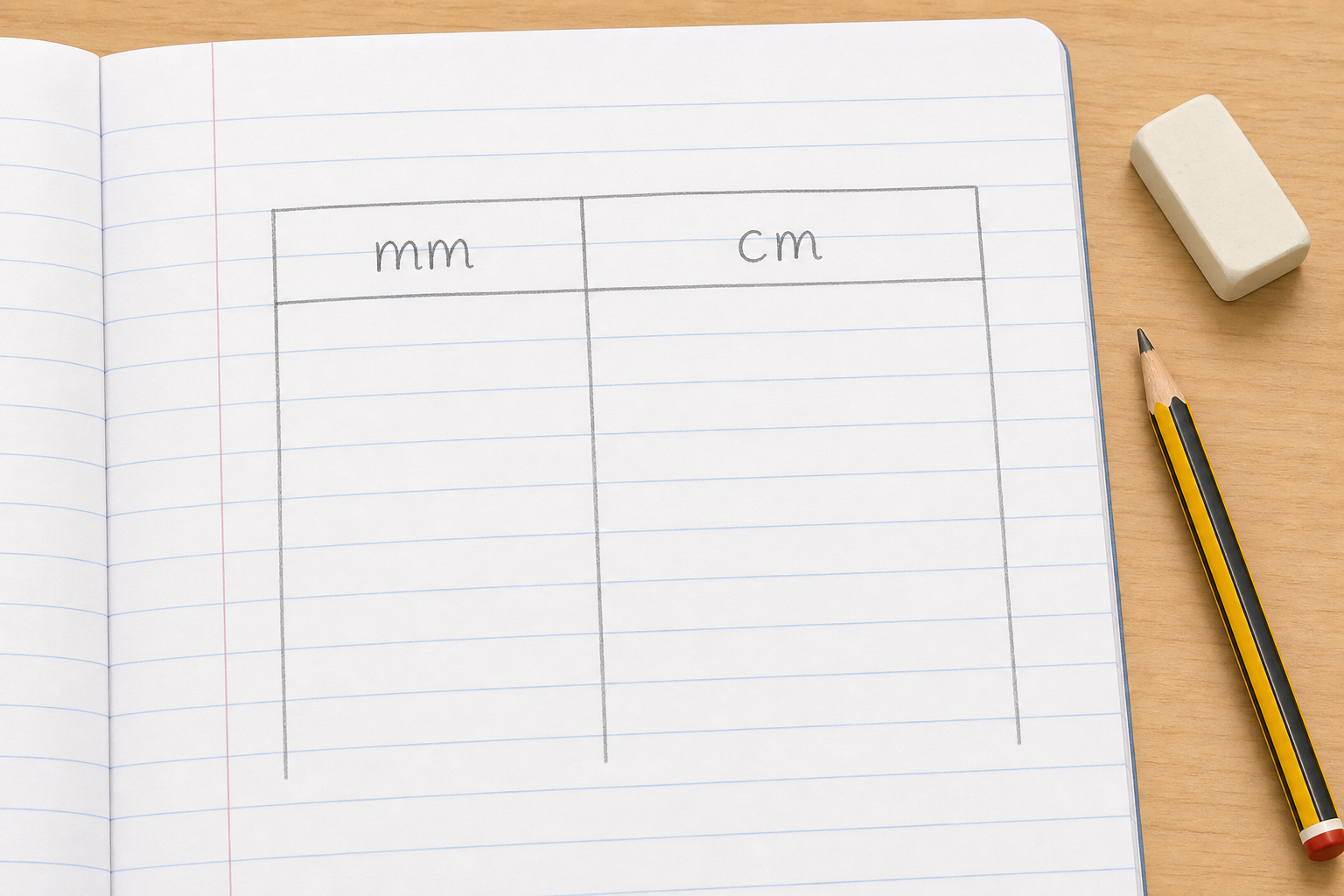
In your maths copy, make two columns headed "metres" and "centimetres". Then sort these six lengths into the column you would use to measure each one:
Walk the room glancing at which column each length lands in — this is whole-class copybook practice, not marking. Watch for a hurley going into centimetres; ask that pupil to picture how many metre sticks long it is.
Whole class in your school's open space, split into three groups, each with its own metre stick and copybooks to record estimates and measurements. Mark three routes of rising length with chalk or masking tape before the lesson: the width of the classroom, the length of the classroom, and the longest wall.
If the yard is unusable, mark the same three rising lengths indoors — across the classroom, along the classroom, and along the full length of the corridor for the longest.
This round is the practice bank — the three groups measure each route in parallel, with each group confirming its count aloud at the end. The estimate-then-measure cycle is the heart of it, so keep the rhythm brisk.
Push for whole-metre estimates even when pupils are unsure — a rough guess they can check is the point. Watch for estimates getting closer as the lesson goes on, and name that out loud as a success.
How do you decide whether to reach for the ruler or the metre stick? Think of one thing you would measure with each.
Listen for pupils naming the size of the object as the deciding factor, not the tool nearest to hand. Revoice a strong answer: so the long things suit the metre stick and the short things suit the ruler. Head off the idea that bigger is always better — a finger in metres would be a tiny fraction, hard to say.
Next we will look at how metres and centimetres are linked, so we can swap between them.
Close by holding the metre stick beside the ruler one more time so pupils carry the size difference into the next lesson on renaming m and cm.
You're previewing this lesson. Get full access to this lesson and hundreds more — each one ready to teach, with interactive activities, printable resources and pupil progress tracking built in.