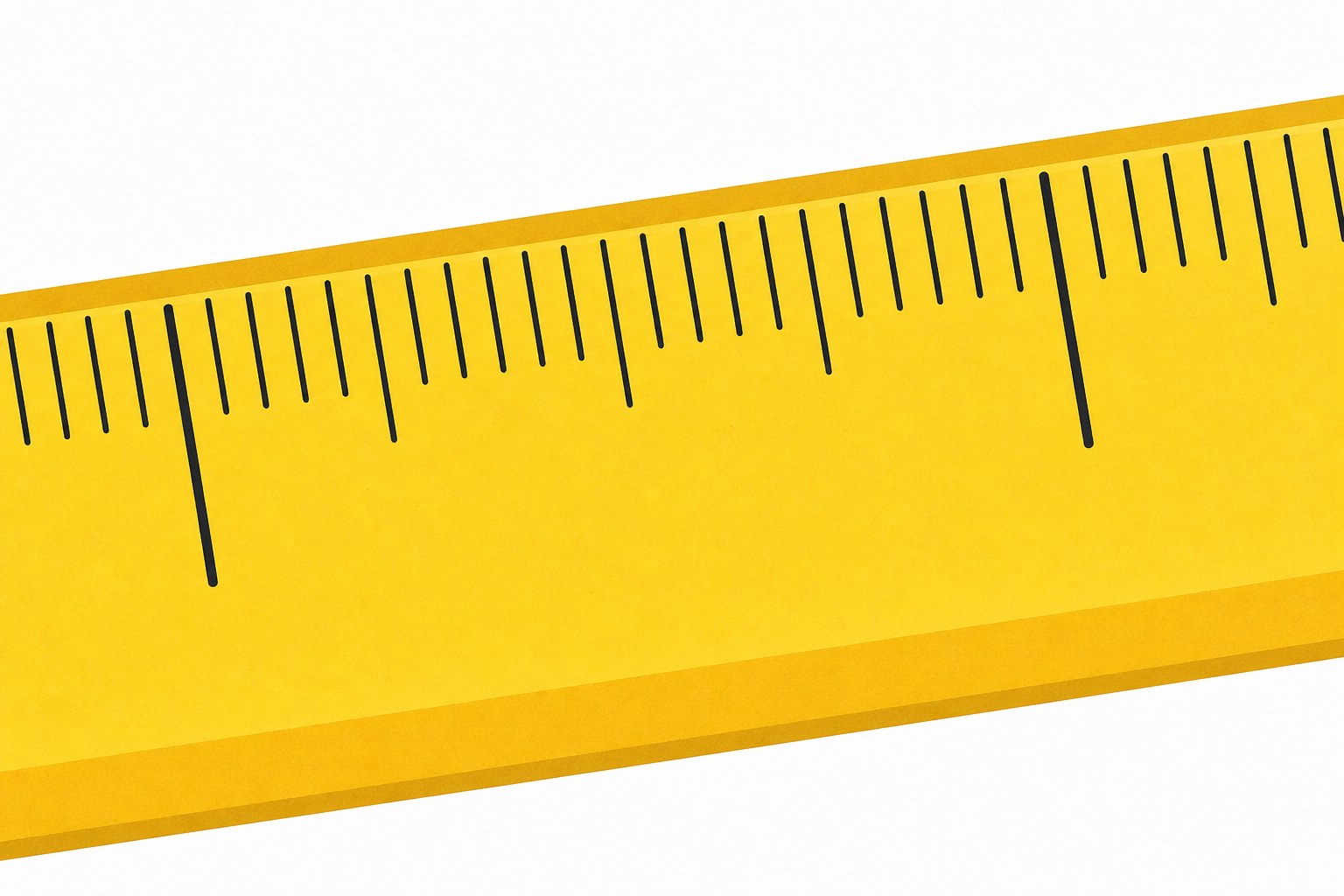
Look very closely at your own ruler, right between the big number 3 and the big number 4. Can you see the tiny little marks crowded in between them? How many little gaps do you think you could count from one big number to the next?
Hold up a real ruler and zoom in on the IWB photo onto the marks between 3 cm and 4 cm. Take three hands-up guesses before anyone counts — the surprise is that there are exactly ten little gaps every single time.
Watch as we read one length on the ruler together, very carefully. First we find the last whole centimetre the object reaches, then we count on in those little millimetre marks to the very end.
The pencil on the board passes the big number 4 and goes five little marks further. So it reaches 4 cm and 5 mm.
Now let us write that same length a second way, in millimetres only. Each centimetre is 10 mm, so 4 cm is 40 mm. Then we have 5 more little marks, so 40 + 5 makes 45 mm altogether. We always do the same thing: multiply the centimetres by 10, then add on the extra millimetres.
Use the measurement-rulers display showing the pencil at 4 cm 5 mm. Point first to the last whole centimetre (the 4), then count the little marks aloud one at a time up to 5.
Now we read a length on the board together. We look at the object on the ruler and read it first to the nearest whole centimetre, and then read it more carefully to the nearest millimetre.
Each time, we ask ourselves two questions: how many whole centimetres does it reach, and how many extra little marks past that?
This round is for talking it through together — pupils take turns at the board and the class agrees or corrects out loud.
Drive the measurement-rulers interactive in explore mode. Send a pupil up to drag the cursor to the end of the object on screen, and ask the class first how many whole centimetres? then how many extra little marks past that? Move the cursor to a new spot for each pupil so the class reads several different lengths.
Watch for pupils reading from the wrong end or starting the millimetre count from zero rather than from the last whole centimetre. Rotate a few pupils through.
In your maths copy, write 1 cm = 10 mm at the top of a fresh line. Then record three small objects, each with its length written two ways: once in centimetres-and-millimetres, and once in millimetres altogether. Remember the rule: multiply the centimetres by 10, then add on the extra millimetres.
Set out each object on its own line, like this:
Walk the room glancing at whether pupils have converted correctly (4 cm 5 mm = 45 mm, not 405 mm). If anyone writes 405, point them back to the rule on the board: 4 × 10 + 5. This is whole-class copybook practice, not marking.
Now measure four small classroom items with your own ruler, reading each one to the nearest millimetre: a crayon, a rubber, a key and a lolly stick. Write each one as "___ cm ___ mm".
For a stretch, also try a coin and a staple. These two are the trickiest to line up, so it is fine to read them to the nearest millimetre as best you can. Then find the difference in millimetres between your longest and your shortest item.
This round is the practice bank — real objects circulate around the room (or sit at stations) and pupils measure each one with their own rulers. Keep the pass-on rhythm brisk; the class confirms each reading aloud at the end.
Circulate and catch alignment slips on the spot — the most common is lining the object up against the ruler's edge instead of the zero mark, or counting millimetres from zero rather than from the last whole centimetre.
The crayon, rubber, key and lolly stick all land cleanly on the ruler, so they are the four core items everyone measures. Keep the coin and staple for the stretch only — they are short and fiddly to align.
Differentiation: pair a pupil who is less secure with a peer who can model lining up the zero carefully; stretch confident pupils with the coin, the staple and the longest-minus-shortest difference question.
When would millimetres tell us something that whole centimetres would miss? Think of a time it really matters to be that little bit more exact.
Listen for pupils naming real situations where small differences matter — fitting a battery, a key, a screw, a piece that must slot in exactly. Revoice: so two things can look the same number of centimetres long but be a few millimetres different, and sometimes those millimetres are the whole story.
Next we look at measuring longer things, choosing between centimetres and metres so we pick the unit that fits.
Keep this brisk. Recap the 1 cm = 10 mm fact one more time before the class moves to the activity-book page.
You're previewing this lesson. Get full access to this lesson and hundreds more — each one ready to teach, with interactive activities, printable resources and pupil progress tracking built in.