1 - Introduction ~5 mins
Welcome
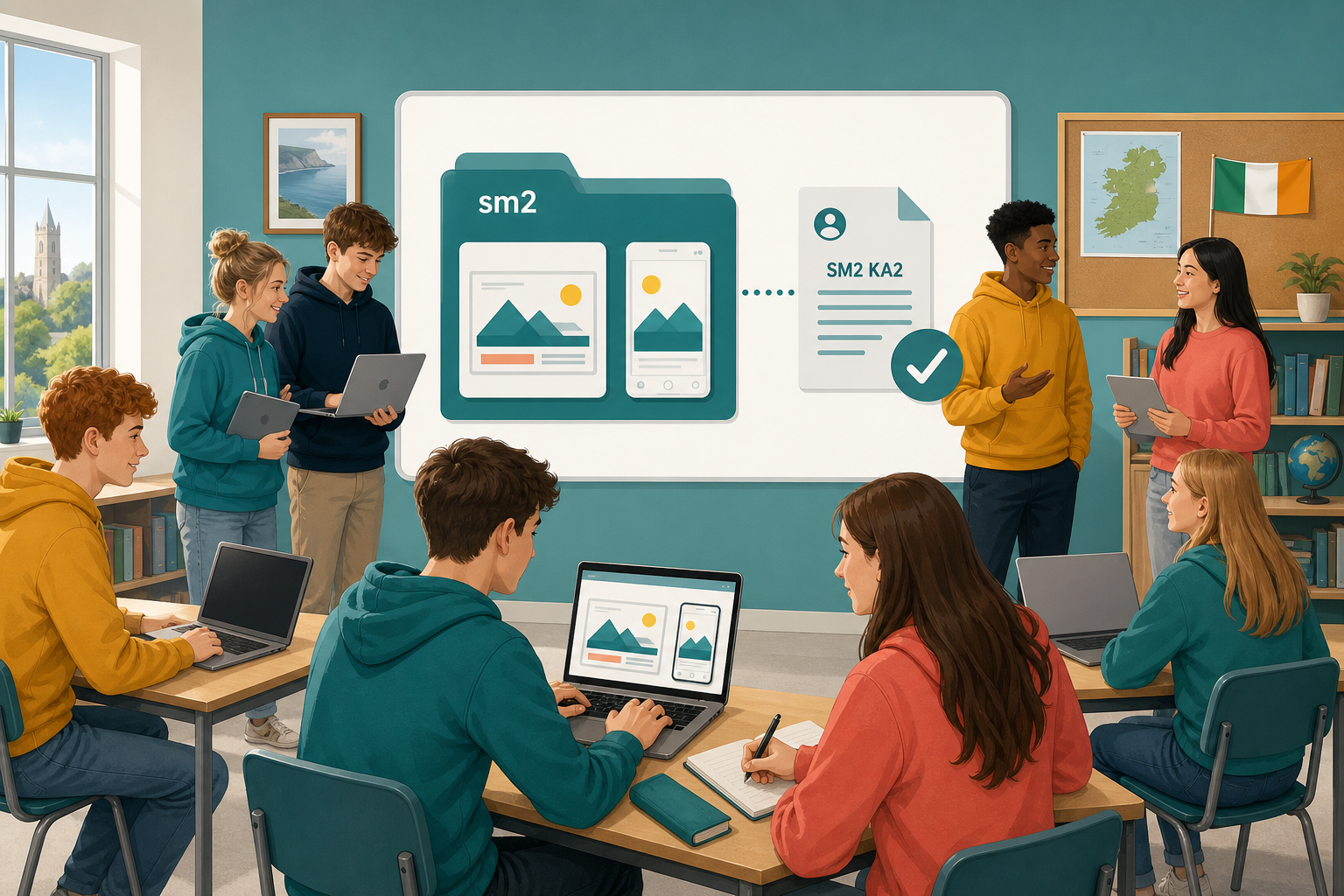 You have already built two presentation formats for your project. Today you write the piece that goes with them: one short, structured reflection that explains why you chose each format and what you can now do because of it.
Save the working file as {{code:sm2_ka2_reflection.docx}} (Word document or Google Doc) plus {{code:sm2_ka2_reflection.pdf}} in your {{code:Project_Portfolio/09_specialism/sm2/}} folder.
Three jobs your reflection must do:
- Explain why you chose each of your two formats, naming what each one is for and who it is aimed at.
- Name what you learned while making them, using examples from your own work.
- List real uses for the VET interview, other LCA work, and life beyond LCA.
Not finished format 1 or format 2 yet? Finish or export that format into your {{code:sm2}} folder with your teacher first (cap polish at about 10 minutes), then join the reflection. Wait until both formats are ready to open beside you before you start the reflection file, because you will be writing about what is actually in them.
Joining after polish? Three things to catch up on before you write. First, open both finished formats beside you, because you will be describing them. Then check that your working file is named {{code:sm2_ka2_reflection.docx}} and sits in your {{code:sm2/}} folder. Finally, remember that the first part of the reflection has to say what each format is for and who it is aimed at, rather than just saying you liked the look of it.
Today you will:
- Explain your two format choices in terms of purpose and audience.
- Describe what you learned while making them, in your own words.
- Name where those skills are useful next: the VET interview, other LCA courses, and life after LCA.
- Save the finished reflection as a working file and a PDF so your teacher can check it.
Warm-up
In your head, finish this sentence in one breath: "I chose format 1 because…" If the reason is only "it looked nice", you will tighten that today so a reader can see the purpose and the audience behind the choice.
2 - Key Concepts ~6 mins
Your reflection is a structured piece of writing, not a diary entry. Write under these three required blocks (plus a short AI disclosure line at the end):
- Choices made — explain format 1 and format 2 by naming what each is for and who it is aimed at. Gloss: a clear reason tied to who will read or watch it, not only taste.
- What I learned in Module 2 — concrete skills and moments from your own work. Gloss: name one skill and when you used it on your formats.
- Real-life applications — VET interview, other LCA courses or tasks, and beyond LCA. Gloss: where the skill travels next, outside this lesson.
AI disclosure: one honest line naming any AI help (or {{code:No AI assistance used}}). Example: "AI Critic mode suggested tighter wording on my second section; I rewrote every sentence in my own words."
Evidence pack: keep {{code:sm2_ka2_reflection.docx}} (Word or Google Doc) and {{code:sm2_ka2_reflection.pdf}} together in {{code:sm2/}}.
A model to listen to. Conor is an invented student, and his project is a phone-accessories stall. Your own project is whatever real brief you built format 1 and format 2 for: your stall, club, service or product. Take the shape of what he writes, not the content.
1. Choices made
"I chose a 5-slide deck for the VET interview because the examiner needs a short, structured talk; I chose a Canva carousel for customers because they scroll on phones."
2. What I learned
"I can now match format to purpose and audience, and use peer feedback without accepting every comment blindly."
3. Real-life applications
"VET: deliver format 1 live with a PDF backup. Other LCA: same structure for a Vocational Preparation share-back. Beyond LCA: update the carousel when stock changes."
AI disclosure: "I used AI Critic mode on one draft paragraph in my second section. I kept only wording I could explain myself."
Your reflection must be about your formats and your own project. Copy the structure, not Conor's content.
3 - Step-by-step Task ~15 mins
Build the skeleton of {{code:sm2_ka2_reflection.docx}} in your word processor, using Heading styles so each of the three sections is easy to find. Keep format 1 and format 2 open beside you, because you are writing about what is actually in them, and about the real brief you built them for: your stall, club, service or product. Write the first section in full, on your choices, using the model you just heard as a guide to how much detail is enough, and leave short starters under the other two sections so you know where to pick up. Stop once the first section is done, because the next activity is where you finish the other two in your own words and then export the PDF.
The first section is the hard one. If the purpose and the audience feel fuzzy, say them out loud before you type. The other two sections come next, with starters already waiting for you.
4 - Common Issues ~4 mins
Common Issues
Keep this table open as a help wall while you write and export in the next activity.
| Issue | Solution |
|---|---|
| My reflection sounds generic ("I learned a lot about presentations") | Name one concrete skill and one moment from your own formats. Example: "Peer Feedback Round 2 cut two slides because the examiner only needs the cost line, not the full stock list." |
| I cannot justify format 2 without repeating format 1 | Change the audience lens. Format 1 is usually for the VET examiner; format 2 should serve a different reader (customers, club members, a supervisor, a social feed). |
| I cannot find where to save or the file landed outside {{code:sm2}} | Close the tab. Open cloud storage, go to {{code:Project_Portfolio}} → {{code:09_specialism}} → {{code:sm2}}, then create or move the file there. Online apps save where the file was created. |
| PDF export is greyed out or missing | In Word Online use {{menu:File -> Export -> Download as PDF}}. In Google Docs use {{menu:File -> Download -> PDF Document}}. If the menu differs slightly, use the app's search box and type PDF. |
| My teacher says my third section is incomplete | You need all three applications: VET interview, at least one other LCA course or Student Task, and one use beyond LCA (Work Experience, apprenticeship, side hustle, or everyday life). |
Before you write sections 2 and 3
Two volunteers speak for about two minutes: one names a Module 2 skill from their own format, and the other names a use beyond LCA. While they talk, a weak and a strong version of section 2 and a complete set of three applications will be up on the board for you to compare your own wording against. Listen for concrete wording whose shape you can borrow, then start your own sections 2 and 3.
5 - Independent Practice ~25 mins
Independent Practice
- Section 2: In Module 2 I learned to… when I…
- VET: For the VET interview I will use format 1 to…
- Other LCA: In [course or Student Task] I can reuse…
- Beyond LCA: Outside LCA I could use this when…
- Essential: {{code:sm2_ka2_reflection.docx}} sits in {{code:Project_Portfolio/09_specialism/sm2/}} with clear headings and three sections where the starters are expanded into full sentences about your own formats
- Essential: your first section names what each format is for and who it is aimed at; your third section covers the VET interview, other LCA work, and life beyond LCA; the AI disclosure line is there
- Essential: {{code:sm2_ka2_reflection.pdf}} is saved beside the working file in {{code:sm2}} and both files are shown to your teacher
- Stretch (early finishers only): Tighten vague sentences and help a partner spot thin lines in their third section (pair support, not rewriting for them)
Unlock the full learning experience
You're previewing this lesson. Get full access to this lesson and hundreds more — each one ready to teach, with interactive activities, printable resources and pupil progress tracking built in.
This lesson is copyright of 123Learn.ie 2017 - 2025. Unauthorised use, copying or distribution is not allowed.