Mathematics
Beginner
40 mins
Teacher/Student led
+80 XP
What you need:
IWB/Projector/Large Screen

Introducing Ratio as Comparison of Quantities

Learn how to compare two quantities using ratio notation with a colon. Explore reading ratios aloud as 'for every this, that many of those', and discover why the order of a ratio matters.
Teacher Class Feed

Load previous activity

    1 - Getting Started ~4 mins

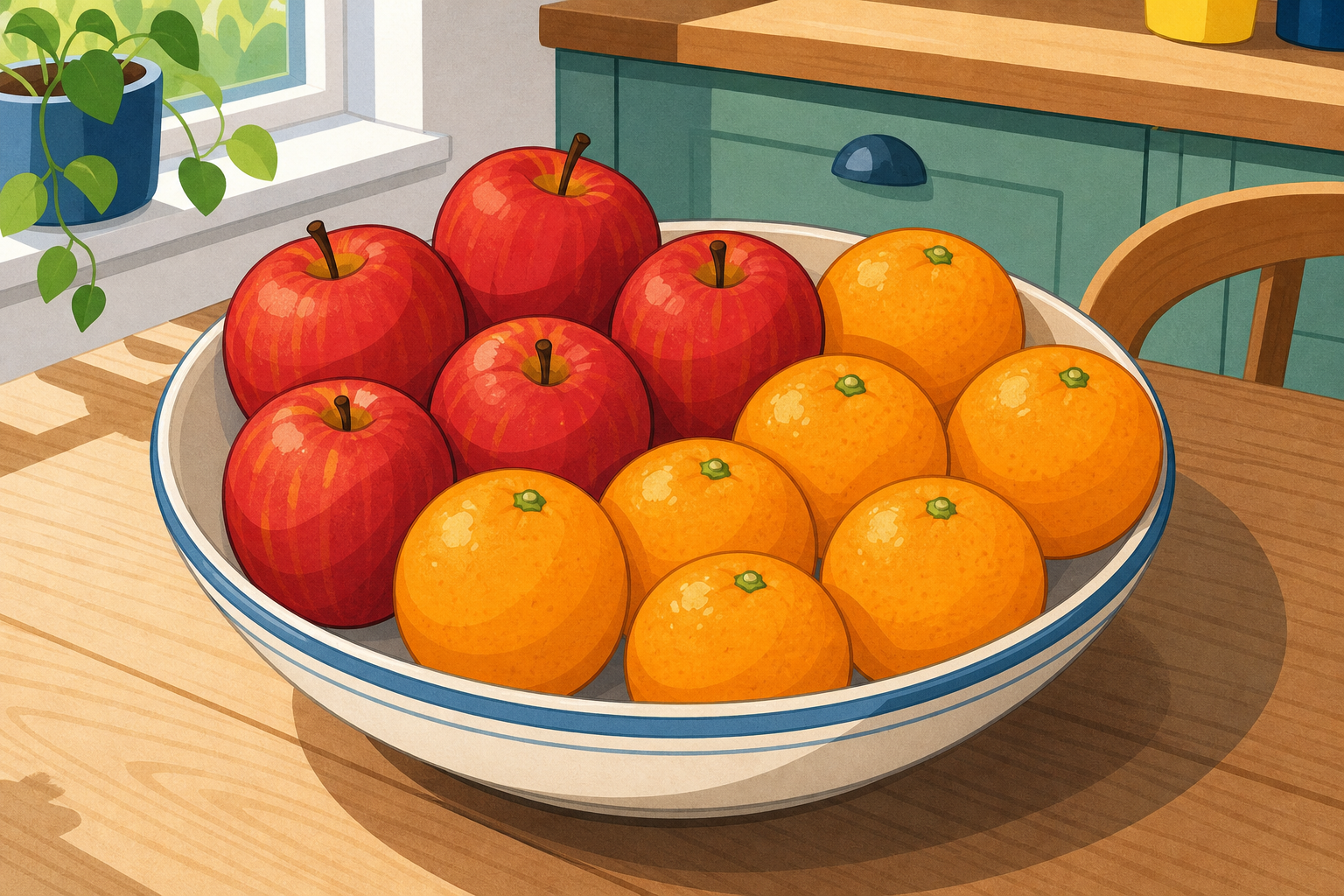
    Illustration for Getting StartedLook at this fruit bowl: there are 4 apples and 6 oranges. How could you describe how many apples there are compared to how many oranges? Could you say it in one short way, instead of counting them all out every time?

    2 - Watch and Notice ~9 mins

    2 red to 3 blue

    Watch two bars: one shows 2 red counters, the other shows 3 blue counters. We say this as 'two to three' and we write it as 2 : 3. That little colon stands for the word 'to'. We can also read the very same comparison as 'for every two reds there are three blues'. Both ways of saying it mean exactly the same thing.

    4 to 6

    Now there are 4 reds and 6 blues. We read this as 'four to six', or 'for every four reds there are six blues', and we write it 4 : 6. Notice it is the same kind of picture as before, just with more counters in each bar.

    1 to 5

    This one is very lopsided: 1 red counter for every 5 blue counters. We read it 'one to five' and write it 1 : 5.

    3 to 3

    Here both bars have 3 counters. We read it 'three to three', written 3 : 3, which means there is the same amount of each.

    3 - Try It Together ~10 mins

    Let's try this together. When I call out a comparison, build the two bars, then read the ratio aloud as 'for every ___ there are ___'. For example, 'five boys to three girls' becomes two bars and the ratio 5 : 3, which we read as 'for every five boys there are three girls'. Remember, 'five to three' and 'for every five there are three' describe the very same comparison.

    Build the comparison

    4 - Write the Ratios in Your Copy ~3 mins

    COPYBOOK MOMENT

    In your maths copy, write each of today's comparisons as a ratio in colon form, one under the other. Under each ratio, write a short sentence: 'for every ___ there are ___'.

    • 4 : 6
    • 2 : 3
    • 1 : 5
    • 5 : 3

    5 - Class Challenge ~8 mins

    Today we work through these builds together at the board: make 2 : 5, then 3 : 4, then 7 : 2, and finally build a ratio where the second amount is double the first. Read each one aloud as you check it.

    Build the called ratio

    6 - What Did We Notice? ~3 mins

    MATHS TALK

    Is the ratio 2 : 3 the same as 3 : 2? One pupil says they mean the same thing. Another says they are different. Who is right, and how would you settle it?

    7 - What's Next ~3 mins

    Today's key ideas

    • A ratio compares two amounts and is written with a colon, like 4 : 6.
    • We read a ratio aloud as 'for every this, that many of those'.
    • The order matters: 2 : 3 is not the same as 3 : 2.

    Coming up

    Next we will look at how ratios can be made simpler or scaled up, just like equivalent fractions, so that 4 : 6 and 2 : 3 can be seen as the same comparison.

    Pupil practice
    Module 4 · Ratio and Proportion Measures
    Lesson 40 · Introducing Ratio as Comparison of Quantities
    Download Activity Book page (PDF)
    End of lesson
    123learn · Online learning platform

    Unlock the full learning experience

    You're previewing this lesson. Get full access to this lesson and hundreds more — each one ready to teach, with interactive activities, printable resources and pupil progress tracking built in.

    Hundreds of curriculum-aligned lessons
    Interactive activities in every lesson
    Printable resources & progress tracking
    Copyright Notice
    This lesson is copyright of 123Learn.ie 2017 - 2025. Unauthorised use, copying or distribution is not allowed.
    🍪 Our website uses cookies to make your browsing experience better. By using our website you agree to our use of cookies. Learn more
