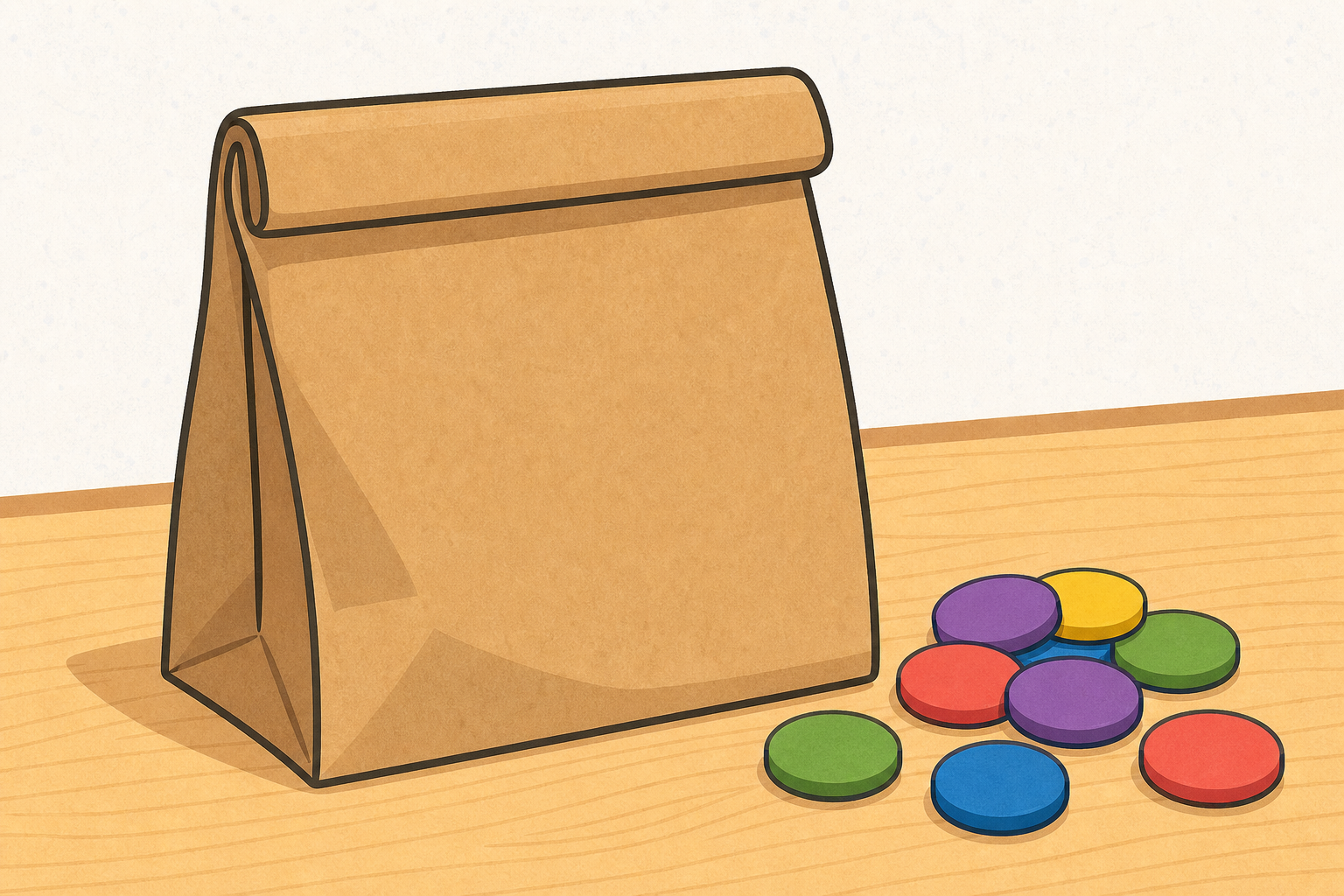
Here is a closed lunch bag. Nobody can see inside, but we know it holds some counters. We do not know how many yet, so let us call that hidden number n.
If we drop three more counters into the bag, how many counters would be inside now?
In the opening we called the hidden number n. We can use any letter to stand for an unknown, so for the balances we will use x. It is doing exactly the same job that n did.
You are about to see three balances. Each one has a bag holding x counters on the left pan, sometimes with a few loose counters beside it, and loose counters on the right. Every beam is level, so the two pans weigh exactly the same. Your job is to work out what is inside the bag.
Look at the next one. The bag on its own balances five loose counters, so what must the bag be holding?
Now two identical bags balance ten counters. Both bags hold the same amount, so what must be inside each one?
In your maths copy, write three short statements that use a letter for an unknown number, then say what adding to it would mean. For example:
Underline the letter in each statement so you can see your variable clearly.
Now we work through these balances together on the board. Take a turn at the board yourself, and when it is someone else's turn, predict the answer from your seat and say whether you agree. Slide the bag value until the beam sits level, and say the value of x aloud before you check it.
Now we solve these balances one after another. Each one has a bit more to think about than the last. Predict the value of x, level the beam, and check with the class.
You're previewing this lesson. Get full access to this lesson and hundreds more — each one ready to teach, with interactive activities, printable resources and pupil progress tracking built in.