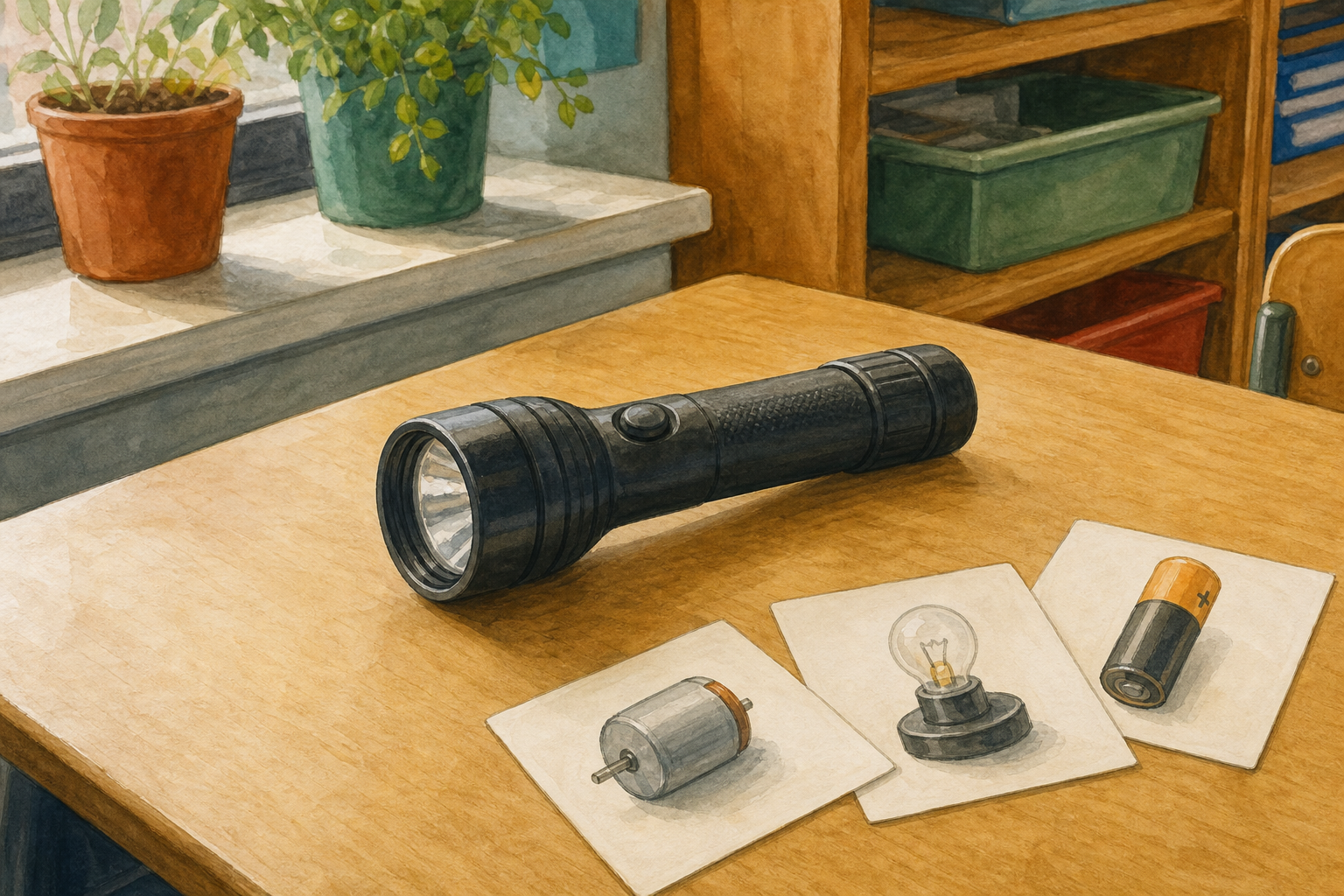
 You already know that devices take inputs, do something, and give outputs. Today we look inside one safe, simple system. What parts do you think are hiding inside a torch, and what job does each one do?
Every part inside the torch has a job. We call each part a component: a part that does one clear job.
You already know systems take an input, run a process, and give an output. In a moment you will look inside and decide which part starts things, which parts do the middle work, and which part gives the light. Ready to find out?
Be detectives: which hidden part is doing which job? In your group, examine one safe system where you can see inside: an adult-prepared opened torch, or the labelled internal photo sheet on your table. Look slowly, because the parts are small, and find the main components; then lay each component card beside the part it names, skipping a card if your torch design is different. As you match them, talk about the job each part seems to do. Do not force anything open that an adult has not approved.
Look again, more slowly, at the opened torch or labelled photos. Can you find the moment the path is broken or complete? Trace a path with your finger: from the switch, to the power, along the contacts, to the light. Tell your group one sentence: which parts touch or join, and what would happen if one part was missing.
Two placements fool lots of people. Use what you saw inside the torch to settle them:
- Is the battery an input, or part of the middle job (power and a path)?
- Does the casing belong with the middle job, because it holds the path in place, or does it sit to one side as a part that supports all the others?
In a few minutes we will sort the parts under three headings, input, process and output, and that three-heading map is what the question on screen calls the IPO map: I for input, P for process, O for output. Either casing answer is fine if you can point to evidence. Be ready to say why.
Unlock the full learning experience
You're previewing this lesson. Get full access to this lesson and hundreds more — each one ready to teach, with interactive activities, printable resources and pupil progress tracking built in.
This lesson is copyright of 123Learn.ie 2017 - 2025. Unauthorised use, copying or distribution is not allowed.