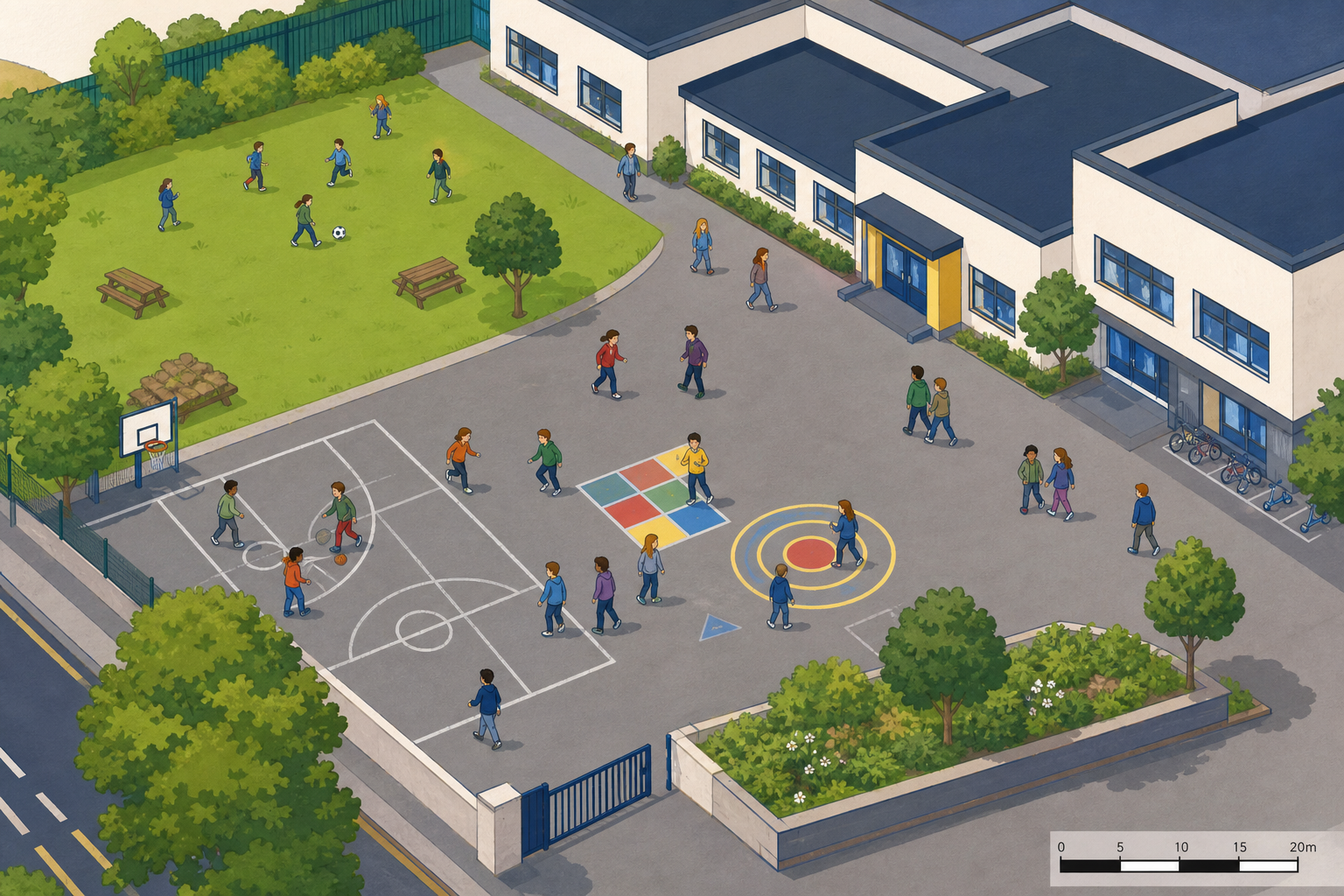
Here is an aerial photo of our school grounds, with a little scale bar in the corner. Take a good look at the yard. Roughly how much space do you think it covers, in square metres? And here is the real question: how could we work out its area without laying metre sticks over every single square metre of it? Hands up with one idea for measuring something this big.
Take three hands-up ideas, not open call-outs. Listen for pacing, splitting into rectangles, or using the photo scale — you will model all three next. Don't reveal which is best yet.
Let's find the area of the same yard three different ways, and watch how the answers land close together. Our yard measures 20 paces along the long side and 12 paces along the short side.
One pace is about 0.7 m, so first I change the paces into metres on the board: 20 × 0.7 = 14 m for the long side, and 12 × 0.7 = 8.4 m for the short side. Now I multiply the two sides: 14 m × 8.4 m ≈ 118 m². Before I show the next answer, predict: will breaking the yard into rectangles give a higher or a lower number?
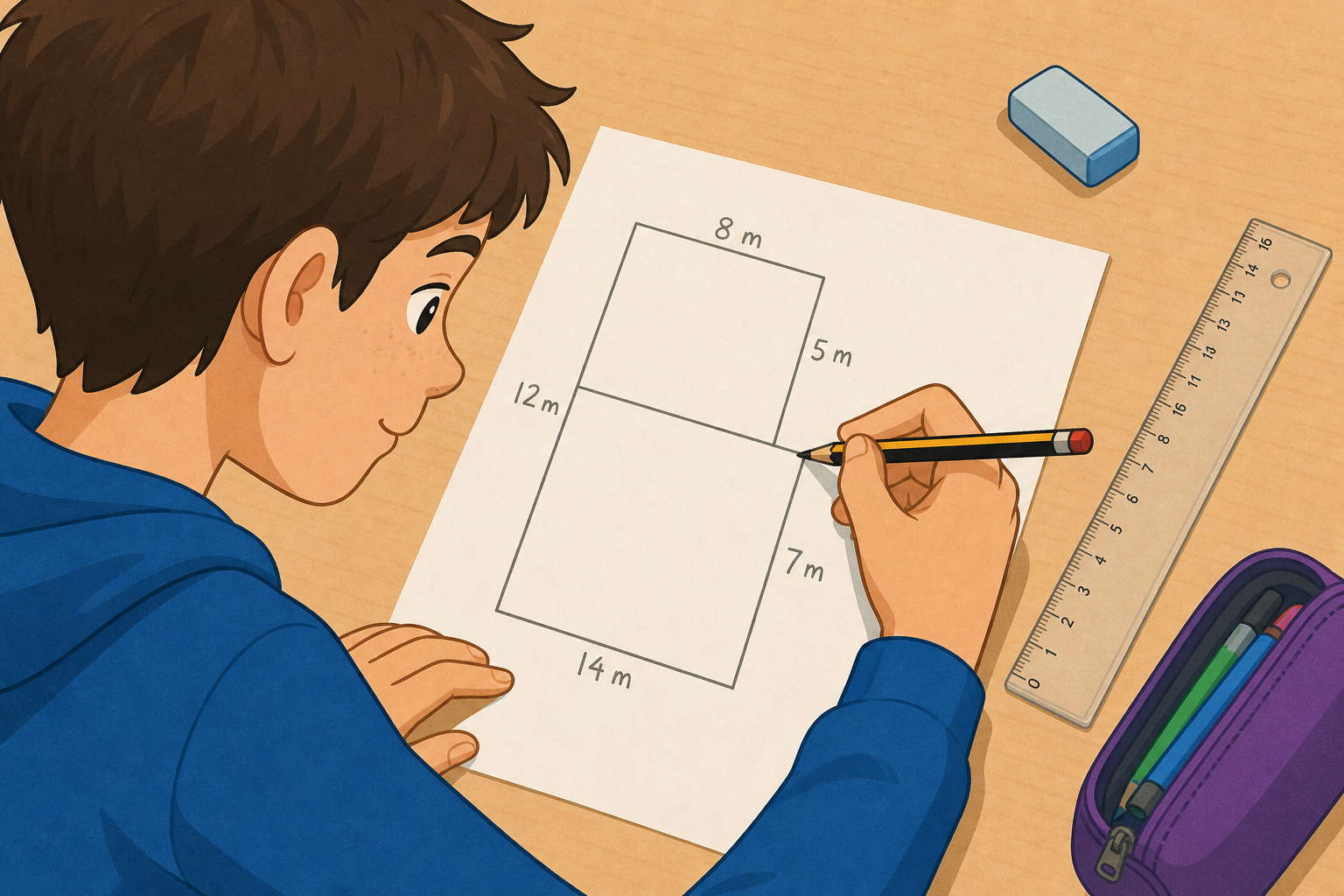
If the yard bends in an L-shape, I split it into two rectangles, find each area, then add them. A 14 m × 8 m piece is 112 m², and a 6 m × 4 m piece is 24 m², so the total is 112 m² + 24 m² = 136 m². Predict again: will measuring on the photo land near these two answers, or far off?
The scale bar tells us that 1 cm on the photo stands for 5 m of real yard. I measure the long side on the photo with a ruler and get 4 cm, so the real long side is 4 × 5 = 20 m. The short side measures 3 cm, so the real short side is 3 × 5 = 15 m. Now the real area is 20 m × 15 m = 300 m². Notice what happened: each side grew 5 times, but the area grew much more than 5 times, because both sides were scaled up. All three methods land within roughly ten per cent of each other on a real yard, and that closeness is exactly the point.
Walk each way aloud, one at a time, and use the shared 20-by-12-pace yard so the answers stay comparable.
Pause after Way 1 and again after Way 2 to take a quick higher-or-lower prediction, and revoice one pupil's reasoning. The key message to land: different methods, close answers, that's how we know to trust it.
Whole class together, with two or three pupils pacing while the rest count aloud. Take the class to whatever flat space your school has room in — yard, hall, or corridor. Before the lesson, decide which two sides (or two stretches) you will pace.
If the yard is unusable, pace two stretches indoors — the full length of the hall as one side and a marked cross-stretch as the other — and work the same paces-to-metres-to-area calculation on the board.
This is a whole-class teacher-led outdoor beat — you record the figures and compute one estimate live so everyone sees the method before groups split off. If the yard is unusable, run it in the hall along the longest stretch.
In your maths copy, write down the two side measurements we found outside, one under the other, with the unit on each. Then show the multiplication that gives the area, and box your answer in square metres.
Walk the room glancing at units and the squared-unit on the area line — this is whole-class copybook practice, not marking. Catch anyone who has dropped the m² or forgotten to convert paces to metres.
Today we work through this together: in small groups, estimate the area of one space in our school using two different methods — pacing-and-scale, and breaking-into-rectangles. Then compare your two estimates and decide which you would trust more, and why.
What is the area of our chosen space, and which of our two estimates can we trust more?
Each group picks one space (for example the yard, the hall, or a corridor). Estimate its area twice, using a different method each time: pace-and-scale for one estimate, break-into-rectangles for the other. Record both estimates with their units, then compare them.
Record: table
Share back: Each group reads out their two estimates and names the one they trust more, giving a reason.
This round is the practice bank — groups measure and model one space by two methods at their station, and the class confirms each finding aloud at the end. Before groups split off, do a quick whole-class demonstration on the printed photo: read the scale bar and convert one length with the class, so they have seen the photo method clearly even though they won't apply it. Circulate and catch the two common slips: forgetting to convert paces to metres, and adding instead of multiplying for area. This is a low-threshold, high-ceiling task — every group can pace one rectangle; the strongest will get their two methods to agree within ten per cent.
Of the two methods you used today — pacing-and-scale and breaking-into-rectangles — which gave the more reliable area, and what made the other one drift? If you had to put one figure for the yard's area in a report to the principal, which estimate would you choose, and why?
Listen for pupils naming pacing as the wobbliest because the pace length is only an approximation, and breaking-into-rectangles as steadier when each part is measured carefully. You can remind them that the photo-scale method you demonstrated is exact when the scale bar is read well, which is why a third check builds confidence. Revoice a strong answer: so the more we cross-check, the more confident we can be in the number we report. A closing maths-journal-entry follows on paper — 'which estimate would you put in a report, and why?'
Today you combined pacing and area to model a space far too big to measure all at once, and you learned that two estimates agreeing closely is how we trust an answer. Next, we take on a second modelling project: planning an end-of-primary celebration that has to balance a real budget, using money, percentage and ratio together.
Keep this brief. The activity-book page for this lesson carries the written follow-up.
You're previewing this lesson. Get full access to this lesson and hundreds more — each one ready to teach, with interactive activities, printable resources and pupil progress tracking built in.