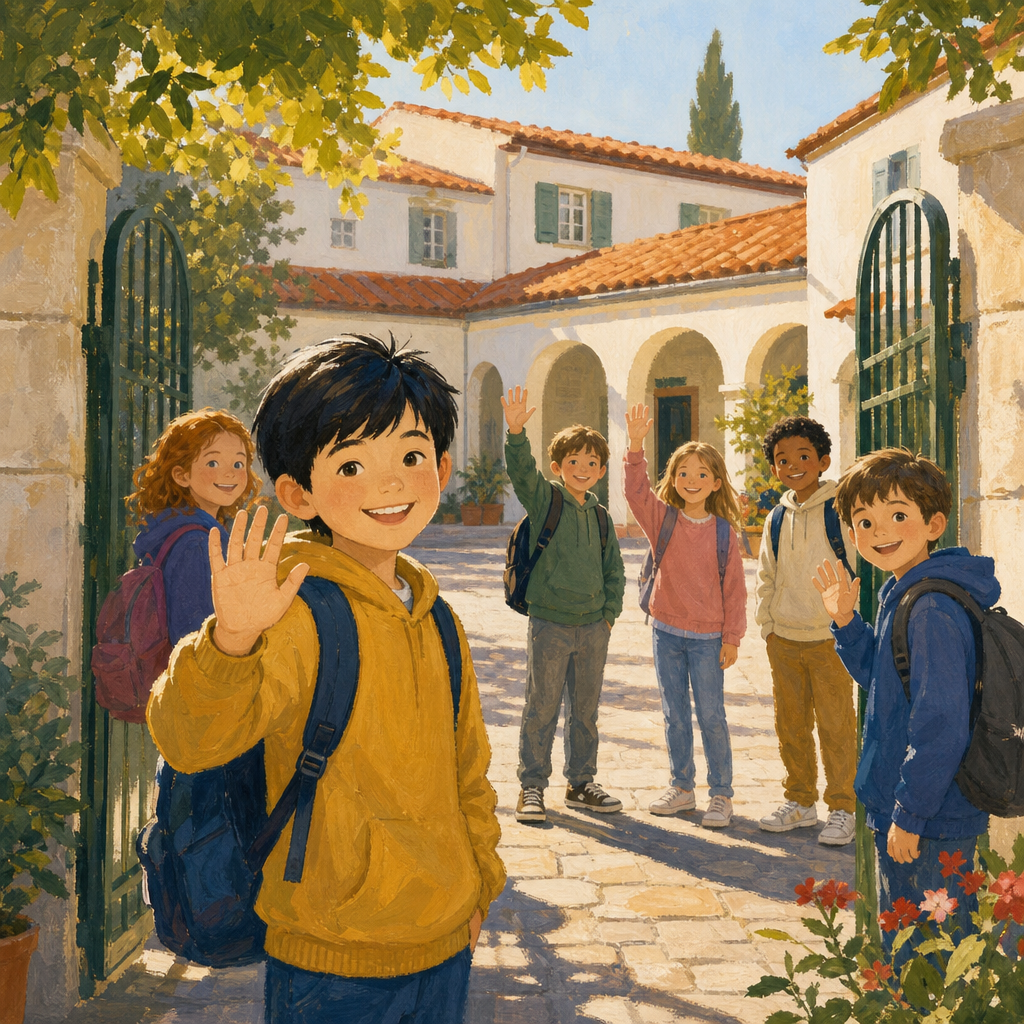
 Picture the gate of a Spanish primary school just before nine. Children wave to friends in the patio and greet the teacher at the door. Before nine o'clock this morning, how many different ways did you say hello? Think of family, friends, teachers, the bus driver. Let's collect four from the class.
By the end of this lesson, you will be able to:
- Recognise and say eight Spanish greeting phrases
- Pick the right greeting for the time of day
- Spot which ones sound a bit like English
Here are today's eight Spanish greeting phrases, met in two short groups. First come the four time-of-day hellos, then the four that ask how someone is or say nice to meet you. Listen to each one, then say it back together. Listen for the soft h in Hola: it is almost silent, not like the English h in hello. For the how-are-you pair: ¿Cómo estás? is for a friend; ¿Cómo está usted? is for a teacher or other adult. Listen for the extra word usted.
The Spanish words and their meanings are in two columns on the board, and volunteers take it in turns to match them. When a volunteer picks a Spanish word, everyone says it aloud together. You are looking for each Spanish greeting beside its English meaning.
Open your copy. Copy these three greetings and write morning, afternoon or evening beside each one: Buenos días, Buenas tardes, Buenas noches. Then add one more phrase you would also use before lunch, such as Hola or ¿Cómo estás?. Watch the accents carefully while the word-table stays on the board.
Unlock the full learning experience
You're previewing this lesson. Get full access to this lesson and hundreds more — each one ready to teach, with interactive activities, printable resources and pupil progress tracking built in.
This lesson is copyright of 123Learn.ie 2017 - 2026. Unauthorised use, copying or distribution is not allowed.